816 posters, 24 topics, 3,314 authors, 1,012 institutions
ePostersLive by SciGen Technologies S.A. All rights reserved.
SAGES 2026 Annual Meeting Emerging Technology Session
March 25-28, 2026 | Tampa, FL, USA

P159
Video-derived instrument-use diversity as an behavioral marker of intraoperative hemostasis
Poster Presenter
Authors
Zixin Chen, He Cai, Jing Zhang, Sirui Peng, Junjie Zhang, Ran Hu, Kan Wang, Lingli Wu, Shangdi Wu, Dian Qin, Bing Peng, Xin Wang
Affiliations
Part of Topic
Artificial Intelligence
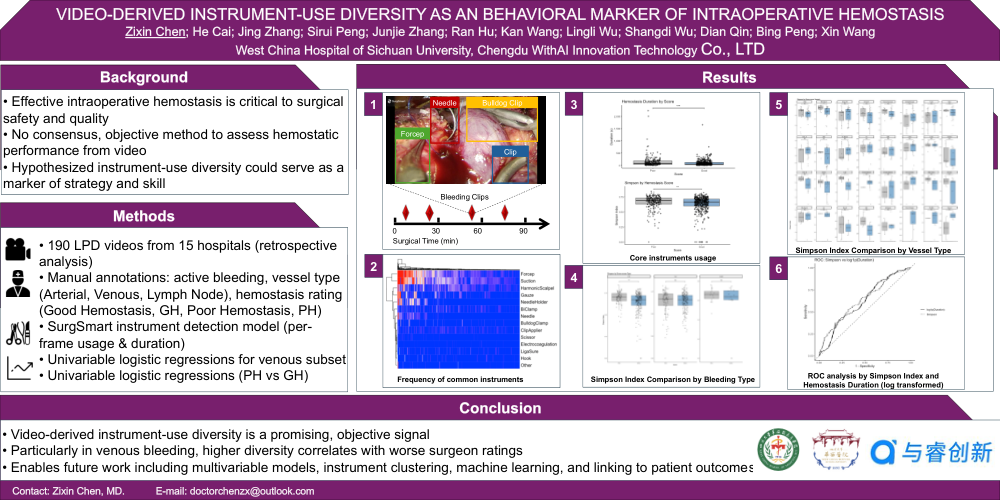
VIDEO-DERIVED INSTRUMENT-USE DIVERSITY AS AN BEHAVIORAL MARKER OF INTRAOPERATIVE HEMOSTASIS Zixin Chen; He Cai; Jing Zhang; Sirui Peng; Junjie Zhang; Ran Hu; Kan Wang; Lingli Wu; Shangdi Wu; Dian Qin; Bing Peng; Xin Wang; West China Hospital of Sichuan University
Background: Effective intraoperative hemostasis is critical to surgical safety and quality, yet there is no consensus, objective method to assess hemostatic performance from operative video. We hypothesized that instrument-use diversity during hemostasis could serve as a behavioral marker of hemostasis strategy and skill.
Methods: We retrospectively analyzed 190 laparoscopic pancreatoduodenectomy (LPD) videos from 15 hospitals across China. Two surgeons manually annotated active bleeding events (start/stop times), vessel type (arterial, venous, lymph node), and hemostasis performance rating (good hemostasis, GH; poor hemostasis, PH). We use the surgical instrument detection model deployed on the SurgSmart platform to extract per-frame instrument usage and duration. For each bleeding clip, we computed hemostasis duration and the Simpson diversity index of instrument application. Group comparisons were performed overall and stratified by vessel type. In the venous subset, we fit univariable logistic regressions with PH vs GH as the outcome and either Simpson index or log-transformed duration as predictors.
Results: We identified 672 bleeding clips with per-frame instrument data for analysis. The most frequently used instruments (mean proportion of clip time) were the bioclamp (5.00%), clip applier (4.05%), and needle holder (3.02%). Overall, PH exhibited greater instrument diversity and longer hemostasis time than GH (Simpson: 0.687 [0.105] vs 0.665 [0.113], P<0.001; duration: 80.5 [139] vs 55.0 [92.0] seconds, P<0.0001). By vessel type analysis, in venous bleeding, both Simpson index and duration differed significantly between GH and PH (0.672 [0.110] vs 0.704 [0.086], P<0.0001; 66.0 [104.0] vs 92.0 [161.5] seconds, P < 0.001). During lymphadenectomy-related venous bleeds, GH group exhibited shorter hemostasis time(36.0 [34.5] vs 94.5 [90.8] seconds, P < 0.001). For arterial bleeds, neither Simpson index nor duration differed significantly (Simpson 0.666 [0.132] vs 0.659 [0.113], P=0.255; duration 127.0 [221.1] vs 93.8 [146.6] seconds, P=0.083). From venous subset univariable analysis, the lower Simpson index was associated with high odds of PH (OR = 0.0031, p<0.001), and longer hemostasis duration (log-scaled) was likewise associated with higher odds of PH (OR = 0.6434, p<0.001).
Conclusion: Video-derived instrument-use diversity is a promising, objective signal of hemostatic performance in LPD, particularly for venous bleeding, where higher diversity correlates with worse surgeon ratings. Clinically, such metrics could enable scalable video-based assessment, targeted coaching, and benchmarking across centers. Future work should incorporate multivariable models (case complexity, bleeding severity), temporal sequencing of instruments, and linkage to patient outcomes for prospective validation.