875 posters, 25 topics, 3,440 authors, 1,061 institutions
ePostersLive by SciGen Technologies S.A. All rights reserved.
SAGES 2026 Annual Meeting Emerging Technology Session
March 25-28, 2026 | Tampa, FL, USA

P167
Artificial Intelligence (AI) Applications in General Surgery in the United States: A Bibliometric Analysis
Poster Presenter
Authors
DIego L Lima, Clara A Mendes de Vasconcellos, Yasmin B da Cruz, Thiago Souza e Silva, Sofia Wagemaker Viana, Matheus Faleiro, Elisa G Forchezatto, Raquel Nogueira, Flavio Malcher
Affiliations
Montefiore Medical Center, Estácio de Sá University, Real hospital Portugues, Recife, Brazil, Federal University of Parana, Division of Thoracic Surgery, Department of Surgery, University of Cincinnati College of Medicine, Cincinnati,
Part of Topic
Artificial Intelligence
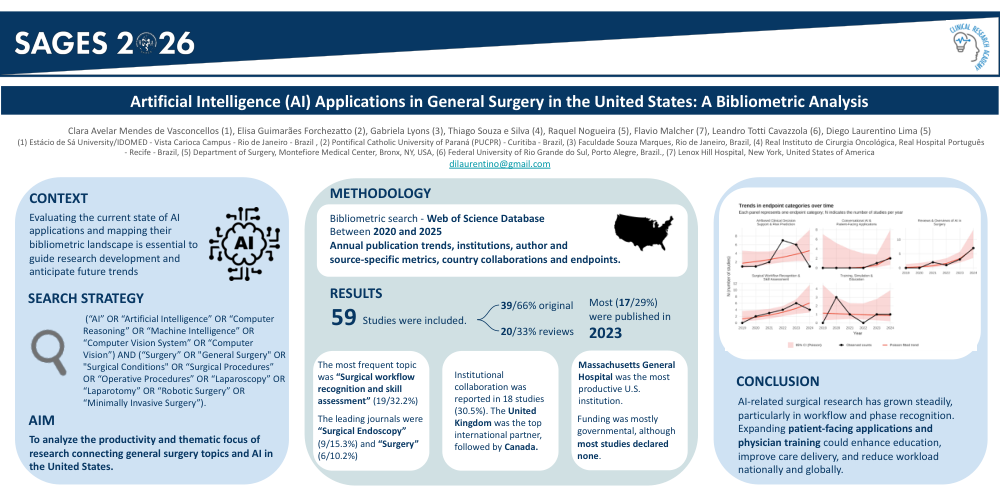
Background: The surgical field has increasingly integrated advanced technologies to enhance precision and patient outcomes. Artificial intelligence (AI) has emerged as a promising new resource across pre-, intra-, and postoperative phases. Although AI development in surgery has advanced rapidly, its full impact may still be underestimated. Evaluating the current state of AI applications and mapping their bibliometric landscape is essential to guide research development and anticipate future trends. To analyze the productivity and thematic focus of research connecting general surgery topics and AI in the United States.
Methods: We performed a bibliometric search for documents published between 2020 and 2025 using the Web of Science database. We excluded non-article type studies, research unrelated to AI applications in general surgery, and papers not reflecting United States output. We analyzed annual publication trends, institutions, author and source-specific metrics, country collaborations, and categorized studies by primary endpoint in 5 different categories.
Results: A total of 11.980 records were identified. Ultimately, 59 papers met all eligibility criteria (n=39; 66.1% original articles and n=20, 33.9% reviews). Most were published in 2023 (n=17 ; 28.8%). The leading journals were “Surgical Endoscopy” (n=9; 15.3%) and “Surgery” (n=6; 10.2%). The most frequent topic was “surgical workflow recognition and skill assessment” (n=19; 32.2%), followed by “clinical decision support and risk prediction” (n=18; 30.5%). The least studied topics were “AI-use in training, simulation and education” (n=6; 10.2%) and “conversational AI/patient-facing applications” (n=3; 5.1%). Massachusetts General Hospital was the most productive U.S. institution. Institutional collaboration was reported in 18 studies (30.5%). The United Kingdom was the top international partner, followed by Canada. When funding was reported, it was mostly governmental, although most studies declared none.
Conclusion: AI-related surgical research has grown steadily, particularly in workflow and phase recognition. Expanding efforts toward patient-facing applications and physician training could enhance education, improve care delivery, and reduce workload nationally and globally.
key words: Artificial Intelligence, General Surgery, Applications