875 posters, 25 topics, 3,440 authors, 1,061 institutions
ePostersLive by SciGen Technologies S.A. All rights reserved.
SAGES 2026 Annual Meeting Emerging Technology Session
March 25-28, 2026 | Tampa, FL, USA

P146
CATASTROPHIC RETROPERITONEAL HEMORRHAGE AND ABDOMINAL COMPARTMENT SYNDROME FOLLOWING ATRIAL FIBRILLATION ABLATION: A CASE REPORT
Poster Presenter
Authors
Affiliations
Part of Topic
Acute Care
Background
· AF ablation is widely performed; major complication rates range 3–6%, with hemorrhagic injuries among the most serious.
· Retroperitoneal bleeding from vascular access injury can rapidly progress to hemorrhagic shock, abdominal compartment syndrome, and multiorgan failure, especially in anticoagulated patients.
· Individuals with congenital or structural heart disease (e.g., ASD repair, dextrocardia, pulmonary hypertension) have:
Higher procedural complication rates
Abnormal vascular anatomy and reduced preload tolerance
Limited cardiopulmonary reserve, predisposing to rapid decompensation with acute blood loss
· Bowel ischemia after AF ablation is rare (<0.1%) and typically occurs in the setting of profound hypotension or vasopressor-dependent shock.
· After renal or visceral artery embolization, clinically significant bowel ischemia occurs in approximately 0.5–3% of cases, often due to non-target embolization or splanchnic hypoperfusion.
· Global mesenteric ischemia is exceptionally rare but carries near-100% mortality, even with aggressive surgical and critical care intervention.
Case Presentation
Patient: 62y/o F PMHX
• Congenital heart disease (ASD repair, dextrocardia, pulmonary HTN, LPA stenosis)
• Refractory AF s/p multiple ablations
• Omphalocele repair, congenital left diaphragmatic hernia repair
Event: Admitted after elective AF ablation (9/11/2025).
Within hours developed:
• Profound hypotension, tachypnea
• Rapid clinical deterioration → ICU admission
• Hemoglobin drop from 12 to 5 g/dL, >6 units transfused
• Intubated Peak Pressure 50, TV 200s
• Bladder Pressure >50
• Abdomen Distended, Ridged
Intervention
1. First Operation – Emergent Bedside Decompressive Laparotomy Post Procedure Day 1 (PPD1)
Indication: Abdominal compartment syndrome & ventilatory failure
Findings: Large hemoperitoneum without intraperitoneal bleeding source
Outcome: Immediate improvement in oxygenation/ventilation
2. Interventional Radiology (PPD1)
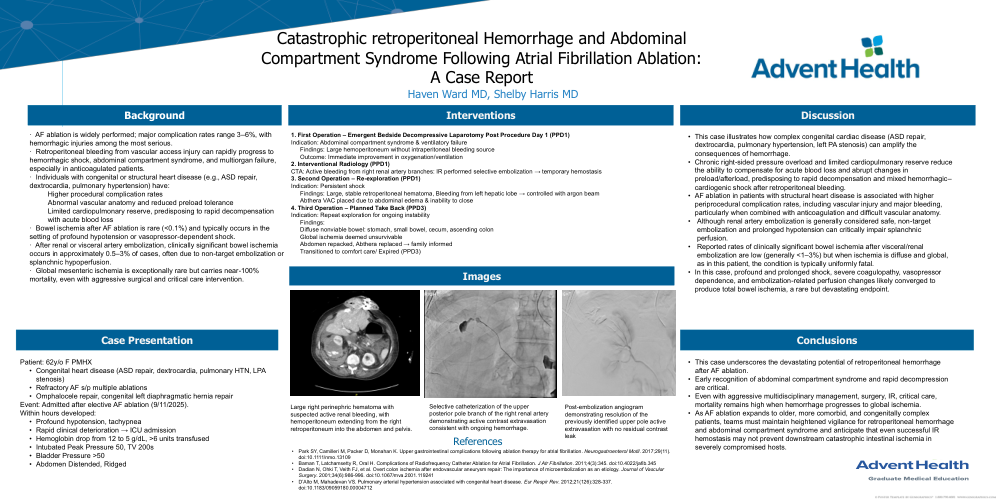
CTA: Active bleeding from right renal artery branches: IR performed selective embolization → temporary hemostasis
3. Second Operation – Re-exploration (PPD1)
Indication: Persistent shock
Findings: Large, stable retroperitoneal hematoma, Bleeding from left hepatic lobe → controlled with argon beam
Abthera VAC placed due to abdominal edema & inability to close
4. Third Operation – Planned Take Back (PPD3)
Indication: Repeat exploration for ongoing instability
Findings:
Diffuse nonviable bowel: stomach, small bowel, cecum, ascending colon
Global ischemia deemed unsurvivable
Abdomen repacked, Abthera replaced → family informed
Transitioned to comfort care/ Expired (PPD3)
Discussion
• This case illustrates how complex congenital cardiac disease (ASD repair, dextrocardia, pulmonary hypertension, left PA stenosis) can amplify the consequences of hemorrhage.
• Chronic right-sided pressure overload and limited cardiopulmonary reserve reduce the ability to compensate for acute blood loss and abrupt changes in preload/afterload, predisposing to rapid decompensation and mixed hemorrhagic–cardiogenic shock after retroperitoneal bleeding.
• AF ablation in patients with structural heart disease is associated with higher periprocedural complication rates, including vascular injury and major bleeding, particularly when combined with anticoagulation and difficult vascular anatomy.
• Although renal artery embolization is generally considered safe, non-target embolization and prolonged hypotension can critically impair splanchnic perfusion.
• Reported rates of clinically significant bowel ischemia after visceral/renal embolization are low (generally <1–3%) but when ischemia is diffuse and global, as in this patient, the condition is typically uniformly fatal.
• In this case, profound and prolonged shock, severe coagulopathy, vasopressor dependence, and embolization-related perfusion changes likely converged to produce total bowel ischemia, a rare but devastating endpoint.
• This case underscores the devastating potential of retroperitoneal hemorrhage after AF ablation.
Conclusion
• Early recognition of abdominal compartment syndrome and rapid decompression are critical.
• Even with aggressive multidisciplinary management, surgery, IR, critical care, mortality remains high when hemorrhage progresses to global ischemia.
• As AF ablation expands to older, more comorbid, and congenitally complex patients, teams must maintain heightened vigilance for retroperitoneal hemorrhage and abdominal compartment syndrome and anticipate that even successful IR hemostasis may not prevent downstream catastrophic intestinal ischemia in severely compromised hosts.