2,281 posters, 63 videos, 56 audios, 43 topics, 18 sessions, 6,174 authors, 2,323 institutions
ePostersLive by SciGen Technologies S.A. All rights reserved.
RCOG World Congress 2025
June 23 - 25, 2025 | ExCeL London, UK
EP.0868
CERVICAL CANCER IN A 16-YEAR-OLD ADOLESCENT: A CASE REPORT
Poster Presenter
Authors
Nicole Casanova, Ana Jara, Carla Urbina, Catalina Alonso, Felipe Nuñez, Italo Bravo, Andres Lehuedé, Maria Pulgar, Jaime Cartagena, Erasmo Bravo
Affiliations
Valparaíso University, Gustavo Fricke Hospital, Gynecologic Oncology Service, Gustavo Fricke Hospital, Gynecologic Oncology Service, Gustavo Fricke Hospital, Gynecologic Oncology Service, Gustavo Fricke Hospital, Gynecologic Oncology Service, Gustavo Fricke Hospital, Gynecologic Oncology Service, Gustavo Fricke Hospital, Gynecologic Oncology Service, Gustavo Fricke Hospital, Gynecologic Oncology Service, Gustavo Fricke Hospital, Gynecologic Oncology Service, Gustavo Fricke Hospital
Part of Topic
Gynaecological oncology
CERVICAL CANCER IN A 16-YEAR-OLD ADOLESCENT: CASE REPORT
Casanova N. (1), Jara A. (1,2), Urbina C. (2), Núñez F. (1,2), Alonso C. (2), Bravo I. (2), Pulgar M. (2), Lehuedé A. (2) Cartagena J. (2), Bravo E. (2)
1 Department of Obstetrics and Gynecology, School of Medicine, University of Valparaíso, Chile
2 Gynecologic Oncology Service, Gustavo Fricke Hospital, Viña del Mar, Chile
Objective: To present a case report of stage IV cervical cancer (CC) in a 16-year-old adolescent who had not begun sexual activity.
Clinical case: A 16-year-old female with no underlying pathologies and who had not begun sexual activity presented with genital bleeding and hypogastric abdominal pain. Physical examination revealed bilateral fixed inguinal lymphadenopathy measuring 2 cm and an irregularly contoured tumor 3 cm from the vaginal introitus, at the expense of the vagina and cervix, measuring 10 cm in diameter, of stony consistency, infiltrating the anterior vaginal wall. Biopsy: Solid undifferentiated carcinoma of the cervix. Immunohistochemistry: Positive for CKAE1/AE3, negative for vimentin, CD45, S100, actin and desmin. Negative for p16 and p63. Negative for synaptophysin, negative for CD99, negative for CD56. Complementary serological studies: negative for HIV, VDRL, HBV and HCV. Tumor markers: LDH 358, BHCG 4.7 and AFP 3.4. Pelvic MRI: Cervix showing an expansile lesion involving the endocervical canal, extending to and occupying a large portion of the vagina, with signs of infiltration into the anterior wall. Numerous external and common iliac lymphadenopathy measuring up to 40 mm, and bilateral inguinal lymphadenopathy. The diagnosis of stage IV B cervical cancer was confirmed.
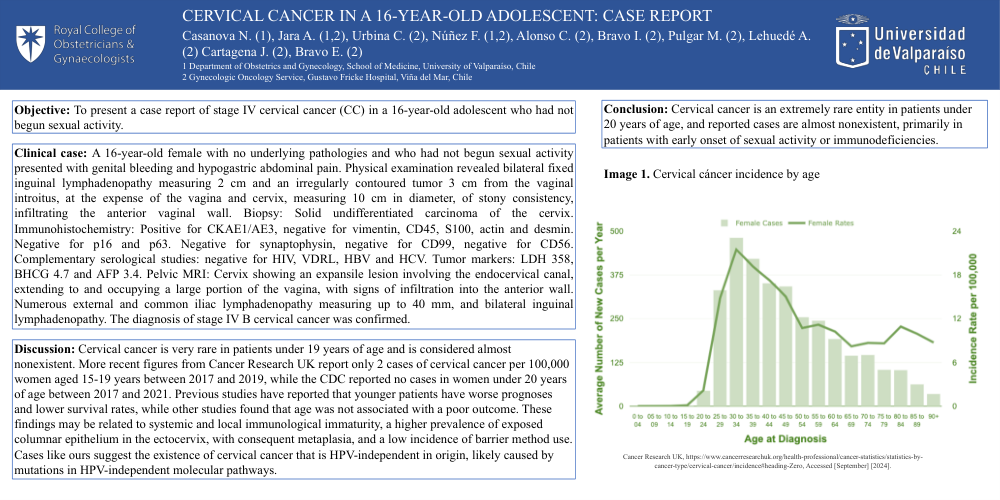
Discussion: Cervical cancer is very rare in patients under 19 years of age and is considered almost nonexistent. More recent figures from Cancer Research UK report only 2 cases of cervical cancer per 100,000 women aged 15-19 years between 2017 and 2019, while the CDC reported no cases in women under 20 years of age between 2017 and 2021. Previous studies have reported that younger patients have worse prognoses and lower survival rates, while other studies found that age was not associated with a poor outcome. These findings may be related to systemic and local immunological immaturity, a higher prevalence of exposed columnar epithelium in the ectocervix, with consequent metaplasia, and a low incidence of barrier method use. Cases like ours suggest the existence of cervical cancer that is HPV-independent in origin, likely caused by mutations in HPV-independent molecular pathways.
Conclusion: Cervical cancer is an extremely rare entity in patients under 20 years of age, and reported cases are almost nonexistent, primarily in patients with early onset of sexual activity or immunodeficiencies.