2,281 posters, 63 videos, 56 audios, 43 topics, 18 sessions, 6,174 authors, 2,323 institutions
ePostersLive by SciGen Technologies S.A. All rights reserved.
RCOG World Congress 2025
June 23 - 25, 2025 | ExCeL London, UK
EP.0733
UTERINE CARCINOSARCOMA (UCS): RETROSPECTIVE STUDY FROMDEDICATED CANCER HOSPITAL
Poster Presenter
Part of Topic
Gynaecological oncology
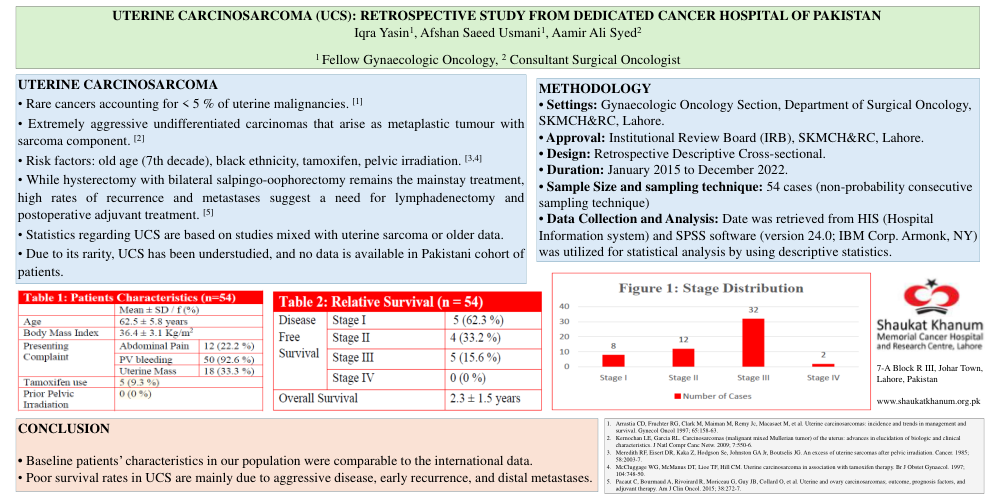
UTERINE CARCINOSARCOMA (UCS): RETROSPECTIVE STUDY FROM DEDICATED CANCER HOSPITAL OF PAKISTAN
Iqra Yasin1, Afshan Saeed Usmani1, Aamir Ali Syed2
1 Fellow Gynaecologic Oncology, 2 Consultant Surgical Oncologist
UTERINE CARCINOSARCOMA
• Rare cancers accounting for < 5 % of uterine malignancies. [1]
• Extremely aggressive undifferentiated carcinomas that arise as metaplastic tumour with sarcoma component. [2]
• Risk factors: old age (7th decade), black ethnicity, tamoxifen, pelvic irradiation. [3,4]
• While hysterectomy with bilateral salpingo-oophorectomy remains the mainstay treatment, high rates of recurrence and metastases suggest a need for lymphadenectomy and postoperative adjuvant treatment. [5]
• Statistics regarding UCS are based on studies mixed with uterine sarcoma or older data.
• Due to its rarity, UCS has been understudied, and no data is available in Pakistani cohort of patients.
METHODOLOGY
• Settings: Gynaecologic Oncology Section, Department of Surgical Oncology, SKMCH&RC, Lahore.
• Approval: Institutional Review Board (IRB), SKMCH&RC, Lahore.
• Design: Retrospective Descriptive Cross-sectional.
• Duration: January 2015 to December 2022.
• Sample Size and sampling technique: 54 cases (non-probability consecutive sampling technique)
• Data Collection and Analysis: Date was retrieved from HIS (Hospital Information system) and SPSS software (version 24.0; IBM Corp. Armonk, NY) was utilized for statistical analysis by using descriptive statistics.
CONCLUSION
• Baseline patients’ characteristics in our population were comparable to the international data.
• Poor survival rates in UCS are mainly due to aggressive disease, early recurrence, and distal metastases.
REFERENCES
1.Arrastia CD, Fruchter RG, Clark M, Maiman M, Remy Jc, Macasaet M, et al. Uterine carcinosarcomas: incidence and trends in management and survival. Gynecol Oncol 1997; 65:158-63.
2.Kernochan LE, Garcia RL. Carcinosarcomas (malignant mixed Mullerian tumor) of the uterus: advances in elucidation of biologic and clinical characteristics. J Natl Compr Canc Netw. 2009; 7:550-6.
3.Meredith RF, Eisert DR, Kaka Z, Hodgson Se, Johnston GA Jr, Boutselis JG. An excess of uterine sarcomas after pelvic irradiation. Cancer. 1985; 58:2003-7.
4.McCluggage WG, McManus DT, Lioe TF, Hill CM. Uterine carcinosarcoma in association with tamoxifen therapy. Br J Obstet Gynaecol. 1997; 104:748-50.
5.Pacaut C, Bourmaud A, Rivoirard R, Moriceau G, Guy JB, Collard O, et al. Uterine and ovary carcinosarcomas; outcome, prognosis factors, and adjuvant therapy. Am J Clin Oncol. 2015; 38:272-7.