2,281 posters, 63 videos, 56 audios, 43 topics, 18 sessions, 6,174 authors, 2,323 institutions
ePostersLive by SciGen Technologies S.A. All rights reserved.
RCOG World Congress 2025
June 23 - 25, 2025 | ExCeL London, UK
EP.0864
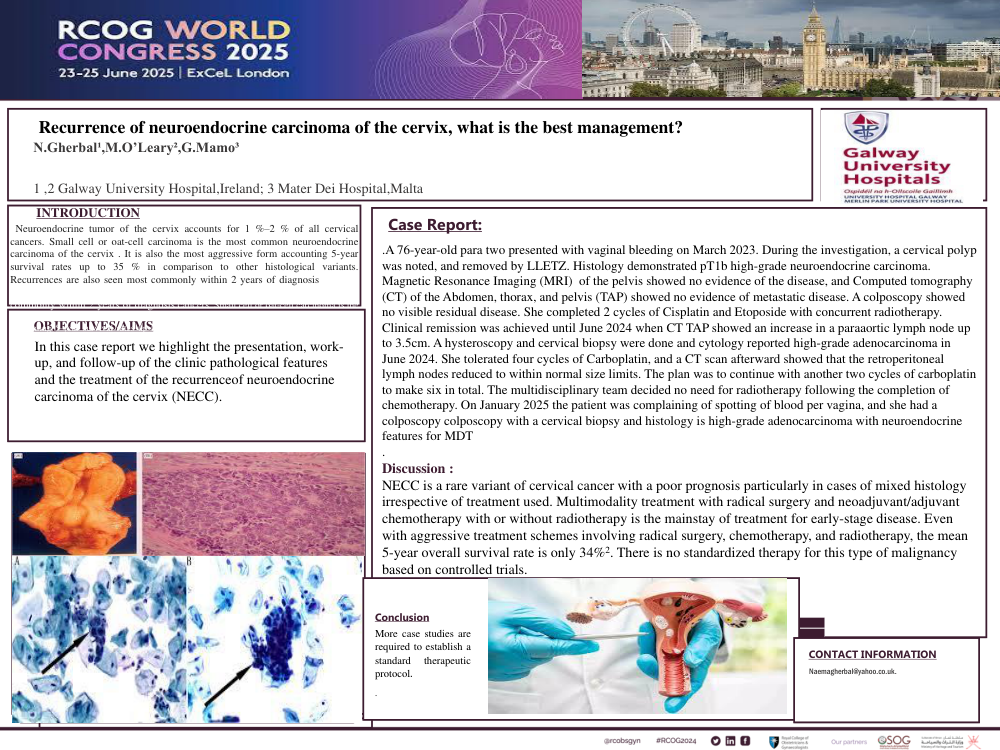
Recurrence of neuroendocrine carcinoma of the cervix, what is the best management?
Poster Presenter
Authors
Affiliations
Part of Topic
Gynaecological oncology
Recurrence of neuroendocrine carcinoma of the cervix, what is the best management?
Objective:
In this case report we highlight the presentation, work-up, and follow-up of the clinic pathological features and the treatment of the recurrence of neuroendocrine carcinoma of the cervix (NECC).
Case Report:
A 76-year-old para two presented with vaginal bleeding on March 2023. During the investigation, a cervical polyp was noted, and removed by LLETZ. Histology demonstrated pT1b high-grade neuroendocrine carcinoma. Magnetic Resonance Imaging (MRI) of the pelvis showed no evidence of the disease, and Computed tomography (CT) of the Abdomen, thorax, and pelvis (TAP) showed no evidence of metastatic disease. A colposcopy showed no visible residual disease. She completed 2 cycles of Cisplatin and Etoposide with concurrent radiotherapy. Clinical remission was achieved until June 2024 when CT TAP showed an increase in a paraaortic lymph node up to 3.5cm. A hysteroscopy and cervical biopsy were done and cytology reported high-grade adenocarcinoma in June 2024. She tolerated four cycles of Carboplatin, and a CT scan afterward showed that the retroperitoneal lymph nodes reduced to within normal size limits. The plan was to continue with another two cycles of carboplatin to make six in total. The multidisciplinary team decided no need for radiotherapy following the completion of chemotherapy. On January 2025 the patient was complaining of spotting of blood per vagina, and she had a colposcopy with a cervical biopsy and histology is high-grade adenocarcinoma with neuroendocrine features for MDT discussion.
Discussion:
Neuroendocrine tumor of the cervix accounts for 1 %–2 % of all cervical cancers. Small cell or oat-cell carcinoma is the most common neuroendocrine carcinoma of the cervix . It is also the most aggressive form accounting 5-year survival rates up to 35 % in comparison to other histological variants. Recurrences are also seen most commonly within 2 years of diagnosis.
NECC is a rare variant of cervical cancer with a poor prognosis particularly in cases of mixed histology irrespective of treatment used. Multimodality treatment with radical surgery and neoadjuvant/adjuvant chemotherapy with Cisplatin and Etoposide with or without radiotherapy is the mainstay of treatment for early-stage disease while chemotherapy with Cisplatin and Etoposide or Topotecan, Paclitaxel, and Bevacizumab is appropriate for women with locally advanced or recurrent NECC. Immune checkpoint inhibitors may be beneficial, but RCT evidence for their efficacy is lacking. Even with aggressive treatment schemes involving radical surgery, chemotherapy, and radiotherapy, the mean 5-year overall survival rate is only 34%2. There is no standardized therapy for this type of malignancy based on controlled trials.
Conclusion:
Due to the aggressive nature of NECC, patients must be kept under careful observation with regular follow-up. Metastasis in such cases particularly to the liver, lungs, and rib cage must be kept in mind. The application of molecular testing for targeted mutations may suggest potential future therapies that may be useful in this disease.
More case studies are required to establish a standard therapeutic protocol.