2,281 posters, 63 videos, 56 audios, 43 topics, 18 sessions, 6,174 authors, 2,323 institutions
ePostersLive by SciGen Technologies S.A. All rights reserved.
RCOG World Congress 2025
June 23 - 25, 2025 | ExCeL London, UK
EP.0862
Squamous Cell carcinoma of cervix with a carcinoid tumor of the lung
Poster Presenter
Authors
Affiliations
Part of Topic
Gynaecological oncology
Squamous Cell carcinoma of the cervix with a carcinoid tumor of the lung, Case report.
Objective:
In this case report, we present a case of malignant tumor of the cervix with a concommitant lung lesion on staging scans, with differential diagnosis of metastatic cervical disease or primary tumor in the lung, and to evaluate management and the treatment options available for the management of this case.
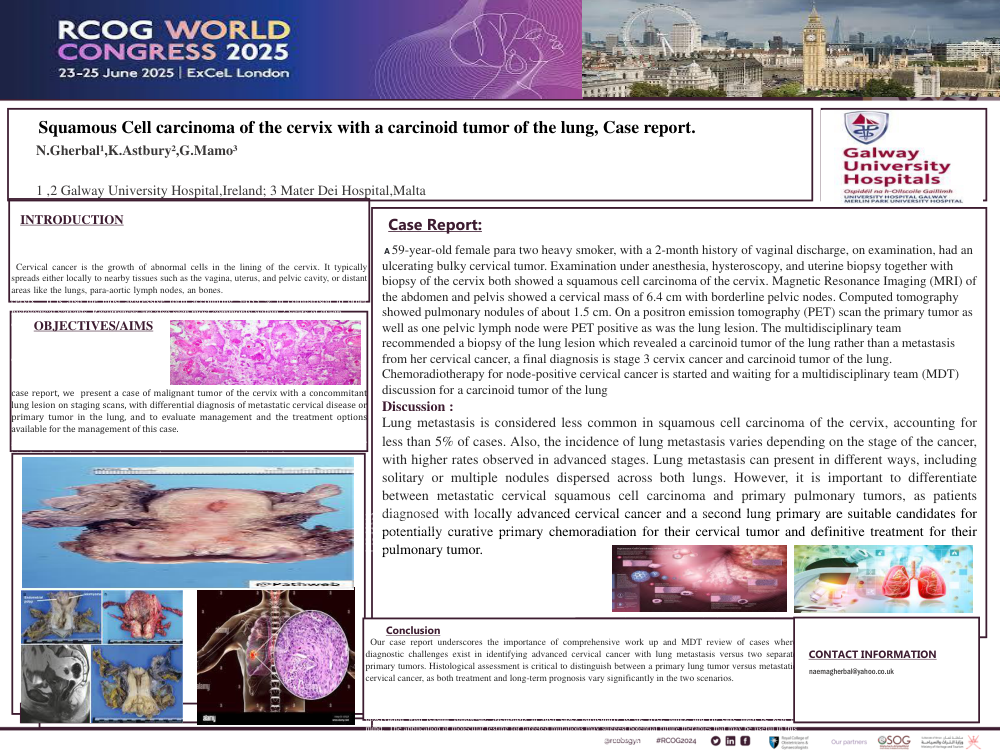
Case report: A 59-year-old female para two heavy smoker, with a 2-month history of vaginal discharge, on examination, had an ulcerating bulky cervical tumor. Examination under anesthesia, hysteroscopy, and uterine biopsy together with biopsy of the cervix both showed a squamous cell carcinoma of the cervix. Magnetic Resonance Imaging (MRI) of the abdomen and pelvis showed a cervical mass of 6.4 cm with borderline pelvic nodes. Computed tomography showed pulmonary nodules of about 1.5 cm. On a positron emission tomography (PET) scan the primary tumor as well as one pelvic lymph node were PET positive as was the lung lesion. The multidisciplinary team recommended a biopsy of the lung lesion which revealed a carcinoid tumor of the lung rather than a metastasis from her cervical cancer, a final diagnosis is stage 3 cervix cancer and carcinoid tumor of the lung. Chemoradiotherapy for node-positive cervical cancer is started and waiting for a multidisciplinary team (MDT) discussion for a carcinoid tumor of the lung.
Discussion:
Cervical cancer is the growth of abnormal cells in the lining of the cervix. It typically spreads either locally to nearby tissues such as the vagina, uterus, and pelvic cavity, or distant areas like the lungs, para-aortic lymph nodes, and bones.
Lung metastasis is considered less common in squamous cell carcinoma of the cervix, accounting for less than 5% of cases. Also, the incidence of lung metastasis varies depending on the stage of the cancer, with higher rates observed in advanced stages. Lung metastasis can present in different ways, including solitary or multiple nodules dispersed across both lungs. However, it is important to differentiate between metastatic cervical squamous cell carcinoma and primary pulmonary tumors, as patients diagnosed with locally advanced cervical cancer and a second lung primary are suitable candidates for potentially curative primary chemoradiation for their cervical tumor and definitive treatment for their pulmonary tumor.
Conclusion:
Our case report underscores the importance of comprehensive work up and MDT review of cases where diagnostic challenges exist in identifying advanced cervical cancer with lung metastasis versus two separate primary tumors. Histological assessment is critical to distinguish between a primary lung tumor versus metastatic cervical cancer, as both treatment and long-term prognosis vary significantly in the two scenarios.