2,281 posters, 63 videos, 56 audios, 43 topics, 18 sessions, 6,174 authors, 2,323 institutions
ePostersLive by SciGen Technologies S.A. All rights reserved.
RCOG World Congress 2025
June 23 - 25, 2025 | ExCeL London, UK
EP.0859
Bartholin Gland Tumor: Rare but Aggressive and Lethal
Poster Presenter
Authors
Affiliations
Luton and Dunstable University Hospital, Suri Seri Begawan Hospital
Part of Topic
Gynaecological oncology
Bartholin Gland Tumor: Rare but Aggressive and Lethal : A Case Report
Ei Mon Mon Kyaw (Senior Clinical Fellow, Luton and Dunstable University Hospital, NHS Foundation Trust), Myat San Yi (Consultant, Suri Seri Begawan Hospital, Brunei)
Objective : To present a rare case of Bartholin gland carcinoma and underscore the critical importance of accurate diagnosis and early, effective multidisciplinary management in improving patient outcomes.
Case Report : A 67-year-old para 9 woman presented to the Emergency Department with delirium, poor appetite, and difficulty walking for the past three days. There was no associated fever, and bowel and urinary habits were initially unremarkable. History was obtained from her husband, as the patient appeared confused and anxious. Further questioning revealed that she had been treated for painful vulvar lesions for three weeks in the dermatology clinic. She was initially diagnosed with herpes simplex infection complicated by secondary bacterial infection. Acyclovir and oral antibiotics were prescribed. Despite this, her symptoms failed to improve, and she was advised to continue the same treatment while awaiting her next review. Before her scheduled follow-up, the patient deteriorated—developing delirium, dyspepsia, and significantly reduced urine output. She became bedridden due to intense vulvar pain, profound lethargy, and urinary incontinence, prompting urgent hospital admission.
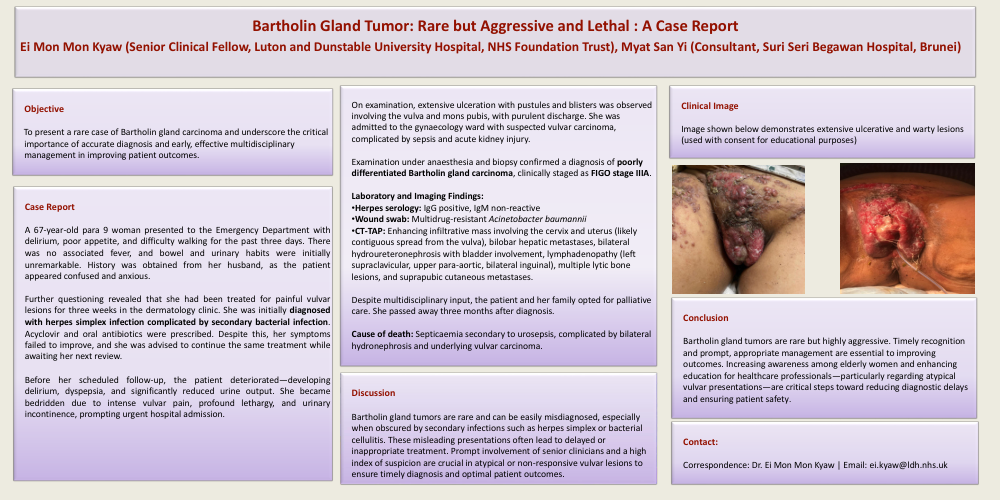
On examination, extensive ulceration with pustules and blisters was observed involving the vulva and mons pubis, with purulent discharge. She was admitted to the gynaecology ward with suspected vulvar carcinoma, complicated by sepsis and acute kidney injury. Examination under anaesthesia and biopsy confirmed a diagnosis of poorly differentiated Bartholin gland carcinoma, clinically staged as FIGO stage IIIA. Laboratory and Imaging Findings: •Herpes serology: IgG positive, IgM non-reactive •Wound swab: Multidrug-resistant Acinetobacter baumannii •CT-TAP: Enhancing infiltrative mass involving the cervix and uterus (likely contiguous spread from the vulva), bilobar hepatic metastases, bilateral hydroureteronephrosis with bladder involvement, lymphadenopathy (left supraclavicular, upper para-aortic, bilateral inguinal), multiple lytic bone lesions, and suprapubic cutaneous metastases. Despite multidisciplinary input, the patient and her family opted for palliative care. She passed away three months after diagnosis. Cause of death: Septicaemia secondary to urosepsis, complicated by bilateral hydronephrosis and underlying vulvar carcinoma.
Discussion : Bartholin gland tumors are rare and can be easily misdiagnosed, especially when obscured by secondary infections such as herpes simplex or bacterial cellulitis. These misleading presentations often lead to delayed or inappropriate treatment. Prompt involvement of senior clinicians and a high index of suspicion are crucial in atypical or non-responsive vulvar lesions to ensure timely diagnosis and optimal patient outcomes.
Conclusion : Bartholin gland tumors are rare but highly aggressive. Timely recognition and prompt, appropriate management are essential to improving outcomes. Increasing awareness among elderly women and enhancing education for healthcare professionals—particularly regarding atypical vulvar presentations—are critical steps toward reducing diagnostic delays and ensuring patient safety.