2,281 posters, 63 videos, 56 audios, 43 topics, 18 sessions, 6,174 authors, 2,323 institutions
ePostersLive by SciGen Technologies S.A. All rights reserved.
RCOG World Congress 2025
June 23 - 25, 2025 | ExCeL London, UK
EP.0851
VULVAR DERMATOFIBROSARCOMA PROTRUBERANS: A CASE REPORT AND TREATMENT INSIGHTS
Poster Presenter
Authors
Affiliations
Part of Topic
Gynaecological oncology
VULVAR DERMATOFIBROSARCOMA PROTUBERANS: A CASE REPORT AND TREATMENT INSIGHTS
Dr Naw Phu Ngone Ko Ko
Specialty Registrar (Obstetrics and Gynaecology)
Sheffield Teaching Hospitals, NHS Foundation Trust
Introduction
Dermatofibrosarcoma protuberans (DFSP) is a rare soft-tissue sarcoma, occurring in approximately 6.25 cases per million person-years. While DFSP typically affects the trunk and extremities, vulvar involvement is exceptionally rare, with fewer than 70 cases reported worldwide.
This rarity, combined with a lack of standardized treatment guidelines, presents significant challenges in clinical management. This report highlights the need for more research to develop treatment protocols for vulvar DFSP.
The case was diagnosed during my clinical practice in Myanmar in 2022, demonstrating the complexities of managing rare vulvar malignancies, particularly in resource-limited settings.
Case Report
A 56-year-old postmenopausal woman (P4, BMI 32) presented with a 2x3 cm, 1 cm thick, non-tender lump adjacent to the thin and vascularized overlying skin on the left vulva, located 2 cm from the vaginal opening and freely mobile. Uterus and cervix were atrophic, and subsequent liquid-based cytology was normal.
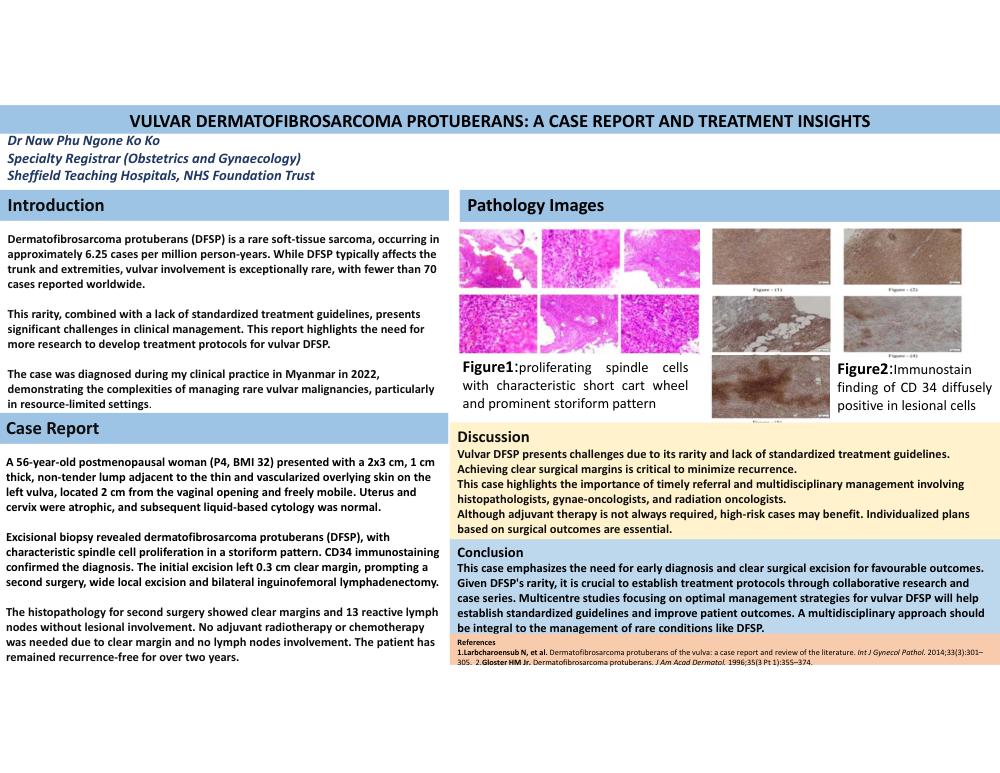
Excisional biopsy revealed dermatofibrosarcoma protuberans (DFSP), with characteristic spindle cell proliferation in a storiform pattern. CD34 immunostaining confirmed the diagnosis. The initial excision left 0.3 cm clear margin, prompting a second surgery, wide local excision and bilateral inguinofemoral lymphadenectomy.
The histopathology for second surgery showed clear margins and 13 reactive lymph nodes without lesional involvement. No adjuvant radiotherapy or chemotherapy was needed due to clear margin and no lymph nodes involvement. The patient has remained recurrence-free for over two years.
Discussion
Vulvar DFSP presents challenges due to its rarity and lack of standardized treatment guidelines. Achieving clear surgical margins is critical to minimize recurrence.
This case highlights the importance of timely referral and multidisciplinary management involving histopathologists, gynae-oncologists, and radiation oncologists.
Although adjuvant therapy is not always required, high-risk cases may benefit. Individualized plans based on surgical outcomes are essential.
Conclusion
This case emphasizes the need for early diagnosis and clear surgical excision for favourable outcomes. Given DFSP's rarity, it is crucial to establish treatment protocols through collaborative research and case series. Multicentre studies focusing on optimal management strategies for vulvar DFSP will help establish standardized guidelines and improve patient outcomes. A multidisciplinary approach should be integral to the management of rare conditions like DFSP.
References
1.Larbcharoensub N, et al. Dermatofibrosarcoma protuberans of the vulva: a case report and review of the literature. Int J Gynecol Pathol. 2014;33(3):301–305.
2.Gloster HM Jr. Dermatofibrosarcoma protuberans. J Am Acad Dermatol. 1996;35(3 Pt 1):355–374.