2,281 posters, 63 videos, 56 audios, 43 topics, 18 sessions, 6,174 authors, 2,323 institutions
ePostersLive by SciGen Technologies S.A. All rights reserved.
RCOG World Congress 2025
June 23 - 25, 2025 | ExCeL London, UK
EP.0848
Anti NMDA Encephalitis with Ovarian Teratoma
Poster Presenter
Authors
Warda Maqsood, Sara Taha, Aya Hajo, Samina Gul, Eddie O'Donnell
Affiliations
Part of Topic
Gynaecological oncology
Anti-NMDA receptor encephalitis primarily affects women, with symptoms including hallucinations, seizures, and motor disturbances, often associated with ovarian teratomas. Presentations can be variable, thus posing a challenge to clinicians in neurology and psychiatry hence we want to report our case.
Case report:
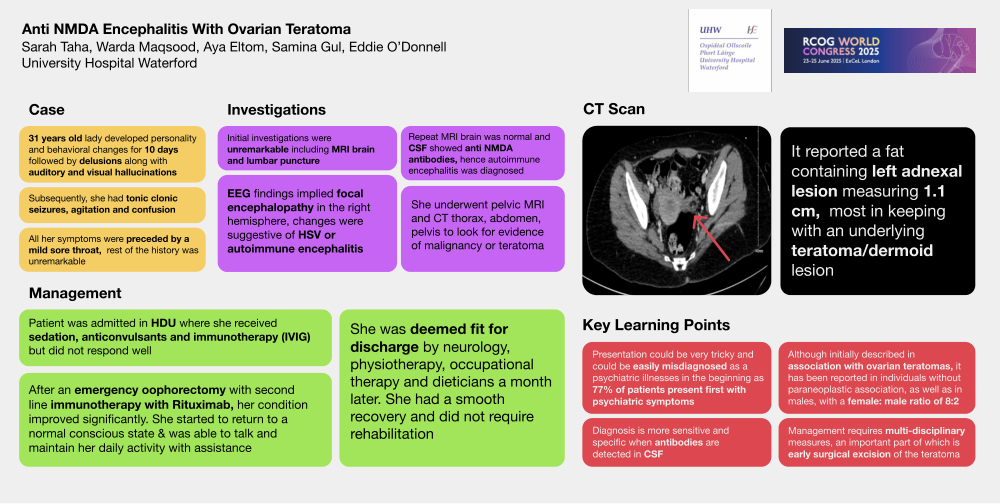
A 31-year-old woman with no prior medical or psychiatric history developed behavioral changes following emotional distress, delusions, agitation, and a tonic-clonic seizure. Despite initial normal MRI and lumbar puncture, she exhibited worsening confusion, catatonia, and hallucinations. EEG suggested focal encephalopathy, and CSF revealed anti-NMDA antibodies, hence autoimmune encephalitis was diagnosed. CT pelvis revealed a 1.1 cm fat lesion in left adnexa. She underwent emergency oophorectomy and immunotherapy with rituximab which led to significant improvement, restoring her consciousness and functionality. She was discharged with ongoing support and rehabilitation for further recovery.
Discussion:
Anti-N-methyl-D-aspartate (NMDA) receptor encephalitis is a rare and debilitating autoimmune disease with a reported age- and sex-standardized incidence of 1 per million person-years. It is more commonly observed in young Black and Asian females, although cases have also been reported in males, with a female-to-male ratio of 8:2. The symptoms are nonspecific and can range from psychiatric and behavioral changes to seizures, altered mental status, and loss of consciousness. Brain MRI and EEG findings are typically unremarkable but can show non specific signs of encephalitis, hence there is delay in diagnosis. CSF studies show raised white cell counts. Diagnosis confirmed through cerebrospinal fluid (CSF) analysis, which detects IgG antibodies against the GluN1 subunit (also referred to as NR1) of the NMDA receptor. The disease is strongly associated with ovarian tumors, particularly mature teratomas. Ovarian teratomas are identified in approximately 58% of affected individuals. Therefore, pelvic imaging is recommended for all female patients. Treatment involves immunotherapy combined with surgical removal of the ovarian tumor. It is important to note that patients with teratomas usually show a poor response to immunotherapy alone until removal of tumor has been undertaken which then alleviates symptoms and reduces risk of recurrence.
Conclusion:
Anti NMDA encephalitis presentations could be very tricky and easily misdiagnosed as psychiatric illnesses in the beginning as 77% of patients present first with psychiatric symptoms. Diagnosis is more sensitive and specific when antibodies are detected in CSF. Management requires multidisciplinary measures, an important part of which is early surgical excision of the teratoma.