2,281 posters, 63 videos, 56 audios, 43 topics, 18 sessions, 6,174 authors, 2,323 institutions
ePostersLive by SciGen Technologies S.A. All rights reserved.
RCOG World Congress 2025
June 23 - 25, 2025 | ExCeL London, UK
EP.0846
Squamous cell carcinoma in ovarian dermoid
Poster Presenter
Authors
Warda Maqsood, Aya Hajo, Samina Gul, John Stratton, John Bermingham
Affiliations
Part of Topic
Gynaecological oncology
Objective:
Ovarian dermoids are the most common germ cell tumors with a rare malignant transformation rate of 0.17-2%, primarily to squamous cell carcinoma (SCC). This case aims to enhance understanding of such rare gynecologic malignancies for early diagnosis and improved patient outcomes.
Case report:
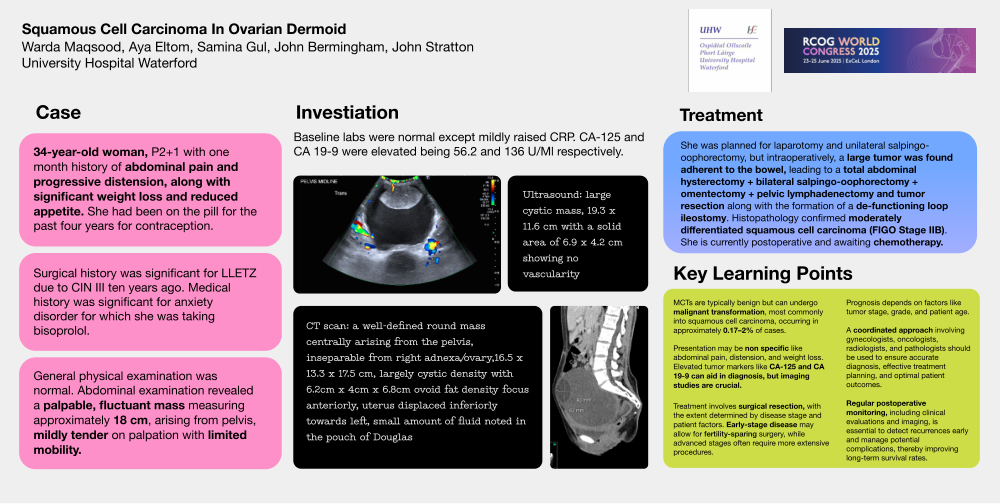
34-year-old, P2+1 with one month of abdominal pain, progressive distension and significant weight loss. Baseline labs normal. CA-125 and CA 19-9 elevated. Imaging revealed a large cyst (19.3 x 11.6 cm) with a solid fat component (6.9 x 4.2 cm), diagnosed as a dermoid cyst. She was planned for laparotomy and unilateral salpingo-oophorectomy, but intraoperatively a large tumor was found adherent to bowel, leading to a total abdominal hysterectomy + bilateral salpingo-oophorectomy + omentectomy + pelvic lymphadenectomy and tumor resection. Histopathology confirmed moderately differentiated squamous cell carcinoma (FIGO Stage IIB). She is currently postoperative, awaiting chemotherapy.
Discussion:
Ovarian germ cell tumors make around 20-25% of all ovarian neoplasms, but only 5% of malignant ovarian neoplasms. Most common type is an ovarian dermoid, also called mature teratoma. In a systematic review which studied over 400 cases from 1977-2016, the incidence of SCC transformation in MCTO(mature cystic teratoma of ovary) was found to be 0.3%. Presentation is quite variable from being asymptomatic to an acute one like torsion. Most common symptom is abdominal/pelvic pain. Others include abdominal distension, palpable mass, weight loss, and loss of appetite. Various tumor markers can be raised such as CA-125, BHCG, AFP, LDH, HE4. RMI score and IOTA index are useful in assessing ovarian masses. There is no current consensus on the use of CT scan and MRI in the evaluation of an adnexal mass but if there is any suspicion of malignancy they should be undertaken. Initial treatment is surgery. Since immature teratomas are more common in young adults, fertility-sparing surgery is recommended due to their high sensitivity to chemotherapy. However, in cases of advanced-stage disease, postmenopausal women or women who do not desire fertility, debulking surgery with comprehensive staging is advised. FIGO staging for cancer of ovary is followed. Grading is important as it indicates malignant potential and hence prognosis. Chemotherapy involves 3-4 cycles of BEP regimen i.e. Bleomycin, Etoposide and Cisplatin.
Conclusions:
While MCTs are typically benign, they can undergo malignant transformation. Patients may present with nonspecific symptoms so level of suspicion should be high. Elevated tumor markers can aid in diagnosis but imaging studies are crucial. Multidisciplinary approach is vital.