2,281 posters, 63 videos, 56 audios, 43 topics, 18 sessions, 6,174 authors, 2,323 institutions
ePostersLive by SciGen Technologies S.A. All rights reserved.
RCOG World Congress 2025
June 23 - 25, 2025 | ExCeL London, UK
EP.0842
Managing Metastatic Phyllodes Tumour During Pregnancy: a multidisciplinary approach
Poster Presenter
Authors
Affiliations
Part of Topic
Gynaecological oncology
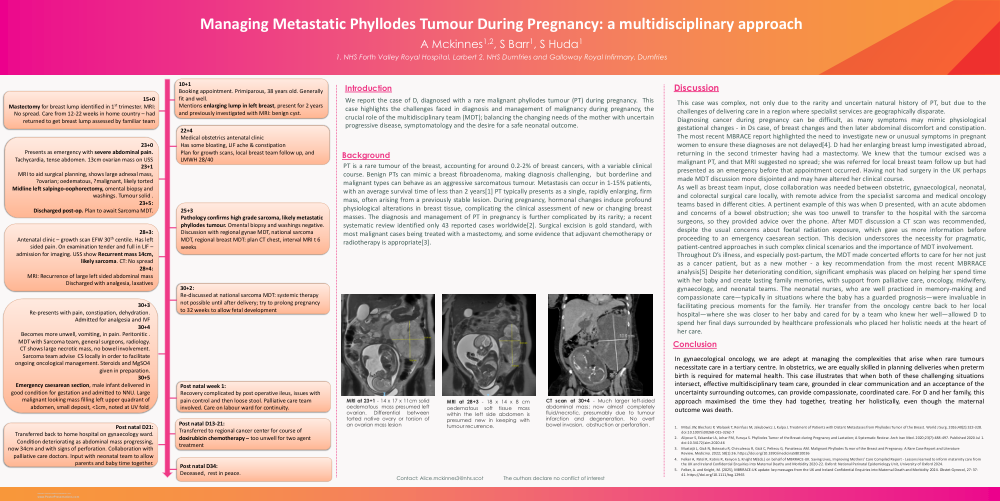
We report the case of D, diagnosed with a rare malignant phyllodes tumour (PT) during pregnancy. This case highlights the challenges faced in diagnosis and management of malignancy during pregnancy, the crucial role of the multidisciplinary team (MDT); balancing the changing needs of the mother with uncertain progressive disease, symptomatology and the desire for a safe neonatal outcome.
PT is a rare tumour of the breast, accounting for around 0.2-2% of breast cancers, with a variable clinical course. Benign PTs can mimic a breast fibroadenoma, making diagnosis challenging, but borderline and malignant types can behave as an aggressive sarcomatous tumour. Metastasis can occur in 1-15% patients, with an average survival time of less than 2 years[1] PT typically presents as a single, rapidly enlarging, firm mass, often arising from a previously stable lesion. During pregnancy, hormonal changes induce profound physiological alterations in breast tissue, complicating the clinical assessment of new or changing breast masses. The diagnosis and management of PT in pregnancy is further complicated by its rarity; a recent systematic review identified only 43 reported cases worldwide[2]. Surgical excision is gold standard, with most malignant cases being treated with a mastectomy, and some evidence that adjuvant chemotherapy or radiotherapy is appropriate[3].
This case was complex, not only due to the rarity and uncertain natural history of PT, but due to the challenges of delivering care in a region where specialist services are geographically disparate.
Diagnosing cancer during pregnancy can be difficult, as many symptoms may mimic physiological gestational changes - in Ds case, of breast changes and then later abdominal discomfort and constipation. The most recent MBRACE report highlighted the need to investigate new or unusual symptoms in pregnant women to ensure these diagnoses are not delayed[4]. D had her enlarging breast lump investigated abroad, returning in the second trimester having had a mastectomy. We knew that the tumour excised was a malignant PT, and that MRI suggested no spread; she was referred for local breast team follow up but had presented as an emergency before that appointment occurred. Having not had surgery in the UK perhaps made MDT discussion more disjointed and may have altered her clinical course.
As well as breast team input, close collaboration was needed between obstetric, gynaecological, neonatal, and colorectal surgical care locally, with remote advice from the specialist sarcoma and medical oncology teams based in different cities. A pertinent example of this was when D presented, with an acute abdomen and concerns of a bowel obstruction; she was too unwell to transfer to the hospital with the sarcoma surgeons, so they provided advice over the phone. After MDT discussion a CT scan was recommended, despite the usual concerns about foetal radiation exposure, which gave us more information before proceeding to an emergency caesarean section. This decision underscores the necessity for pragmatic, patient-centred approaches in such complex clinical scenarios and the importance of MDT involvement.
Throughout D’s illness, and especially post-partum, the MDT made concerted efforts to care for her not just as a cancer patient, but as a new mother - a key recommendation from the most recent MBRRACE analysis[5] Despite her deteriorating condition, significant emphasis was placed on helping her spend time with her baby and create lasting family memories, with support from palliative care, oncology, midwifery, gynaecology, and neonatal teams. The neonatal nurses, who are well practiced in memory-making and compassionate care—typically in situations where the baby has a guarded prognosis—were invaluable in facilitating precious moments for the family. Her transfer from the oncology centre back to her local hospital—where she was closer to her baby and cared for by a team who knew her well—allowed D to spend her final days surrounded by healthcare professionals who placed her holistic needs at the heart of her care.
In gynaecological oncology, we are adept at managing the complexities that arise when rare tumoursnecessitate care in a tertiary centre. In obstetrics, we are equally skilled in planning deliveries when preterm birth is required for maternal health. This case illustrates that when both of these challenging situations intersect, effective multidisciplinary team care, grounded in clear communication and an acceptance of the uncertainty surrounding outcomes, can provide compassionate, coordinated care. For D and her family, this approach maximised the time they had together, treating her holistically, even though the maternal outcome was death.