2,281 posters, 63 videos, 56 audios, 43 topics, 18 sessions, 6,174 authors, 2,323 institutions
ePostersLive by SciGen Technologies S.A. All rights reserved.
RCOG World Congress 2025
June 23 - 25, 2025 | ExCeL London, UK
EP.0839
Atypical Endometrial Hyperplasia after Subtotal Hysterectomy in Patient Using Hormone Replacement Therapy.
Poster Presenter
Part of Topic
Gynaecological oncology
Atypical Endometrial Hyperplasia after Subtotal Hysterectomy in Patient Using Hormone Replacement Therapy
Miriam Eskandar, Medical Student, Mr Seamus Eckford, Constultant O&G. Royal Devon University Healthcare Trust, Devon, UK. Department of Obstetrics and Gynecology University of Exeter.
BACKGROUND
- Subtotal hysterectomy (supracervical) preserves the cervix and is often preferred for quicker recovery and perceived benefits in sexual function.
- However, residual endometrial tissue in the cervical canal remains hormonally responsive.
- Unopposed oestrogen HRT in postmenopausal women can stimulate this residual tissue.(1)
- Atypical endometrial hyperplasia is a precancerous condition usually arising in the uterine cavity — its presence in a retained cervical stump is rare and underreported.
CASE DESCRIPTION
- Patient: 59-year-old postmenopausal woman
- History: Subtotal hysterectomy for fibroids and abnormal uterine bleeding 10 years previously
- HRT: 7 years of unopposed oestrogen (2mg oestradiol)
- Presentation: 3 weeks of postmenopausal spotting
- Investigations:
Transvaginal US: No endometrial cavity visible
Cervical polyp identified and removed
Endocervical biopsy: Atypical endometrial hyperplasia
- Management:
Started on high dose medroxyprogesterone acetate
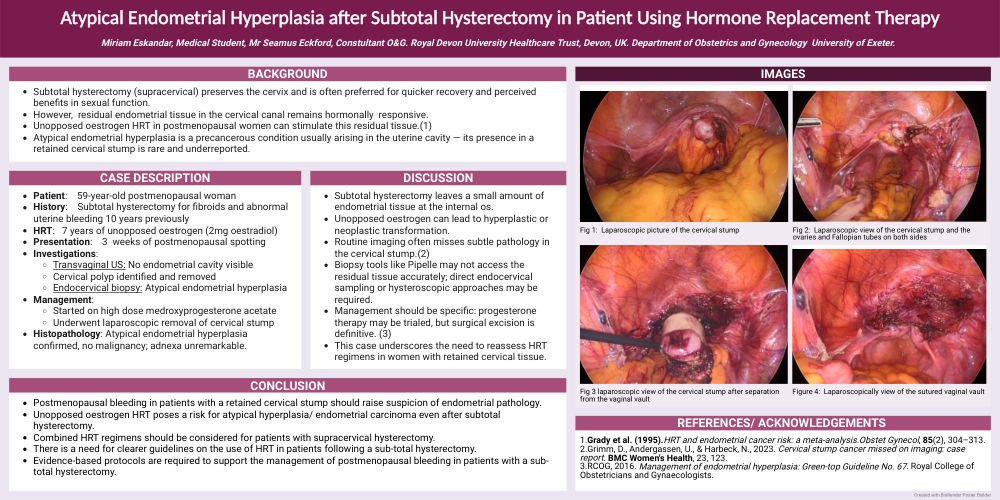
Underwent laparoscopic removal of cervical stump
- Histopathology: Atypical endometrial hyperplasia confirmed, no malignancy; adnexa unremarkable.
DISCUSSION
● Subtotal hysterectomy leaves a small amount of endometrial tissue at the internal os.
● Unopposed oestrogen can lead to hyperplastic or neoplastic transformation.
● Routine imaging often misses subtle pathology in the cervical stump.(2)
● Biopsy tools like Pipelle may not access the residual tissue accurately; direct endocervical sampling or hysteroscopic approaches may be required.
● Management should be specific: progesterone therapy may be trialed, but surgical excision is definitive. (3)
● This case underscores the need to reassess HRT regimens in women with retained cervical tissue.
CONCLUSION
Postmenopausal bleeding in patients with a retained cervical stump should raise suspicion of endometrial pathology.
Unopposed oestrogen HRT poses a risk for atypical hyperplasia/ endometrial carcinoma even after subtotal hysterectomy
Combined HRT regimens should be considered for patients with supracervical hysterectomy.
There is a need for clearer guidelines on the use of HRT in patients following a sub-total hysterectomy.
Evidence-based protocols are required to support the management of postmenopausal bleeding in patients with a sub- total hysterectomy.
REFERENCES/ ACKNOWLEDGEMENTS
1.Grady et al. (1995).HRT and endometrial cancer risk: a meta-analysis.Obstet Gynecol, 85(2), 304–313. 2.Grimm, D., Andergassen, U., & Harbeck, N., 2023. Cervical stump cancer missed on imaging: case report. BMC Women's Health, 23, 123.
3.RCOG, 2016. Management of endometrial hyperplasia: Green-top Guideline No. 67. Royal College of Obstetricians and Gynaecologists.