2,281 posters, 63 videos, 56 audios, 43 topics, 18 sessions, 6,174 authors, 2,323 institutions
ePostersLive by SciGen Technologies S.A. All rights reserved.
RCOG World Congress 2025
June 23 - 25, 2025 | ExCeL London, UK
EP.0831
Mixed Germ Cell Tumour in Adolescence: Diagnosis and Treatment Challenges.
Poster Presenter
Part of Topic
Gynaecological oncology
History
A 12-year-old female presented with a 2-day history of lower abdominal pain and a firm, mobile mass extending to the umbilicus. She denied other symptoms. Examination showed a distended lower abdomen with a significant, mobile mass. Vaginal examination was not performed.
Investigations
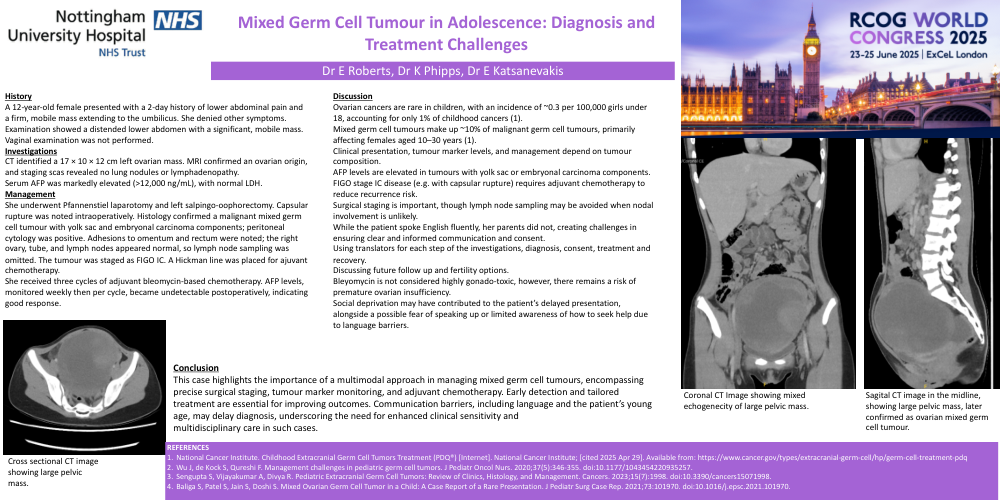
CT identified a 17 × 10 × 12 cm left ovarian mass. MRI confirmed an ovarian origin, and staging scas revealed no lung nodules or lymphadenopathy.
Serum AFP was markedly elevated (>12,000 ng/mL), with normal LDH.
Management
She underwent Pfannenstiel laparotomy and left salpingo-oophorectomy. Capsular rupture was noted intraoperatively. Histology confirmed a malignant mixed germ cell tumour with yolk sac and embryonal carcinoma components; peritoneal cytology was positive. Adhesions to omentum and rectum were noted; the right ovary, tube, and lymph nodes appeared normal, so lymph node sampling was omitted. The tumour was staged as FIGO IC. A Hickman line was placed for ajuvant chemotherapy.
She received three cycles of adjuvant bleomycin-based chemotherapy. AFP levels, monitored weekly then per cycle, became undetectable postoperatively, indicating good response.
Discussion
Ovarian cancers are rare in children, with an incidence of ~0.3 per 100,000 girls under 18, accounting for only 1% of childhood cancers (1).
Mixed germ cell tumours make up ~10% of malignant germ cell tumours, primarily affecting females aged 10–30 years (1).
Clinical presentation, tumour marker levels, and management depend on tumour composition.
AFP levels are elevated in tumours with yolk sac or embryonal carcinoma components.
FIGO stage IC disease (e.g. with capsular rupture) requires adjuvant chemotherapy to reduce recurrence risk.
Surgical staging is important, though lymph node sampling may be avoided when nodal involvement is unlikely.
While the patient spoke English fluently, her parents did not, creating challenges in ensuring clear and informed communication and consent.
Using translators for each step of the investigations, diagnosis, consent, treatment and recovery.
Discussing future follow up and fertility options.
Bleyomycin is not considered highly gonado-toxic, however, there remains a risk of premature ovarian insufficiency.
Social deprivation may have contributed to the patient’s delayed presentation, alongside a possible fear of speaking up or limited awareness of how to seek help due to language barriers.
Conclusion
This case highlights the importance of a multimodal approach in managing mixed germ cell tumours, encompassing precise surgical staging, tumour marker monitoring, and adjuvant chemotherapy. Early detection and tailored treatment are essential for improving outcomes. Communication barriers, including language and the patient’s young age, may delay diagnosis, underscoring the need for enhanced clinical sensitivity and multidisciplinary care in such cases.