2,281 posters, 63 videos, 56 audios, 43 topics, 18 sessions, 6,174 authors, 2,323 institutions
ePostersLive by SciGen Technologies S.A. All rights reserved.
RCOG World Congress 2025
June 23 - 25, 2025 | ExCeL London, UK
EP.0826
Eccrine porocarcinoma of the clitoris
Poster Presenter
Part of Topic
Gynaecological oncology
A case report of Eccrine porocarcinoma of the clitoris
Objective:
Eccrine porocarcinoma (EPC) is a rare skin tumor that arises from sweat glands and represents 0.005–0.01 % of all skin tumors. It can be present in unusual locations such as the clitoris.
The Case Report:
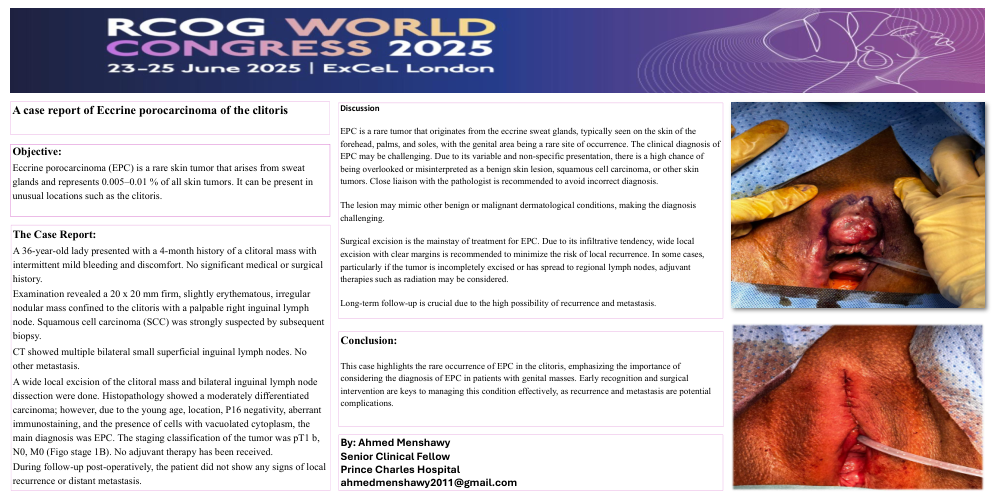
A 36-year-old lady presented with a 4-month history of a clitoral mass with intermittent mild bleeding and discomfort. No significant medical or surgical history. Examination revealed a 20 x 20 mm firm, slightly erythematous, irregular nodular mass confined to the clitoris with a palpable right inguinal lymph node. Squamous cell carcinoma (SCC) was strongly suspected by subsequent biopsy.
CT showed multiple bilateral small superficial inguinal lymph nodes. No other metastasis. A wide local excision of the clitoral mass and bilateral inguinal lymph node dissection were done. Histopathology showed a moderately differentiated carcinoma; however, due to the young age, location, P16 negativity, aberrant immunostaining, and the presence of cells with vacuolated cytoplasm, the main diagnosis was EPC.
The staging classification of the tumor was pT1 b, N0, M0 (Figo stage 1B). No adjuvant therapy has been received. During follow-up post-operatively, the patient did not show any signs of local recurrence or distant metastasis.
Discussion
EPC is a rare tumor that originates from the eccrine sweat glands, typically seen on the skin of the forehead, palms, and soles, with the genital area being a rare site of occurrence. The clinical diagnosis of EPC may be challenging. Due to its variable and non-specific presentation, there is a high chance of being overlooked or misinterpreted as a benign skin lesion, squamous cell carcinoma, or other skin tumors.
Close liaison with the pathologist is recommended to avoid incorrect diagnosis. The lesion may mimic other benign or malignant dermatological conditions, making the diagnosis challenging. Surgical excision is the mainstay of treatment for EPC. Due to its infiltrative tendency, wide local excision with clear margins is recommended to minimize the risk of local recurrence. In some cases, particularly if the tumor is incompletely excised or has spread to regional lymph nodes, adjuvant therapies such as radiation may be considered.
Long-term follow-up is crucial due to the high possibility of recurrence and metastasis.
Conclusion:
This case highlights the rare occurrence of EPC in the clitoris, emphasizing the importance of considering the diagnosis of EPC in patients with genital masses. Early recognition and surgical intervention are keys to managing this condition effectively, as recurrence and metastasis are potential complications.
By: Ahmed Menshawy
Senior Clinical Fellow
Prince Charles Hospital
ahmedmenshawy2011@gmail.com