2,281 posters, 63 videos, 56 audios, 43 topics, 18 sessions, 6,174 authors, 2,323 institutions
ePostersLive by SciGen Technologies S.A. All rights reserved.
RCOG World Congress 2025
June 23 - 25, 2025 | ExCeL London, UK
EP.0808
Endometrial Pathology in women referred to Outpatient Hysteroscopy: Clinical Factors & Diagnostic Outcomes
Poster Presenter
Authors
Affiliations
Part of Topic
Gynaecological oncology
Objective: This retrospective cohort study aims to understand the clinical characteristics and the diagnostic results of patients who have attended the outpatient hysteroscopy clinic at Colchester General Hospital.
Design: We focused on the association between risk factors, including age, BMI, HRT usage, endometrial thickness on transvaginal ultrasound, ultrasound findings (fibroid, polyps, intracavity fluid), findings on hysteroscopy and histology. The primary outcome of this study is identification of endometrial cancer on histology.
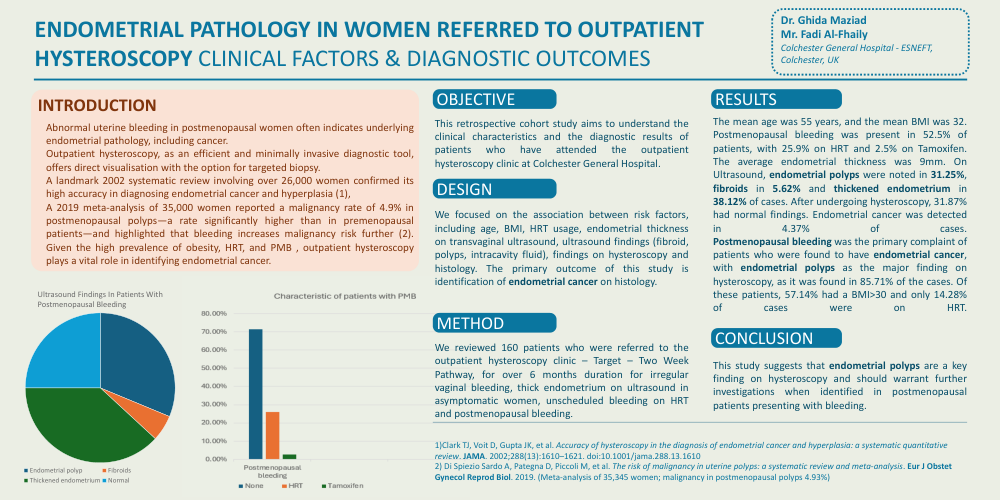
Method: We reviewed 160 patients who were referred to the outpatient hysteroscopy clinic – Target – Two Week Pathway, for over 6 months duration for irregular vaginal bleeding, thick endometrium on ultrasound in asymptomatic women, unscheduled bleeding on HRT and postmenopausal bleeding.
Results: The mean age was 55 years, and the mean BMI was 32. Postmenopausal bleeding was present in 52.5% of patients, with 25.9% on HRT and 2.5% on Tamoxifen. The average endometrial thickness was 9mm. On Ultrasound, endometrial polyps were noted in 31.25%, fibroids in 5.62% and thickened endometrium in 38.12% of cases. After undergoing hysteroscopy, 31.87% had normal findings. Endometrial cancer was detected in 4.37% of cases.
Postmenopausal bleeding was the primary complaint of patients who were found to have endometrial cancer, with endometrial polyps as the major finding on hysteroscopy, as it was found in 85.71% of the cases. Of these patients, 57.14% had a BMI>30 and only 14.28% of cases were on HRT.
Conclusions: This study suggests that endometrial polyps are a key finding on hysteroscopy and should warrant further investigations when identified in postmenopausal patients presenting with bleeding.