2,281 posters, 63 videos, 56 audios, 43 topics, 18 sessions, 6,174 authors, 2,323 institutions
ePostersLive by SciGen Technologies S.A. All rights reserved.
RCOG World Congress 2025
June 23 - 25, 2025 | ExCeL London, UK
EP.0803
MHT for Cancer Survivors
Poster Presenter
Part of Topic
Gynaecological oncology
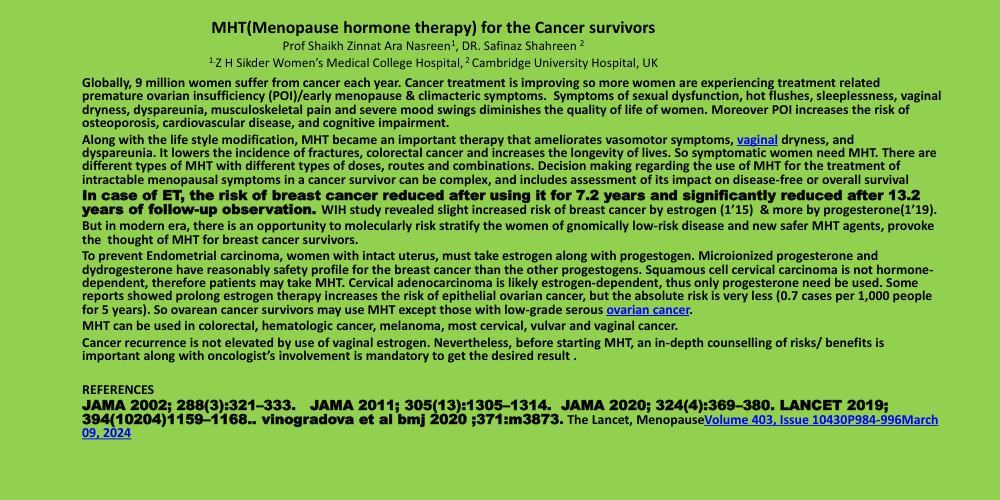
MHT(Menopause hormone therapy) for the Cancer survivors
Prof Shaikh Zinnat Ara Nasreen 1 , DR. Safinaz Shahreen 2
1. Z H Sikder Women’s Medical College Hospital, 2 Cambridge University Hospital, UK
Globally, 9 million women suffer from cancer each year.
Cancer treatment is improving so more women are experiencing treatment related
premature ovarian insufficiency (POI)/early menopause & climacteric symptoms. Symptoms of sexual dysfunction, hot flushes, s lee plessness, vaginal
dryness, dyspareunia, musculoskeletal pain and severe mood swings diminishes the quality of life of women. Moreover POI increases the risk of
osteoporosis, cardiovascular disease, and cognitive impairment.
Along with the life style modification, MHT became an important therapy that ameliorates
vasomotor symptoms, vaginal dryness, and
dyspareunia. It lowers the incidence of fractures, colorectal cancer and increases the longevity of lives. So symptomatic women need MHT. There are
different types of MHT with different types of doses, routes and combinations. Decision making regarding the use of MHT for t he treatment of
intractable menopausal symptoms in a cancer survivor can be complex, and includes assessment of its impact on disease free or ov erall survival
In case of ET, the risk of breast cancer reduced after using it for 7.2 years and significantly reduced after 13.2
years of follow up observation. WIH study revealed slight increased risk of breast cancer by estrogen (1’15) & more by progesterone(1’19).
But in modern era, there is an opportunity to molecularly risk stratify the women of gnomically low
risk disease and new safer M HT agents, provoke
the thought of MHT for breast cancer survivors.
To prevent Endometrial carcinoma,
women with intact uterus, must take estrogen along with progestogen . Microionized progesterone and
dydrogesterone have reasonably safety profile for the breast cancer than the other progestogens . Squamous cell cervical carcinoma is not hormone
dependent, therefore patients may take MHT. Cervical adenocarcinoma is likely estrogen dependent, thus only progesterone need be used. Some
reports showed prolong estrogen therapy increases the risk of epithelial ovarian cancer, but the absolute risk is very less ( 0.7 cases per 1,000 people
for 5 years). So ovarean cancer survivors may use MHT except those with low grade serous ovarian cancer .
MHT can be used
in colorectal, hematologic cancer, melanoma, most cervical, vulvar and vaginal cancer.
Cancer recurrence is not elevated by use of vaginal estrogen. Nevertheless,
before starting MHT, an in depth counselling of risks/ benefits is
important along with oncologist’s involvement is mandatory to get the desired result .
REFERENCES
JAMA
2002; 288(3):321 333. JAMA 2011; 305(13):1305 1314. JAMA 2020; 324(4):369 380. LANCET 2019;
394(10204)1159 1168.. vinogradova et al bmj 2020 ;371:m3873 The Lancet, Menopause Volume 403, Issue 10430 P984 996 March
09, 2024