2,281 posters, 63 videos, 56 audios, 43 topics, 18 sessions, 6,174 authors, 2,323 institutions
ePostersLive by SciGen Technologies S.A. All rights reserved.
RCOG World Congress 2025
June 23 - 25, 2025 | ExCeL London, UK
EP.0797
Psammoma bodies in malignant adnexal lesions
Part of Topic
Gynaecological oncology
Psammoma bodies in malignant adnexal lesions
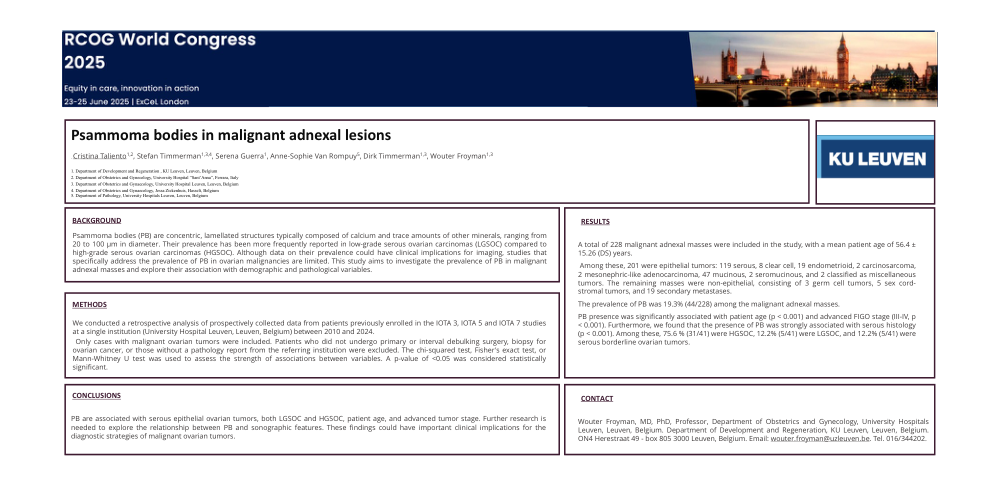
Background: Psammoma bodies (PB) are concentric, lamellated structures typically composed of calcium and trace amounts of other minerals, ranging from 20 to 100 μm in diameter. Their prevalence has been more frequently reported in low-grade serous ovarian carcinomas (LGSOC) compared to high-grade serous ovarian carcinomas (HGSOC). Although data on their prevalence could have clinical implications for imaging, studies that specifically address the prevalence of PB in ovarian malignancies are limited. This study aims to investigate the prevalence of PB in malignant adnexal masses and explore their association with demographic and pathological variables.
Design: We conducted a retrospective analysis of prospectively collected data from patients previously enrolled in the IOTA 3, IOTA 5 and IOTA 7 studies at a single institution (University Hospital Leuven, Leuven, Belgium) between 2010 and 2024.
Methods: Only cases with malignant ovarian tumors were included. Patients who did not undergo primary or interval debulking surgery, biopsy for ovarian cancer, or those without a pathology report from the referring institution were excluded. The chi-squared test, Fisher's exact test, or Mann-Whitney U test was used to assess the strength of associations between variables. A p-value of <0.05 was considered statistically significant.
Results: A total of 228 malignant adnexal masses were included in the study, with a mean patient age of 56.4 ± 15.26 (DS) years. Among these, 201 were epithelial tumors: 119 serous, 8 clear cell, 19 endometrioid, 2 carcinosarcoma, 2 mesonephric-like adenocarcinoma, 47 mucinous, 2 seromucinous, and 2 classified as miscellaneous tumors. The remaining masses were non-epithelial, consisting of 3 germ cell tumors, 5 sex cord-stromal tumors, and 19 secondary metastases. The prevalence of PB was 19.3% (44/228) among the malignant adnexal masses. PB presence was significantly associated with patient age (p < 0.001) and advanced FIGO stage (III-IV, p < 0.001). Furthermore, we found that the presence of PB was strongly associated with serous histology (p < 0.001). Among these, 75.6 % (31/41) were HGSOC, 12.2% (5/41) were LGSOC, and 12.2% (5/41) were serous borderline ovarian tumors.
Conclusions: PB are associated with serous epithelial ovarian tumors, both LGSOC and HGSOC, patient age, and advanced tumor stage. Further research is needed to explore the relationship between PB and sonographic features. These findings could have important clinical implications for the diagnostic strategies of malignant ovarian tumors.