2,281 posters, 63 videos, 56 audios, 43 topics, 18 sessions, 6,174 authors, 2,323 institutions
ePostersLive by SciGen Technologies S.A. All rights reserved.
RCOG World Congress 2025
June 23 - 25, 2025 | ExCeL London, UK
EP.0794
Cardiopulmonary Exercise Testing as a Predictor of Survival in Ovarian Cancer Surgery
Poster Presenter
Authors
Affiliations
Part of Topic
Gynaecological oncology
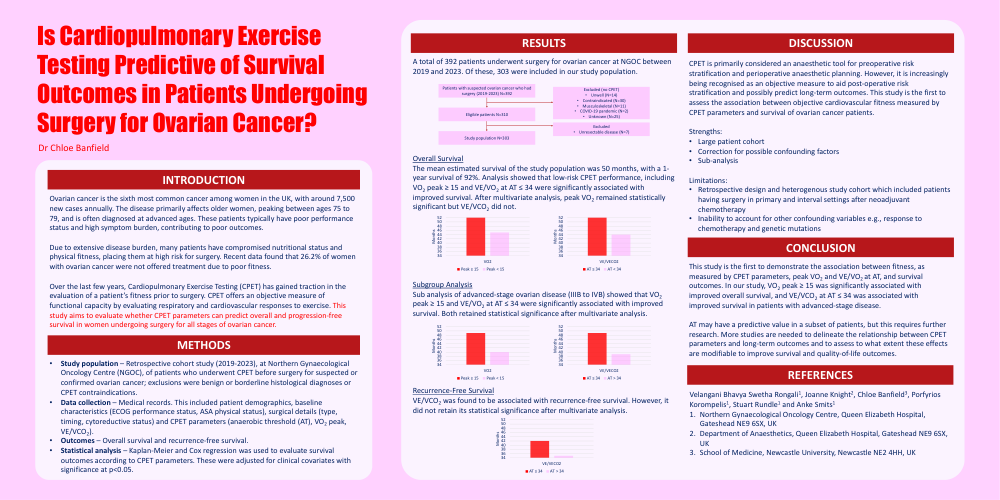
Is Cardiopulmonary Exercise Testing Predictive of Survival Outcomes in Patients Undergoing Surgery for Ovarian Cancer?
Ovarian cancer is the sixth most common cancer among women in the UK, with around 7,500 new cases annually. The disease primarily affects older women, peaking between ages 75 to 79, and is often diagnosed at advanced ages. These patients typically have poor performance status and high symptom burden, contributing to poor outcomes.
Due to extensive disease burden, many patients have compromised nutritional status and physical fitness, placing them at high risk for surgery. Recent data found that 26.2% of women with ovarian cancer were not offered treatment due to poor fitness.
Over the last few years, Cardiopulmonary Exercise Testing (CPET) has gained traction in the evaluation of a patient’s fitness prior to surgery. CPET offers an objective measure of functional capacity by evaluating respiratory and cardiovascular responses to exercise. This study aims to evaluate whether CPET parameters can predict overall and progression-free survival in women undergoing surgery for all stages of ovarian cancer.
A total of 392 patients underwent surgery for ovarian cancer at NGOC between 2019 and 2023. Of these, 303 were included in our study population.
Overall Survival
The mean estimated survival of the study population was 50 months, with a 1-year survival of 92%. Analysis showed that low-risk CPET performance, including VO2 peak ≥ 15 and VE/VO2 at AT ≤ 34 were significantly associated with improved survival. After multivariate analysis, peak VO2 remained statistically significant but VE/VCO2 did not.
Subgroup Analysis
Sub analysis of advanced-stage ovarian disease (IIIB to IVB) showed that VO2 peak ≥ 15 and VE/VO2 at AT ≤ 34 were significantly associated with improved survival. Both retained statistical significance after multivariate analysis.
Recurrence-Free Survival
VE/VCO2 was found to be associated with recurrence-free survival. However, it did not retain its statistical significance after multivariate analysis.
CPET is primarily considered an anaesthetic tool for preoperative risk stratification and perioperative anaesthetic planning. However, it is increasingly being recognised as an objective measure to aid post-operative risk stratification and possibly predict long-term outcomes. This study is the first to assess the association between objective cardiovascular fitness measured by CPET parameters and survival of ovarian cancer patients.
Strengths:
Limitations:
This study is the first to demonstrate the association between fitness, as measured by CPET parameters, peak VO2 and VE/VO2 at AT, and survival outcomes. In our study, VO2 peak ≥ 15 was significantly associated with improved overall survival, and VE/VCO2 at AT ≤ 34 was associated with improved survival in patients with advanced-stage disease.
AT may have a predictive value in a subset of patients, but this requires further research. More studies are needed to delineate the relationship between CPET parameters and long-term outcomes and to assess to what extent these effects are modifiable to improve survival and quality-of-life outcomes.
Velangani Bhavya Swetha Rongali1, Joanne Knight2, Chloe Banfield3, Porfyrios Korompelis1, Stuart Rundle1 and Anke Smits1