2,281 posters, 63 videos, 56 audios, 43 topics, 18 sessions, 6,174 authors, 2,323 institutions
ePostersLive by SciGen Technologies S.A. All rights reserved.
RCOG World Congress 2025
June 23 - 25, 2025 | ExCeL London, UK
EP.0790
The Protective Role of Mirena IUS in Postmenopausal Bleeding: Polyps and Malignancy
Part of Topic
Gynaecological oncology
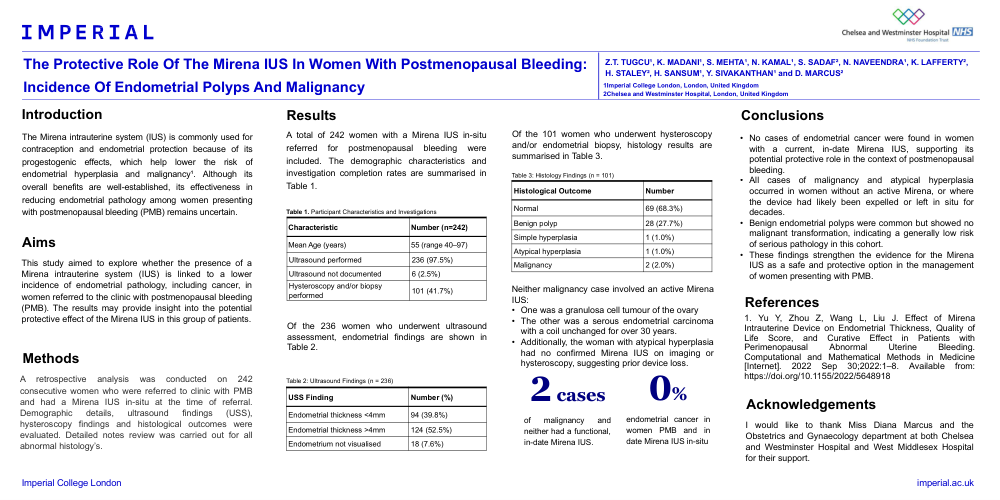
The Protective Role Of The Mirena IUS In Women With Postmenopausal Bleeding: Incidence Of Endometrial Polyps And Malignancy
Introduction
The Mirena intrauterine system (IUS) is commonly used for contraception and endometrial protection because of its progestogenic effects, which help lower the risk of endometrial hyperplasia and malignancy¹. Although its overall benefits are well-established, its effectiveness in reducing endometrial pathology among women presenting with postmenopausal bleeding (PMB) remains uncertain.
Aims
This study aimed to explore whether the presence of a Mirena intrauterine system (IUS) is linked to a lower incidence of endometrial pathology, including cancer, in women referred to the clinic with postmenopausal bleeding (PMB). The results may provide insight into the potential protective effect of the Mirena IUS in this group of patients.
Methods
A retrospective analysis was conducted on 242 consecutive women who were referred to clinic with PMB and had a Mirena IUS in-situ at the time of referral. Demographic details, ultrasound findings (USS), hysteroscopy findings and histological outcomes were evaluated. Detailed notes review was carried out for all abnormal histology’s.
Results
A total of 242 women with a Mirena IUS in-situ referred for postmenopausal bleeding were included. The demographic characteristics and investigation completion rates are summarised in Table 1.
Of the 236 women who underwent ultrasound assessment, endometrial findings are shown in Table 2.
Of the 101 women who underwent hysteroscopy and/or endometrial biopsy, histology results are summarised in Table 3.
Neither malignancy case involved an active Mirena IUS:
One was a granulosa cell tumour of the ovary
The other was a serous endometrial carcinoma with a coil unchanged for over 30 years.
Additionally, the woman with atypical hyperplasia had no confirmed Mirena IUS on imaging or hysteroscopy, suggesting prior device loss.
Conclusions
No cases of endometrial cancer were found in women with a current, in-date Mirena IUS, supporting its potential protective role in the context of postmenopausal bleeding.
All cases of malignancy and atypical hyperplasia occurred in women without an active Mirena, or where the device had likely been expelled or left in situ for decades.
Benign endometrial polyps were common but showed no malignant transformation, indicating a generally low risk of serious pathology in this cohort.
These findings strengthen the evidence for the Mirena IUS as a safe and protective option in the management of women presenting with PMB.
References
1. Yu Y, Zhou Z, Wang L, Liu J. Effect of Mirena Intrauterine Device on Endometrial Thickness, Quality of Life Score, and Curative Effect in Patients with Perimenopausal Abnormal Uterine Bleeding. Computational and Mathematical Methods in Medicine [Internet]. 2022 Sep 30;2022:1–8. Available from: https://doi.org/10.1155/2022/5648918
Acknowledgements
I would like to thank Miss Diana Marcus and the Obstetrics and Gynaecology department at both Chelsea and Westminster Hospital and West Middlesex Hospital for their support.