2,281 posters, 63 videos, 56 audios, 43 topics, 18 sessions, 6,174 authors, 2,323 institutions
ePostersLive by SciGen Technologies S.A. All rights reserved.
RCOG World Congress 2025
June 23 - 25, 2025 | ExCeL London, UK
EP.0781
A systematic review of routine measurements in ovarian cancer prediction models
Poster Presenter
Authors
Affiliations
Part of Topic
Gynaecological oncology
Audio
Introduction
•Ovarian cancer is one of the most common gynaecological cancers in women.
•Approximately 60% of cases are diagnosed at advanced stages (1).
•Due to its late diagnosis, the disease has a high rate of morbidity and mortality as well as a poor prognosis, with a 30% 5-year survival rate (2).
•Earlier detection of ovarian cancer is key in improving survival.
Aims
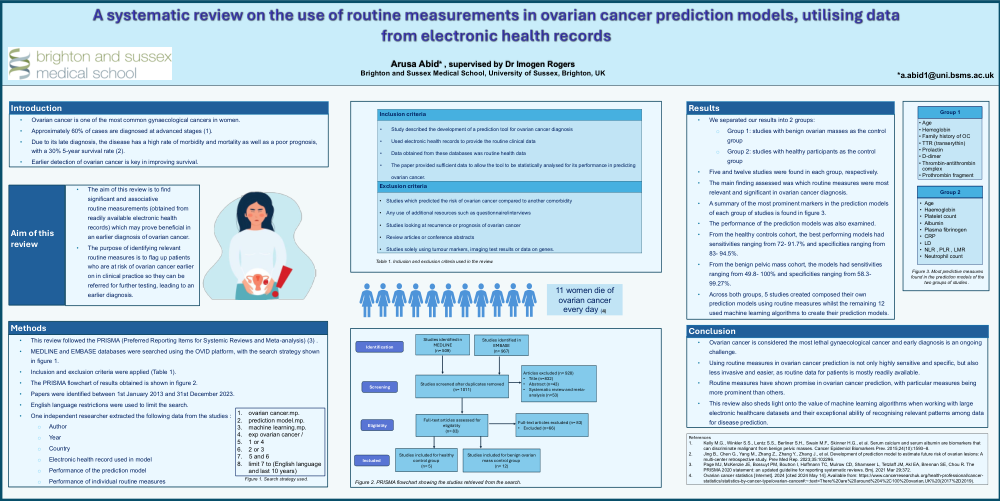
•The aim of this review is to find significant and associative routine measurements (obtained from readily available electronic health records) which may prove beneficial in an earlier diagnosis of ovarian cancer.
•The purpose of identifying relevant routine measures is to flag up patients who are at risk of ovarian cancer earlier on in clinical practice so they can be referred for further testing, leading to an earlier diagnosis.
Methods
•This review followed the PRISMA (Preferred Reporting Items for Systemic Reviews and Meta-analysis) (3) .
•MEDLINE and EMBASE databases were searched using the OVID platform, with the search strategy shown in figure 1.
•Inclusion and exclusion criteria were applied (Table 1).
•The PRISMA flowchart of results obtained is shown in figure 2.
•Papers were identified between 1st January 2013 and 31st December 2023.
•English language restrictions were used to limit the search.
•One independent researcher extracted the following data from the studies :
oAuthor
oYear
oCountry
oElectronic health record used in model
oPerformance of the prediction model
Performance of individual routine measures
Results
•We separated our results into 2 groups:
oGroup 1: studies with benign ovarian masses as the control group
oGroup 2: studies with healthy participants as the control group
•Five and twelve studies were found in each group, respectively.
•The main finding assessed was which routine measures were most relevant and significant in ovarian cancer diagnosis.
•A summary of the most prominent markers in the prediction models of each group of studies is found in figure 3.
•The performance of the prediction models was also examined.
•From the healthy controls cohort, the best performing models had sensitivities ranging from 72- 91.7% and specificities ranging from 83- 94.5%.
•From the benign pelvic mass cohort, the models had sensitivities ranging from 49.8- 100% and specificities ranging from 58.3- 99.27%.
•Across both groups, 5 studies created composed their own prediction models using routine measures whilst the remaining 12 used machine learning algorithms to create their prediction models.
Conclusion
•Ovarian cancer is considered the most lethal gynaecological cancer and early diagnosis is an ongoing challenge.
•Using routine measures in ovarian cancer prediction is not only highly sensitive and specific, but also less invasive and easier, as routine data for patients is mostly readily available.
•Routine measures have shown promise in ovarian cancer prediction, with particular measuresbeing more prominent than others.
•This review also sheds light onto the value of machine learning algorithms when working with large electronic healthcare datasets and their exceptional ability of recognising relevant patterns among data for disease prediction.