2,281 posters, 63 videos, 56 audios, 43 topics, 18 sessions, 6,174 authors, 2,323 institutions
ePostersLive by SciGen Technologies S.A. All rights reserved.
RCOG World Congress 2025
June 23 - 25, 2025 | ExCeL London, UK
EP.0779
Pathway To Prompt Care: Reviewing Gynaecological Cancer Referrals For Vulval Abnormalities
Poster Presenter
Part of Topic
Gynaecological oncology
Pathways to Prompt Care:
Reviewing Gynaecological Cancer Referrals for Vulval Abnormalities
Nusrat Kamal1, S Sadaf2, K Lafferty2, H Staley2, H Sansum1, Y Sivakanthan1, Z Tugce Tugcu1, N Naveendra1, K Madani1, S Mehta1, D Marcus2
1 Imperial College London, London, United Kingdom 2 Chelsea and Westminster Hospital, London, United Kingdom
Introduction
Vulval abnormalities describes any variation from the normal appearance, structure or function of the vulva. Conditions affecting the vulva include lichen sclerosis, lichen planus, vulval atrophy1, vulval intraepithelial neoplasms and vulval cancer2.
The United Kingdom (UK) has 1400 new cases of vulva cancer each year3. The incidence of vulva cancer is set to rise by 5% from 2023 to 20403.
In the UK, women with an unexplained vulval lump, ulceration or bleeding are referred to the 2 week-wait urgent suspected cancer pathway4. This pathway consists of a full history, examination and biopsy4.
Aim
The aim of the study was to assess the outcomes of those referred to the suspected cancer pathway with a vulval abnormality concerning for cancer.
Methods
310 patients were referred with a vulval abnormality, with 2.3% ultimately diagnosed with vulval cancer. Patients were aged 20-93 years old, with a median age of 59.
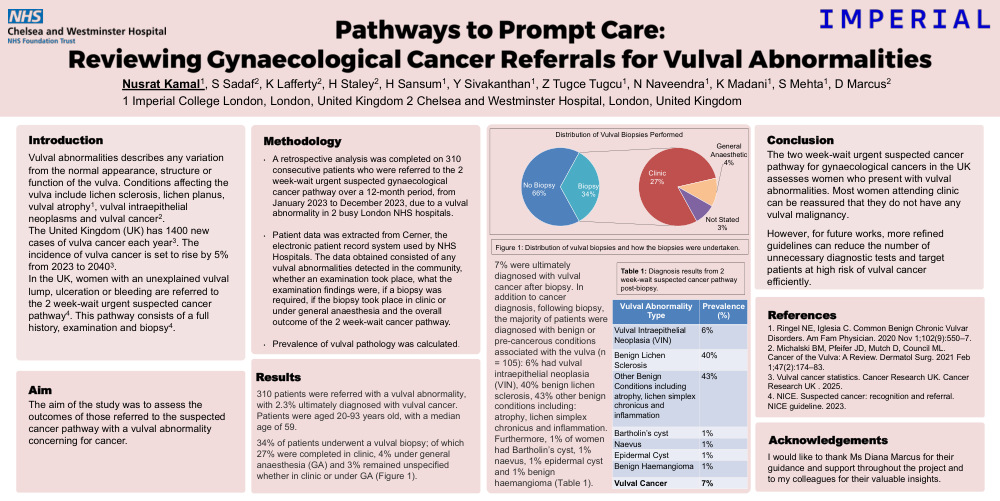
34% of patients underwent a vulval biopsy; of which 27% were completed in clinic, 4% under general anaesthesia (GA) and 3% remained unspecified whether in clinic or under GA (Figure 1).
7% were ultimately diagnosed with vulval cancer after biopsy. In addition to cancer diagnosis, following biopsy, the majority of patients were diagnosed with benign or pre-cancerous conditions associated with the vulva (n = 105): 6% had vulval intraepithelial neoplasia (VIN), 40% benign lichen sclerosis, 43% other benign conditions including: atrophy, lichen simplex chronicus and inflammation. Furthermore, 1% of women had Bartholin’s cyst, 1% naevus, 1% epidermal cyst and 1% benign haemangioma (Table 1).
The two week-wait urgent suspected cancer pathway for gynaecological cancers in the UK assesses women who present with vulval abnormalities. Most women attending clinic can be reassured that they do not have any vulval malignancy.
However, for future works, more refined guidelines can reduce the number of unnecessary diagnostic tests and target patients at high risk of vulval cancer efficiently.