2,281 posters, 63 videos, 56 audios, 43 topics, 18 sessions, 6,174 authors, 2,323 institutions
ePostersLive by SciGen Technologies S.A. All rights reserved.
RCOG World Congress 2025
June 23 - 25, 2025 | ExCeL London, UK
EP.0777
Retrospective Analysis of Elevated CA125 Levels: Findings from Suspected Ovarian Cancer Referrals
Part of Topic
Gynaecological oncology
Title: Retrospective Analysis of Elevated CA125: Findings from Suspected Ovarian Cancer Referrals
Background:
Ovarian cancer is the sixth most common cancer in UK women, with around 7,400 cases annually. CA125, a protein on ovarian cancer cells, is widely used in
primary care to evaluate women presenting with symptoms suggestive of ovarian cancer. While ≥ 35 U/mL was the threshold, it lacks specificity, as elevations can occur in various benign conditions. Recently, pan London referral criteria has been updated, CA125 threshold is now age dependent. Combining CA125 with
symptom scores improves diagnostic accuracy.
Objective:
This study aimed to evaluate the outcomes in patients referred with CA125 > 35 U/mL to identify diagnostic patterns and cancer prevalence.
Methods:
A retrospective analysis was conducted on 292 consecutive patients referred for suspected ovarian cancer with raised CA125 levels over 12 months in a busy
London NHS trust. Data on demographics, referral sources, symptoms, imaging, and final outcomes were collected.
Results:
4,872 patients were urgently referred for suspected gynecological malignancies over a 12-month period at two busy London NHS hospitals. Of these, 292
referrals were for raised Ca125 (6% of all referrals). The age range was 21–97 years (median=48). Of these, 157 were premenopausal, 112 postmenopausal,
and 22 perimenopausal. Abdominal pain (n=100), bloating (n=85), and postmenopausal bleeding (n=14) were common associated symptoms.
A total of 243 patients (83%) had benign conditions managed without surgery, including endometriosis (n=22), adenomyosis (n=8), pelvic inflammatory disease (n=3), and dermoid cysts (n=3). 16/292 patients underwent surgery for benign pathologies.
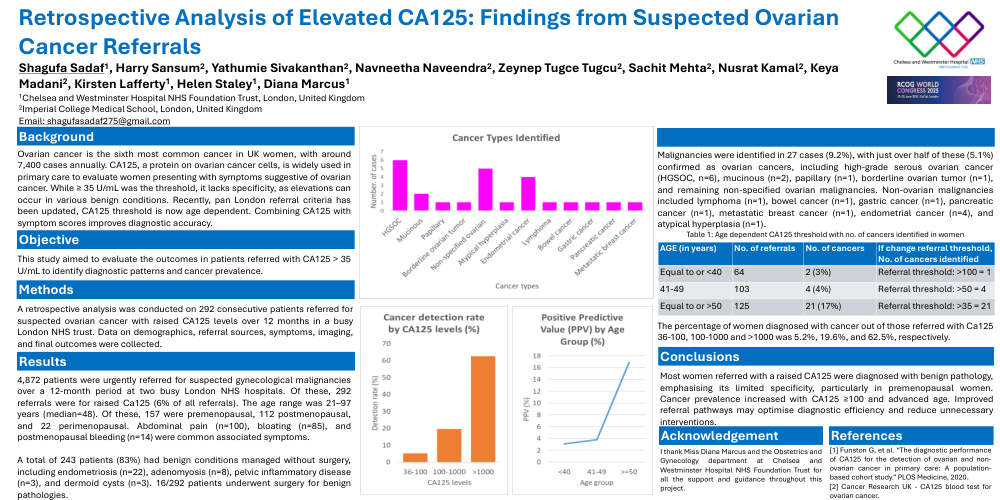
Malignancies were identified in 27 cases (9.2%), with just over half of these (5.1%) confirmed as ovarian cancers, including high-grade serous ovarian cancer (HGSOC, n=6), mucinous (n=2), papillary (n=1), borderline ovarian tumor (n=1), and remaining non-specified ovarian malignancies. Non-ovarian malignancies included lymphoma (n=1), bowel cancer (n=1), gastric cancer (n=1), pancreatic cancer (n=1), metastatic breast cancer (n=1), endometrial cancer (n=4), and atypical hyperplasia (n=1).
The percentage of women diagnosed with cancer out of those referred with Ca125 36-100, 100-1000 and >1000 was 5.2%, 19.6%, and 62.5%, respectively.
Conclusion:
Most women referred with a raised CA125 were diagnosed with benign pathology, emphasising its limited specificity, particularly in premenopausal women.
Cancer prevalence increased with CA125 ≥100 and advanced age. Improved referral pathways may optimise diagnostic efficiency and reduce unnecessary
interventions.