2,281 posters, 63 videos, 56 audios, 43 topics, 18 sessions, 6,174 authors, 2,323 institutions
ePostersLive by SciGen Technologies S.A. All rights reserved.
RCOG World Congress 2025
June 23 - 25, 2025 | ExCeL London, UK
EP.0768
A case report of paraneoplastic encephalitis secondary to endometrial endometroid adenocarcinoma
Poster Presenter
Authors
Affiliations
Part of Topic
Gynaecological oncology
Case
A previously independent 78-year-old was found in her house by her neighbour, confused and soiled. She was admitted to hospital and underwent infective screening including LP, CT & MRI scans of her abdomen and brain, EEG & autoimmune screening. She continued to deteriorate with worsening confusion amd limited mobility. A diagnosis of seronegative encephalitis was made with positive NMDA receptor antibodies however no source was able to be identified.
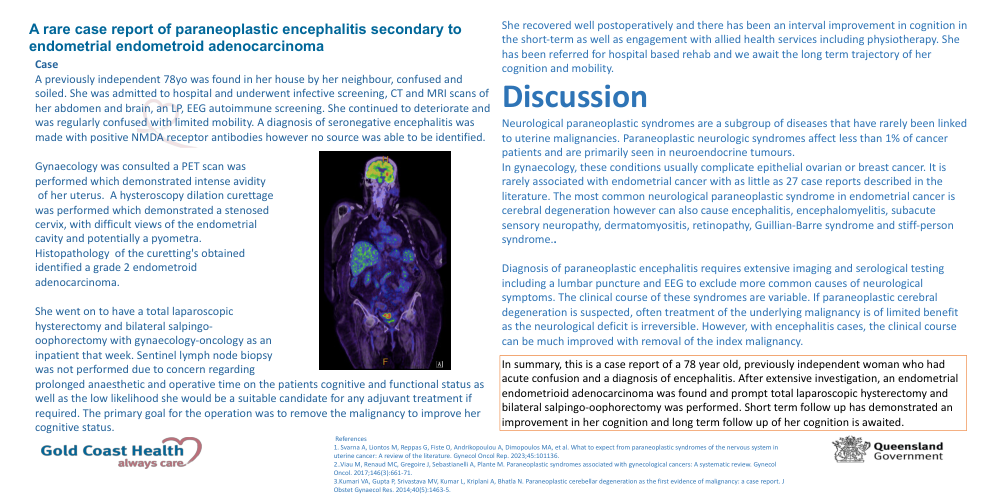
Gynaecology was consulted after a PET scan demonstrated intense avidity of her uterus. A hysteroscopy dilation curettage was performed which demonstrated a stenosed cervix, with difficult views of the endometrial cavity and potentially a pyometra.
Histopathology of the curetting's obtained identified a grade 2 endometroid adenocarcinoma.
She went on to have a total laparoscopic hysterectomy and bilateral salpingo-oophorectomy with gynaecology-oncology as an inpatient that week. Sentinel lymph node biopsy was not performed due to concern regarding prolonged anaesthetic and operative time on the patients cognitive and functional status as well as the low likelihood she would be a suitable candidate for any adjuvant treatment if required. The primary goal for the operation was to remove the malignancy to improve her cognitive function.
She recovered well postoperatively and there has been an interval improvement in cognition in the short-term as well as engagement with allied health services including physiotherapy. She has been referred for hospital based rehab and we await the long term trajectory of her cognition and mobility.
Discussion
Neurological paraneoplastic syndromes are a subgroup of diseases that have rarely been linked to uterine malignancies. Paraneoplastic neurologic syndromes affect less than 1% of cancer patients and are primarily seen in neuroendocrine tumours.
In gynaecology, these conditions usually complicate epithelial ovarian or breast cancer. It is rarely associated with endometrial cancer with as little as 27 case reports described in the literature. The most common neurological paraneoplastic syndrome in endometrial cancer is cerebral degeneration however can also cause encephalitis, encephalomyelitis, subacute sensory neuropathy, dermatomyositis, retinopathy, Guillian-Barre syndrome and stiff-person syndrome..
Diagnosis of paraneoplastic encephalitis requires extensive imaging and serological testing including a lumbar puncture and EEG to exclude more common causes of neurological symptoms. The clinical course of these syndromes are variable. If paraneoplastic cerebral degeneration is suspected, often treatment of the underlying malignancy is of limited benefit as the neurological deficit is irreversible. However, with encephalitis cases, the clinical course can be much improved with removal of the index malignancy.
In summary, this is a case report of a 78 year old, previously independent woman who had acute confusion and a diagnosis of encephalitis. After extensive investigation, an endometrial endometrioid adenocarcinoma was found and prompt total laparoscopic hysterectomy and bilateral salpingo-oophorectomy was performed. Short term follow up has demonstrated an improvement in her cognition and long term follow up of her cognition is awaited.