2,281 posters, 63 videos, 56 audios, 43 topics, 18 sessions, 6,174 authors, 2,323 institutions
ePostersLive by SciGen Technologies S.A. All rights reserved.
RCOG World Congress 2025
June 23 - 25, 2025 | ExCeL London, UK
EP.0763
A Rare Case of Primary Vaginal Cancer
Poster Presenter
Authors
Affiliations
Part of Topic
Gynaecological oncology
Abstract:
Primary vaginal cancer is rare, comprising 1-2% of all gynecological cancers because most lesions are metastatic and closely associated with HPV infection. We report a case of poorly differentiated posterior vaginal wall Squamous Cell Carcinoma (SCC) which largely remained asymptomatic thus documenting diagnostic challenges.
Objective:To identify and diagnose the rare case of Primary Vaginal Cancer
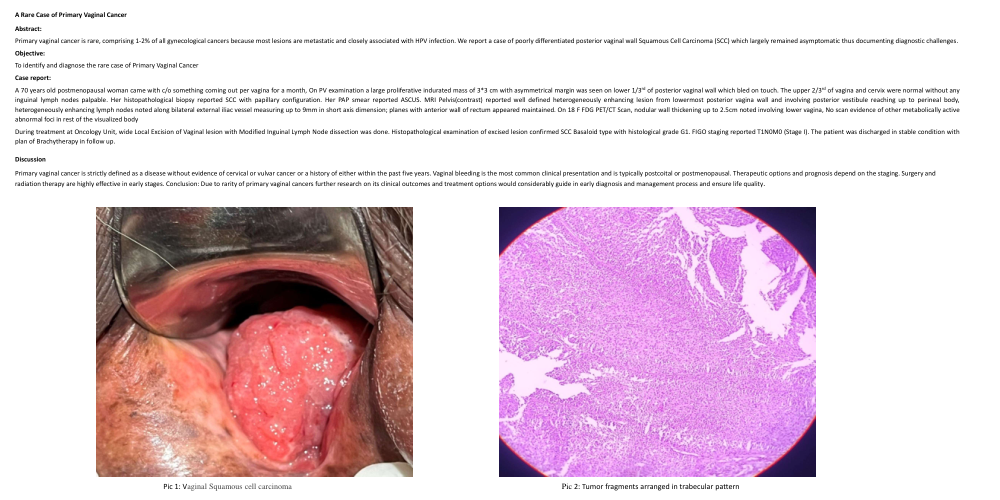
Case report:A 70 years old postmenopausal woman came with c/o something coming out per vagina for a month, On PV examination a large proliferative indurated mass of 3*3 cm with asymmetrical margin was seen on lower 1/3rd of posterior vaginal wall which bled on touch. The upper 2/3rd of vagina and cervix were normal without any inguinal lymph nodes palpable. Her histopathological biopsy reported SCC with papillary configuration. Her PAP smear reported ASCUS. MRI Pelvis(contrast) reported well defined heterogeneously enhancing lesion from lowermost posterior vagina wall and involving posterior vestibule reaching upto perineal body, heterogeneously enhancing lymph nodes noted along bilateral external iliac vessel measuring upto 9mm in short axis dimension; planes with anterior wall of rectum appeared maintained. On 18 F FDG PET/CT Scan, nodular wall thickening upto 2.5cm noted involving lower vagina, No scan evidence of other metabolically active abnormal foci in rest of the visualized body
During treatment at Oncology Unit, wide Local Excision of Vaginal lesion with Modified Inguinal Lymph Node dissection was done. Histopathological examination of excised lesion confirmed SCC Basaloid type with histological grade G1. FIGO staging reported T1N0M0 (Stage I). The patient was discharged in stable condition with plan of Brachytherapy in followup.
Discussion: Primary vaginal cancer is strictly defined as a disease without evidence of cervical or vulvar cancer or a history of either within the past five years. Vaginal bleeding is the most common clinical presentation and is typically postcoital or postmenopausal. Therapeutic options and prognosis depend on the staging. Surgery and radiation therapy are highly effective in early stages.
Conclusion: Due to rarity of primary vaginal cancers further research on its clinical outcomes and treatment options would considerably guide in early diagnosis and management process and ensure life quality.