2,281 posters, 63 videos, 56 audios, 43 topics, 18 sessions, 6,174 authors, 2,323 institutions
ePostersLive by SciGen Technologies S.A. All rights reserved.
RCOG World Congress 2025
June 23 - 25, 2025 | ExCeL London, UK
EP.0762
A case report of a recurrent vulval cancer
Poster Presenter
Authors
Affiliations
Part of Topic
Gynaecological oncology
A case of a recurrent vulval cancer
Authors: Dr.Aljubori, Miss Astbury , Dr. Peacock
Objective
The aim of this case report is to increase the awareness of this condition among patients, doctors and media which requires urgent referral through cancer pathway.
Case Report
A 93-year- old, Para 3 (vaginal birth) who lives in care home, seen in Gynae-One stop clinic as regular GP’s referral (6 months) for sore vulval lesion. She has some medical issues; limited mobility, urine and faecal incontinence and confusion (on regular morphine). History of previous vulvectomy with lymph node (LN) resection for squamous cell cancer ( SCC) in 2015, Five years regular follow up was uneventful (completed in October 2020). Previous cervical smears all normal. Examination revealed a 3x5cm painful irregular hard cauliflower mass on left vulva with huge right femoral hernia.
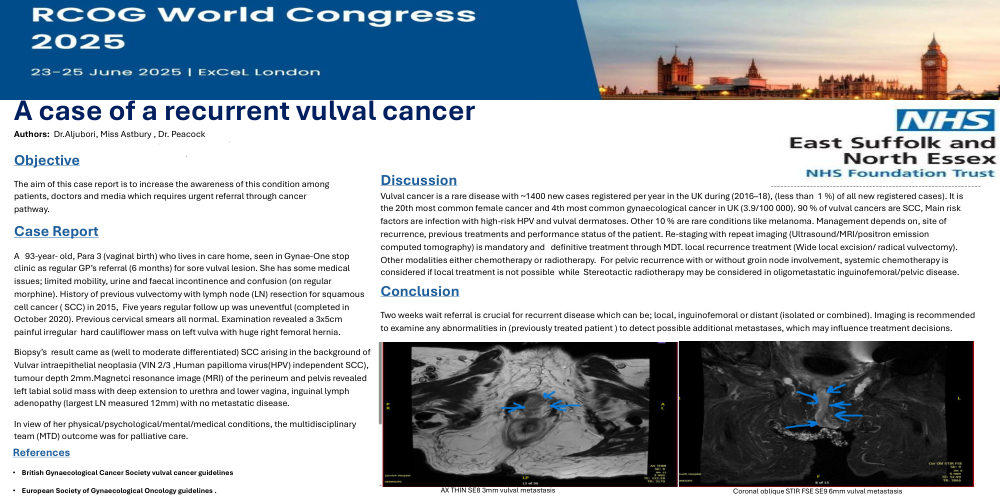
Biopsy’s result came as (well to moderate differentiated) SCC arising in the background of Vulvar intraepithelial neoplasia (VIN 2/3 ,Human papilloma virus(HPV) independent SCC), tumour depth 2mm.Magnetci resonance image (MRI) of the perineum and pelvis revealed left labial solid mass with deep extension to urethra and lower vagina, inguinal lymph adenopathy (largest LN measured 12mm) with no metastatic disease.
In view of her physical/psychological/mental/medical conditions, the multidisciplinary team (MTD) outcome was for palliative care.
References
Discussion
Vulval cancer is a rare disease with ~1400 new cases registered per year in the UK during (2016–18), (less than 1 %) of all new registered cases). It is the 20th most common female cancer and 4th most common gynaecological cancer in UK (3.9/100 000). 90 % of vulval cancers are SCC, Main risk factors are infection with high-risk HPV and vulval dermatoses. Other 10 % are rare conditions like melanoma. Management depends on, site of recurrence, previous treatments and performance status of the patient. Re-staging with repeat imaging (Ultrasound/MRI/positron emission computed tomography) is mandatory and definitive treatment through MDT. local recurrence treatment (Wide local excision/ radical vulvectomy). Other modalities either chemotherapy or radiotherapy. For pelvic recurrence with or without groin node involvement, systemic chemotherapy is considered if local treatment is not possible while Stereotactic radiotherapy may be considered in oligometastatic inguinofemoral/pelvic disease.
Conclusion
Two weeks wait referral is crucial for recurrent disease which can be; local, inguinofemoral or distant (isolated or combined). Imaging is recommended to examine any abnormalities in (previously treated patient ) to detect possible additional metastases, which may influence treatment decisions.