2,281 posters, 63 videos, 56 audios, 43 topics, 18 sessions, 6,174 authors, 2,323 institutions
ePostersLive by SciGen Technologies S.A. All rights reserved.
RCOG World Congress 2025
June 23 - 25, 2025 | ExCeL London, UK
EP.0754
Audit exploring adherence to guidelines for those referred with suspected endometrial cancer
Poster Presenter
Authors
Samah Ballal, Urooj Mahboob, Samantha Winton, Kapilmeet Kaur
Affiliations
Part of Topic
Gynaecological oncology
Audit exploring adherence to guidelines for those referred with suspected endometrial cancer
Objective
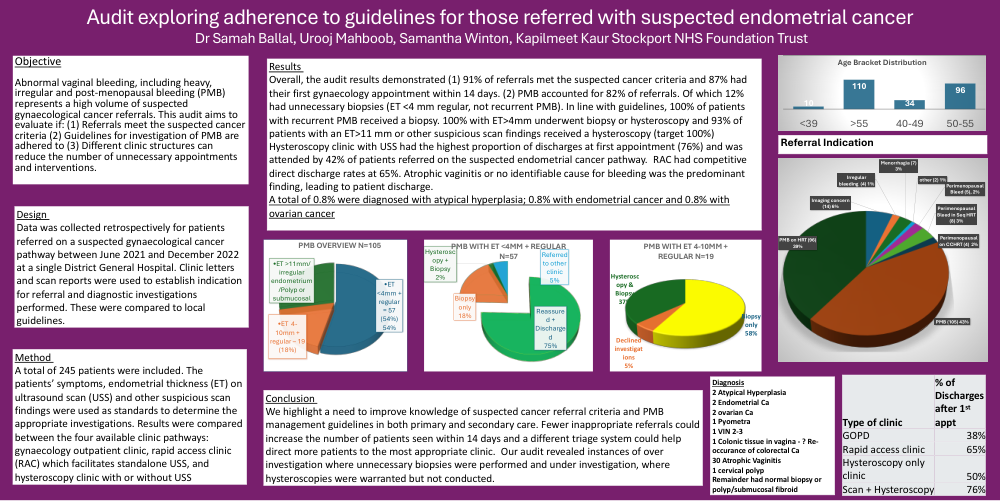
Abnormal vaginal bleeding, including heavy, irregular and post-menopausal bleeding (PMB) represents a high volume of suspected gynaecological cancer referrals. This audit aims to evaluate if: (1) Referrals meet the suspected cancer criteria (2) Guidelines for investigation of PMB are adhered to (3) Different clinic structures can reduce the number of unnecessary appointments and interventions.
Design
Data was collected retrospectively for patients referred on a suspected gynaecological cancer pathway between June 2021 and December 2022 at a single District General Hospital. Clinic letters and scan reports were used to establish indication for referral and diagnostic investigations performed. These were compared to local guidelines.
Method
A total of 245 patients were included. The patients’ symptoms, endometrial thickness (ET) on ultrasound scan (USS) and other suspicious scan findings were used as standards to determine the appropriate investigations. Results were compared between the four available clinic pathways: gynaecology outpatient clinic, rapid access clinic (RAC) which facilitates standalone USS, and hysteroscopy clinic with or without USS
Results
Overall, the audit results demonstrated (1) 91% of referrals met the suspected cancer criteria and 87% had their first gynaecology appointment within 14 days. (2) PMB accounted for 82% of referrals. Of which 12% had unnecessary biopsies (ET <4 mm regular, not recurrent PMB). In line with guidelines, 100% of patients with recurrent PMB received a biopsy. 100% with ET>4mm underwent biopsy or hysteroscopy and 93% of patients with an ET>11 mm or other suspicious scan findings received a hysteroscopy (target 100%)
Hysteroscopy clinic with USS had the highest proportion of discharges at first appointment (76%) and was attended by 42% of patients referred on the suspected endometrial cancer pathway. RAC had competitive direct discharge rates at 65%. Atrophic vaginitis or no identifiable cause for bleeding was the predominant finding, leading to patient discharge.
A total of 0.8% were diagnosed with atypical hyperplasia; 0.8% with endometrial cancer and 0.8% with ovarian cancer
Conclusion
We highlight a need to improve knowledge of suspected cancer referral criteria and PMB management guidelines in both primary and secondary care. Fewer inappropriate referrals could increase the number of patients seen within 14 days and a different triage system could help direct more patients to the most appropriate clinic. Our audit revealed instances of over investigation where unnecessary biopsies were performed and under investigation, where hysteroscopies were warranted but not conducted.
Diagnosis
2 Atypical Hyperplasia
2 Endometrial Ca
2 ovarian Ca
1 Pyometra
1 VIN 2-3
1 Colonic tissue in vagina - ? Re-occurance of colorectal Ca
30 Atrophic Vaginitis
1 cervical polyp
Remainder had normal biopsy or polyp/submucosal fibroid