2,281 posters, 63 videos, 56 audios, 43 topics, 18 sessions, 6,174 authors, 2,323 institutions
ePostersLive by SciGen Technologies S.A. All rights reserved.
RCOG World Congress 2025
June 23 - 25, 2025 | ExCeL London, UK
EP.0749
Rare-case of Primary Fallopian-Tube Carcinoma Masquerading as Chronic-PID : A Diagnostic Conundrum
Part of Topic
Gynaecological oncology
A Rare Case of Primary Fallopian Tube Carcinoma masquerading As Chronic PID : A Diagnostic Conundrum
Background: Primary fallopian tube carcinoma is a rare malignancy accounting for less than .1% of genital cancer. Pre-operative diagnosis is difficult because the threshold for suspicion is not high, there are vague clinical symptoms and in the majority of cases, it mimics ovarian neoplasm or tubo-ovarian masses. Diagnosis is often intraoperative and by histopathology, with involvement of one or both fallopian tubes, and normal-looking ovaries and uterus. We encountered such a patient who was offered surgery for bilateral tubo-ovarian masses suggestive of chronic pelvic inflammatory disease, which later turned out to be primary fallopian tube malignancy, with no preoperative suggestion of cancer.
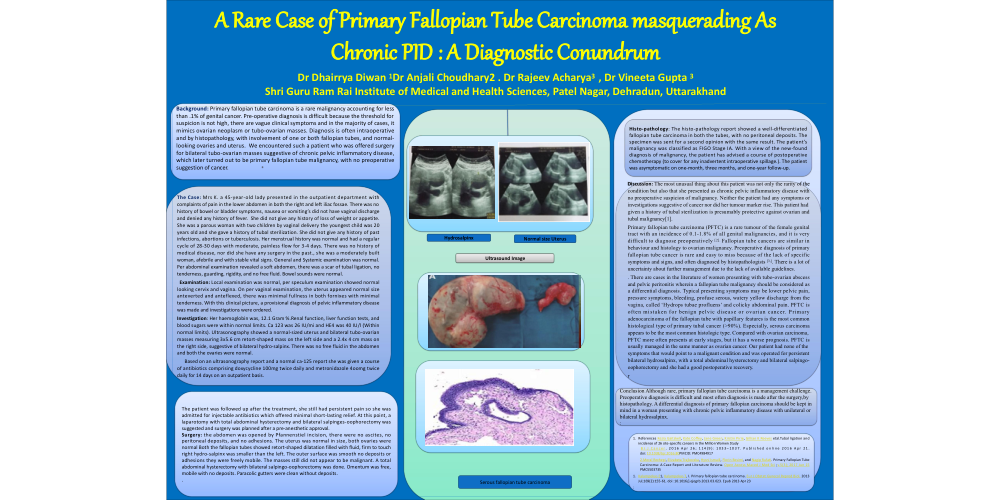
The Case: Mrs K. a 45-year-old lady presented in the outpatient department with complaints of pain in the lower abdomen in both the right and left iliac fossae. There was no history of bowel or bladder symptoms, nausea or vomiting’s did not have vaginal discharge and denied any history of fever. She did not give any history of loss of weight or appetite. She was a parous woman with two children by vaginal delivery the youngest child was 20 years old and she gave a history of tubal sterilization. She did not give any history of past infections, abortions or tuberculosis. Her menstrual history was normal and had a regular cycle of 28-30 days with moderate, painless flow for 3-4 days. There was no history of medical disease, nor did she have any surgery in the past., she was a moderately built woman, afebrile and with stable vital signs. General and Systemic examination was normal. Per abdominal examination revealed a soft abdomen, there was a scar of tubal ligation, no tenderness, guarding, rigidity, and no free fluid. Bowel sounds were normal. Examination: Local examination was normal, per speculum examination showed normal looking cervix and vagina. On per vaginal examination, the uterus appeared normal size anteverted and anteflexed, there was minimal fullness in both fornixes with minimal tenderness. With this clinical picture, a provisional diagnosis of pelvic inflammatory disease was made and investigations were ordered. Investigation: Her haemoglobin was, 12.1 Gram %.Renal function, liver function tests, and blood sugars were within normal limits. Ca 123 was 26 IU/mi and HE4 was 40 IU/l (Within normal limits). Ultrasonography showed a normal-sized uterus and bilateral tubo-ovarian masses measuring 3x5.6 cm retort-shaped mass on the left side and a 2.4x 4 cm mass on the right side, suggestive of bilateral hydro-salpinx. There was no free fluid in the abdomen and both the ovaries were normal. Based on an ultrasonography report and a normal ca-125 report she was given a course of antibiotics comprising doxycycline 100mg twice daily and metronidazole 4oomg twice daily for 14 days on an outpatient basis.
The Case: Mrs K. a 45-year-old lady presented in the outpatient department with complaints of pain in the lower abdomen in both the right and left iliac fossae. There was no history of bowel or bladder symptoms, nausea or vomiting’s did not have vaginal discharge and denied any history of fever. She did not give any history of loss of weight or appetite. She was a parous woman with two children by vaginal delivery the youngest child was 20 years old and she gave a history of tubal sterilization. She did not give any history of past infections, abortions or tuberculosis. Her menstrual history was normal and had a regular cycle of 28-30 days with moderate, painless flow for 3-4 days. There was no history of medical disease, nor did she have any surgery in the past., she was a moderately built woman, afebrile and with stable vital signs. General and Systemic examination was normal. Per abdominal examination revealed a soft abdomen, there was a scar of tubal ligation, no tenderness, guarding, rigidity, and no free fluid. Bowel sounds were normal. Examination: Local examination was normal, per speculum examination showed normal looking cervix and vagina. On per vaginal examination, the uterus appeared normal size anteverted and anteflexed, there was minimal fullness in both fornixes with minimal tenderness. With this clinical picture, a provisional diagnosis of pelvic inflammatory disease was made and investigations were ordered. Investigation: Her haemoglobin was, 12.1 Gram %.Renal function, liver function tests, and blood sugars were within normal limits. Ca 123 was 26 IU/mi and HE4 was 40 IU/l (Within normal limits). Ultrasonography showed a normal-sized uterus and bilateral tubo-ovarian masses measuring 3x5.6 cm retort-shaped mass on the left side and a 2.4x 4 cm mass on the right side, suggestive of bilateral hydro-salpinx. There was no free fluid in the abdomen and both the ovaries were normal. Based on an ultrasonography report and a normal ca-125 report she was given a course of antibiotics comprising doxycycline 100mg twice daily and metronidazole 4oomg twice daily for 14 days on an outpatient basis.
Histo-pathology: The histo-pathology report showed a well-differentiated fallopian tube carcinoma in both the tubes, with no peritoneal deposits. The specimen was sent for a second opinion with the same result. The patient’s malignancy was classified as FIGO Stage IA. With a view of the new-found diagnosis of malignancy, the patient has advised a course of postoperative chemotherapy (to cover for any inadvertent intraoperative spillage.). The patient was asymptomatic on one-month, three months, and one-year follow-up.
Discussion: The most unusual thing about this patient was not only the rarity of the condition but also that she presented as chronic pelvic inflammatory disease with no preoperative suspicion of malignancy. Neither the patient had any symptoms or investigations suggestive of cancer nor did her tumour marker rise. This patient had given a history of tubal sterilization is presumably protective against ovarian and tubal malignancy[1]. Primary fallopian tube carcinoma (PFTC) is a rare tumour of the female genital tract with an incidence of 0.1-1.8% of all genital malignancies, and it is very difficult to diagnose preoperatively [2]. Fallopian tube cancers are similar in behaviour and histology to ovarian malignancy. Preoperative diagnosis of primary fallopian tube cancer is rare and easy to miss because of the lack of specific symptoms and signs, and often diagnosed by histopathologists [3,]. There is a lot of uncertainty about further management due to the lack of available guidelines. . There are cases in the literature of women presenting with tubo-ovarian abscess and pelvic peritonitis wherein a fallopian tube malignancy should be considered as a differential diagnosis. Typical presenting symptoms may be lower pelvic pain, pressure symptoms, bleeding, profuse serous, watery yellow discharge from the vagina, called ‘Hydrops tubae profluens’ and colicky abdominal pain. PFTC is often mistaken for benign pelvic disease or ovarian cancer. Primary adenocarcinoma of the fallopian tube with papillary features is the most common histological type of primary tubal cancer (>90%). Especially, serous carcinoma appears to be the most common histologic type. Compared with ovarian carcinoma, PFTC more often presents at early stages, but it has a worse prognosis. PFTC is usually managed in the same manner as ovarian cancer. Our patient had none of the symptoms that would point to a malignant condition and was operated for persistent bilateral hydrosalpinx, with a total abdominal hysterectomy and bilateral salpingo-oophorectomy and she had a good postoperative recovery.