2,281 posters, 63 videos, 56 audios, 43 topics, 18 sessions, 6,174 authors, 2,323 institutions
ePostersLive by SciGen Technologies S.A. All rights reserved.
RCOG World Congress 2025
June 23 - 25, 2025 | ExCeL London, UK
EP.0747
Assessing RMI1 Score Performance in Diagnosing Malignant Ovarian Tumors
Poster Presenter
Part of Topic
Gynaecological oncology
Introduction:
The diagnosis of ovarian cancer is often established at an advanced stage of disease progression, due to the absence of a universal screening method. The Risk of Malignancy Index 1 (RMI1) is a scoring system used to predict the likelihood of malignancy in suspected ovarian masses. The objective of our study was to evaluate the performance of the RMI1 score in assessing the risk of malignancy in suspected ovarian masses managed in our department.
Methods:
This was a descriptive, longitudinal, retrospective, and monocentric study conducted in the Gynecology and Obstetrics Department of the Maternity Center of Tunis. The study spanned a period of three years, from January 2019 to December 2021, and included women who underwent surgery for suspected ovarian masses meeting the criteria for suspicion. A total of 88 patients were included in the study. Women lost to follow-up were excluded.
Results :
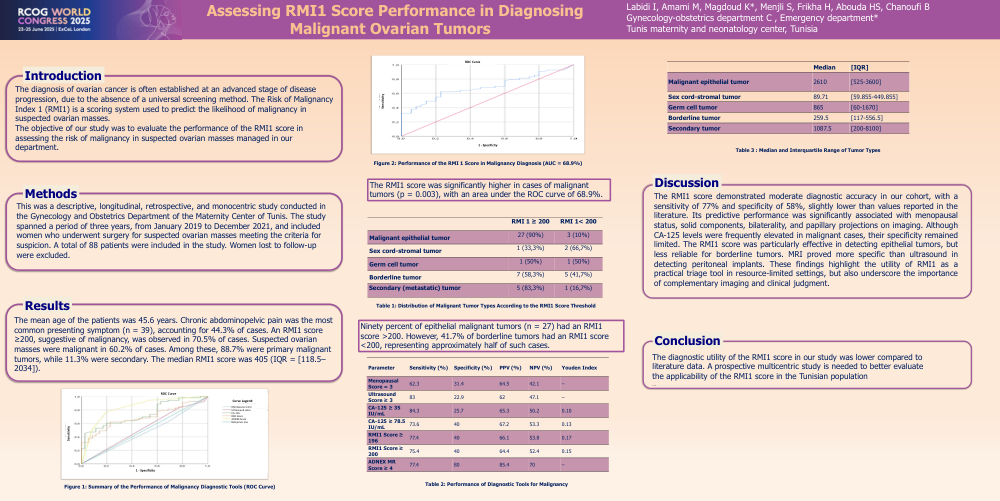
The mean age of the patients was 45.6 years. Chronic abdominopelvic pain was the most common presenting symptom (n = 39), accounting for 44.3% of cases. An RMI1 score ≥200, suggestive of malignancy, was observed in 70.5% of cases. Suspected ovarian masses were malignant in 60.2% of cases. Among these, 88.7% were primary malignant tumors, while 11.3% were secondary. The median RMI1 score was 405 (IQR = [118.5 2034]). The RMI1 score was significantly higher in cases of malignant tumors (p = 0.003), with an area under the ROC curve of 68.9%. Ninety percent of epithelial malignant tumors (n = 27) had an RMI1 score >200. However, 41.7% of borderline tumors had an RMI1 score <200, representing approximately half of such cases.
Discussion:
The RMI1 score demonstrated moderate diagnostic accuracy in our cohort,with a sensitivity of 77% and specificity of 58%, slightly lower than values reported in the literature. Its predictive performance was significantly associated with menopausal status,solid components, bilaterality, and papillary projections on imaging. Although CA-125 levels were frequently elevated in malignant cases, their specificity remained limited.The RMI1 score was particularly effective indetecting epithelial tumors,but less reliable for borderline tumors. MRI proved more specific than ultrasound in detecting peritoneal implants. These findings highlight the utility of RMI1 as a practical triagetool inresource-limited settings, but also under score the importance of complementary imaging and clinical judgment.
Conclusion:
The diagnostic utility of the RMI1 score in our study was lower compared to literature data. A prospective multicentric study is needed to better evaluate the applicability of the RMI1 score in the Tunisian population.