2,281 posters, 63 videos, 56 audios, 43 topics, 18 sessions, 6,174 authors, 2,323 institutions
ePostersLive by SciGen Technologies S.A. All rights reserved.
RCOG World Congress 2025
June 23 - 25, 2025 | ExCeL London, UK
EP.0745
Trends and Disparities in Cervical Cancer Mortality in the United States
Part of Topic
Gynaecological oncology
Trends and Disparities in Cervical Cancer Mortality in the United States
A. Fatima1, MDA.Shah2, J. Stratton1
1. Department of Obstetrics and Gynecology, University hospital Waterford Ireland
2. Department of Family Medicine, Western Michigan University, Kalamazoo, Michigan, USA
Objective: Despite progress in cervical cancer treatment, a substantial gap remains in understanding mortality rates in the United States. This study aims to improve evidence-based interventions by analyzing mortality trends from 1999 to 2020, with a focus on demographic factors such as age, race, and geographic region.
Design: This study conducted a retrospective analysis utilizing the CDC WONDER (Wide-ranging Online Data for Epidemiologic Research) database.
Method: We extracted data using ICD-10 codes C53 to identify cervical cancer-related deaths among women aged 15 years and older from 1999 to 2020. Demographic disparities in mortality rates over time were analyzed based on age, ethnicity, and geographic regions through systematic database analysis. Results are reported as age-adjusted mortality rates (AAMR) with 95% confidence intervals (CI), standardized to cervical cancer-related deaths in the United States in the year 2000.
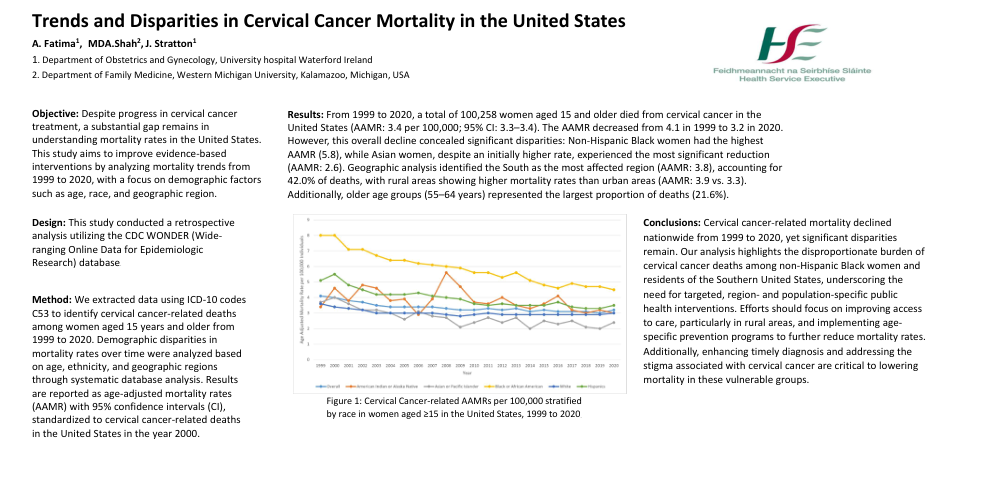
Results: From 1999 to 2020, a total of 100,258 women aged 15 and older died from cervical cancer in the United States (AAMR: 3.4 per 100,000; 95% CI: 3.3–3.4). The AAMR decreased from 4.1 in 1999 to 3.2 in 2020. However, this overall decline concealed significant disparities: Non-Hispanic Black women had the highest AAMR (5.8), while Asian women, despite an initially higher rate, experienced the most significant reduction (AAMR: 2.6). Geographic analysis identified the South as the most affected region (AAMR: 3.8), accounting for 42.0% of deaths, with rural areas showing higher mortality rates than urban areas (AAMR: 3.9 vs. 3.3). Additionally, older age groups (55–64 years) represented the largest proportion of deaths (21.6%).
Conclusions: Cervical cancer-related mortality declined nationwide from 1999 to 2020, yet significant disparities remain. Our analysis highlights the disproportionate burden of cervical cancer deaths among non-Hispanic Black women and residents of the Southern United States, underscoring the need for targeted, region- and population-specific public health interventions. Efforts should focus on improving access to care, particularly in rural areas, and implementing age-specific prevention programs to further reduce mortality rates. Additionally, enhancing timely diagnosis and addressing the stigma associated with cervical cancer are critical to lowering mortality in these vulnerable groups.