2,281 posters, 63 videos, 56 audios, 43 topics, 18 sessions, 6,174 authors, 2,323 institutions
ePostersLive by SciGen Technologies S.A. All rights reserved.
RCOG World Congress 2025
June 23 - 25, 2025 | ExCeL London, UK
EP.0744
Management of Borderline Ovarian Tumours: A comprehensive Review of Published Evidence
Poster Presenter
Authors
Kyriaki-Barbara Papalois, Samuel Oxley, Michail Sideris, Ranjit Manchanda
Affiliations
Oxford University Hospitals NHS Foundation Trust, Churchill Hospital Old Rd, Headington, Oxford OX3 7LE, Wolfson Institute of Population Health, Barts CRUK Cancer Centre, Queen Mary University of London, Charterhouse Square, London EC1M 6BQ, UK
Part of Topic
Gynaecological oncology
Management of Borderline Ovarian Tumours: A comprehensive Review of Published Evidence
Borderline Ovarian Tumours (BOTs) comprise 15-20% of all epithelial ovarian tumours. BOTs are characterised by increased mitotic activity but lack infiltrative destructive growth and stromal invasion (1). With an incidence of 1.8-4.8 per 100,000 they can affect one third of pre-menopausal women (2). The disease carries an excellent prognosis for the majority of patients albeit consensus regarding aspects of BOT management has not been reached.
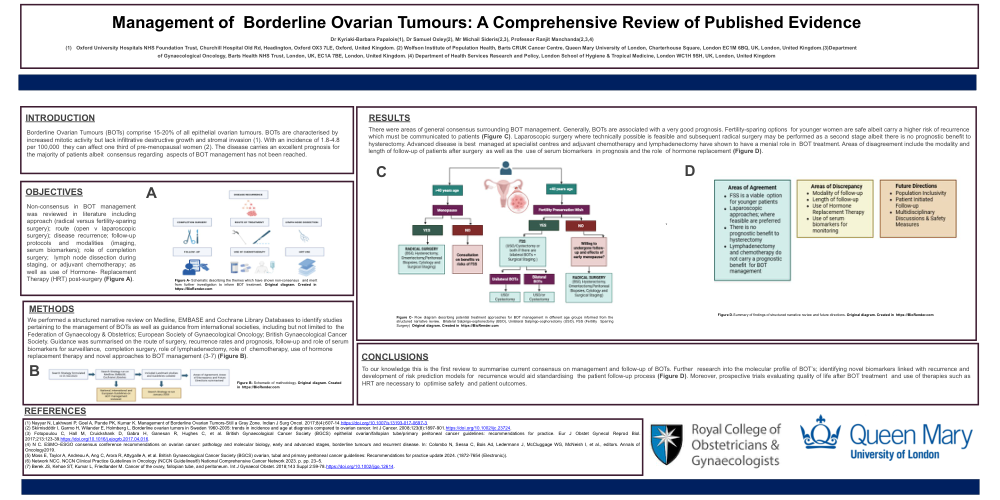
Non-consensus in BOT management was reviewed in literature including approach (radical versus fertility-sparing surgery); route (open v laparoscopic surgery); disease recurrence; follow-up protocols and modalities (imaging, serum biomarkers); role of completion surgery; lymph node dissection during staging, or adjuvant chemotherapy; as well as use of Hormone- Replacement Therapy (HRT) post-surgery (Figure A).
We performed a structured narrative review on Medline, EMBASE and Cochrane Library Databases to identify studies pertaining to the management of BOTs as well as guidance from international societies, including but not limited to the Federation of Gynaecology & Obstetrics; European Society of Gynaecological Oncology; British Gynaecological Cancer Society. Guidance was summarised on the route of surgery, recurrence rates and prognosis, follow-up and role of serum
biomarkers for surveillance, completion surgery, role of lymphadenectomy, role of chemotherapy, use of hormone replacement therapy and novel approaches to BOT management (3-7) (Figure B).
There were areas of general consensus surrounding BOT management. Generally, BOTs are associated with a very good prognosis. Fertility-sparing options for younger women are safe albeit carry a higher risk of recurrence which must be communicated to patients (Figure C).Laparoscopic surgery where technically possible is feasible and subsequent radical surgery may be performed as a second stage albeit there is no prognostic benefit to hysterectomy. Advanced disease is best managed at specialist centres and adjuvant chemotherapy and lymphadenectomy have shown to have a menial role in BOT treatment. Areas of disagreement include the modality and length of follow-up of patients after surgery as well as the use of serum biomarkers in prognosis and the role of hormone replacement (Figure D).
To our knowledge this is the first review to summarise current consensus on management and follow-up of BOTs. Further research into the molecular profile of BOT’s; identifying novel biomarkers linked with recurrence and development of risk prediction models for recurrence would aid standardising the patient follow-up process (Figure D).Moreover, prospective trials evaluating quality of life after BOT treatment and use of therapies such as HRT are necessary to optimise safety and patient outcomes.