2,281 posters, 63 videos, 56 audios, 43 topics, 18 sessions, 6,174 authors, 2,323 institutions
ePostersLive by SciGen Technologies S.A. All rights reserved.
RCOG World Congress 2025
June 23 - 25, 2025 | ExCeL London, UK
EP.0741
Chronic Pyometra in Postmenopausal Women: Successful Non-Surgical Management
Poster Presenter
Authors
Affiliations
Part of Topic
Gynaecological oncology
Chronic Pyometra in Postmenopausal Women: Successful Non-Surgical Management
The primary objective of this case report is to highlight the successful non-surgical management of pyometra in an 83-year-old postmenopausal woman using targeted antibiotic therapy.
Design:
This is a retrospective analysis of a single-patient case. The rationale for the adopted procedures was to explore conservative management options for pyometra in elderly postmenopausal women with comorbid conditions, aiming to avoid surgical intervention when possible.
Method:
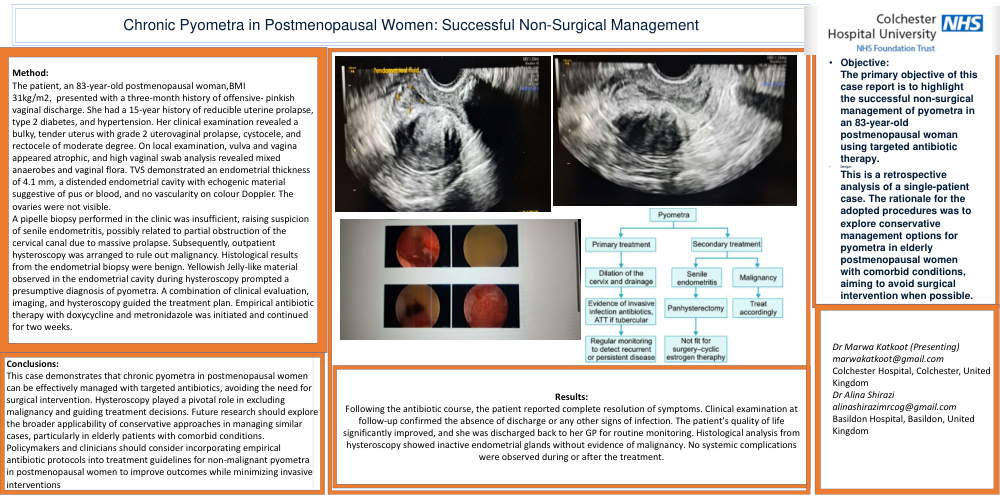
The patient, an 83-year-old postmenopausal woman,BMI 31kg/m2, presented with a three-month history of offensive- pinkish vaginal discharge. She had a 15-year history of reducible uterine prolapse, type 2 diabetes, and hypertension. Her clinical examination revealed a bulky, tender uterus with grade 2 uterovaginal prolapse, cystocele, and rectocele of moderate degree. On local examination, vulva and vagina appeared atrophic, and high vaginal swab analysis revealed mixed anaerobes and vaginal flora. TVS demonstrated an endometrial thickness of 4.1 mm, a distended endometrial cavity with echogenic material suggestive of pus or blood, and no vascularity on color Doppler. The ovaries were not visible.
A pipelle biopsy performed in the clinic was insufficient, raising suspicion of senile endometritis, possibly related to partial obstruction of the cervical canal due to massive prolapse. Subsequently, outpatient hysteroscopy was arranged to rule out malignancy. Histological results from the endometrial biopsy were benign. Yellowish Jelly-like material observed in the endometrial cavity during hysteroscopy prompted a presumptive diagnosis of pyometra. A combination of clinical evaluation, imaging, and hysteroscopy guided the treatment plan. Empirical antibiotic therapy with doxycycline and metronidazole was initiated and continued for two weeks.
Results:
Following the antibiotic course, the patient reported complete resolution of symptoms. Clinical examination at follow-up confirmed the absence of discharge or any other signs of infection. The patient’s quality of life significantly improved, and she was discharged back to her GP for routine monitoring. Histological analysis from hysteroscopy showed inactive endometrial glands without evidence of malignancy. No systemic complications were observed during or after the treatment.
Conclusions:
This case demonstrates that chronic pyometra in postmenopausal women can be effectively managed with targeted antibiotics, avoiding the need for surgical intervention. Hysteroscopy played a pivotal role in excluding malignancy and guiding treatment decisions. Future research should explore the broader applicability of conservative approaches in managing similar cases, particularly in elderly patients with comorbid conditions. Policymakers and clinicians should consider incorporating empirical antibiotic protocols into treatment guidelines for non-malignant pyometra in postmenopausal women to improve outcomes while minimizing invasive interventions .