2,281 posters, 63 videos, 56 audios, 43 topics, 18 sessions, 6,174 authors, 2,323 institutions
ePostersLive by SciGen Technologies S.A. All rights reserved.
RCOG World Congress 2025
June 23 - 25, 2025 | ExCeL London, UK
EP.0615
Puerperal Uterine Inversion turned chronic in a 19-year-old female: A Case Report
Part of Topic
General gynaecology
Puerperal Uterine Inversion Turned Chronic in a 19-year-old Patient: A Case Report
Prof. Dr. Kaweeta Kumari
Introduction
Uterine inversion - a rare, life- threatening obstetric emergency - typically results from third-stage labor mismanagement and can lead to fatal hemorrhage if untreated. Classified as acute (<24h), subacute (>24h), or chronic (>1 month post-delivery). Chronic cases occur more frequently in low-resource settings, where care delays worsen outcomes. Timely intervention and skilled management are crucial to prevent maternal mortality. A uterine inversion is rare, complicating about 1 in 2000 to 1 in 23,000 deliveries 1.
Case Presentation
This is a case of a 19-year-old Pakistani lady , para 1, who presented to the outpatient department at CGH with complaint of generalized weakness and shortness of breath. She had delivered a healthy baby girl at home eight months earlier, facilitated by an untrained birth attendant. During labor, excessive abdominal pressure and unnecessary traction on the umbilical cord were applied, leading to postpartum hemorrhage. Despite collapsing, she was managed conservatively at home without seeking hospital care. The patient experienced heavy & continuous vaginal bleeding for 8 months and developed symptoms of anemia, including fatigue.
Case Presentation Contd.
She presented to a public sector hospital where Initial evaluation revealed severe anemia (Hb: 3.5 g/dL), which was treated with blood transfusions, but the underlying condition remained undiagnosed. She was later referred to the gynecology department of our hospital where vaginal examination & examination under anesthesia revealed a round, firm, bleeding mass originating from the cervix, along with the absence of the uterine fundus. Ultrasonography confirmed chronic uterine inversion.
After stabilization, elective laparotomy was performed.
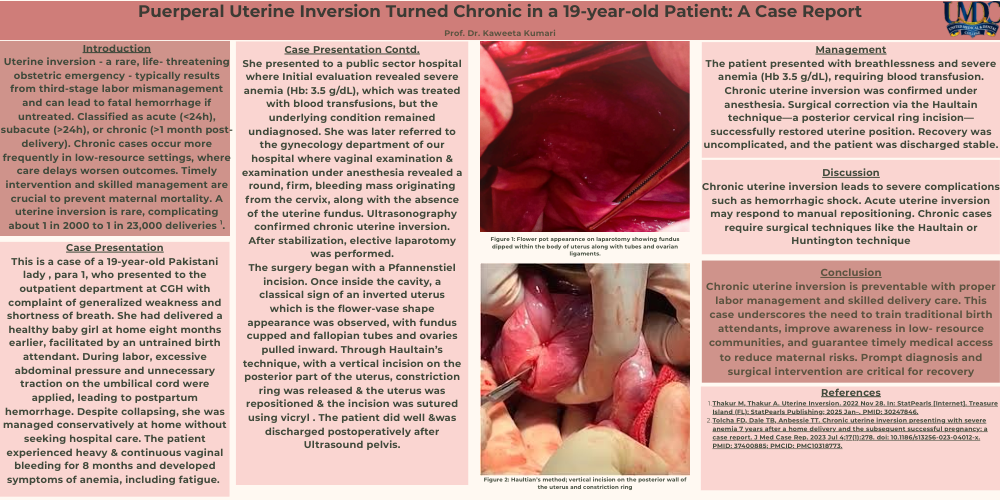
The surgery began with a Pfannenstiel incision. Once inside the cavity, a classical sign of an inverted uterus which is the flower-vase shape appearance was observed, with fundus cupped and fallopian tubes and ovaries pulled inward. Through Haultain’s technique, with a vertical incision on the posterior part of the uterus, constriction ring was released & the uterus was repositioned & the incision was sutured using vicryl . The patient did well &was discharged postoperatively after Ultrasound pelvis.
Figure 1: Flower pot appearance on laparotomy showing fundus dipped within the body of uterus along with tubes and ovarian ligaments.
Figure 2: Haultian’s method; vertical incision on the posterior wall of the uterus and constriction ring
Management
The patient presented with breathlessness and severe anemia (Hb 3.5 g/dL), requiring blood transfusion. Chronic uterine inversion was confirmed under anesthesia. Surgical correction via the Haultain technique—a posterior cervical ring incision—successfully restored uterine position. Recovery was uncomplicated, and the patient was discharged stable.
Discussion
Chronic uterine inversion leads to severe complications such as hemorrhagic shock. Acute uterine inversion may respond to manual repositioning. Chronic cases require surgical techniques like the Haultain or Huntington technique
Conclusion
Chronic uterine inversion is preventable with proper labor management and skilled delivery care. This case underscores the need to train traditional birth attendants, improve awareness in low- resource communities, and guarantee timely medical access to reduce maternal risks. Prompt diagnosis and surgical intervention are critical for recovery
References
- Thakur M, Thakur A. Uterine Inversion. 2022 Nov 28. In: StatPearls [Internet]. Treasure Island (FL): StatPearls Publishing; 2025 Jan–. PMID: 30247846.
- Tolcha FD, Dale TB, Anbessie TT. Chronic uterine inversion presenting with severe anemia 7 years after a home delivery and the subsequent successful pregnancy: a case report. J Med Case Rep. 2023 Jul 4;17(1):278. doi: 10.1186/s13256-023-04012-x. PMID: 37400885; PMCID: PMC10318773.