2,281 posters, 63 videos, 56 audios, 43 topics, 18 sessions, 6,174 authors, 2,323 institutions
ePostersLive by SciGen Technologies S.A. All rights reserved.
RCOG World Congress 2025
June 23 - 25, 2025 | ExCeL London, UK
EP.0613
Tranexamic acid related bilateral pulmonary emboli : A case Report
Poster Presenter
Part of Topic
General gynaecology
Tranexamic acid related bilateral pulmonary emboli : A case Report
Dr I Boughazi-Senior Clinical Fellow in endocrinology and diabetes –Chelsea and Westminster Hospital.
Dr I Benselma- Trainee in Obstetrics and Gynaecology-Luton and Dunstable University Hospital.
Dr N Arulraj- Consultant in Acute Medicine - Chelsea and Westminster Hospital.
Dr E Sanverdi-Consultant Radiologist-Chelsea and Westminster Hospital
Background:
Tranexamic acid is a synthetic lysine derivate that exerts its antifibrinolytic effect by reversible blocking lysine binding sites on plasminogen preventing fibrin degradation.
It is commonly used for the treatment of menorrhagia in women.
We present a case of suspected tranexamic acid–related bilateral pulmonary embolism in a healthy, active, middle-aged woman receiving tranexamic acid, with no other significant risk factors for thromboembolism
Case Presentation:
A 45-year-old Asian woman, generally healthy with a background of hypertension, presented with a one-month history of menorrhagia, which led to a significant drop in haemoglobin (by 5g) and shortness of breath. She was started on tranexamic acid for the management of her menorrhagia. After four days of treatment, her shortness of breath worsened, prompting referral to the emergency department for further evaluation and management of symptomatic anaemia.
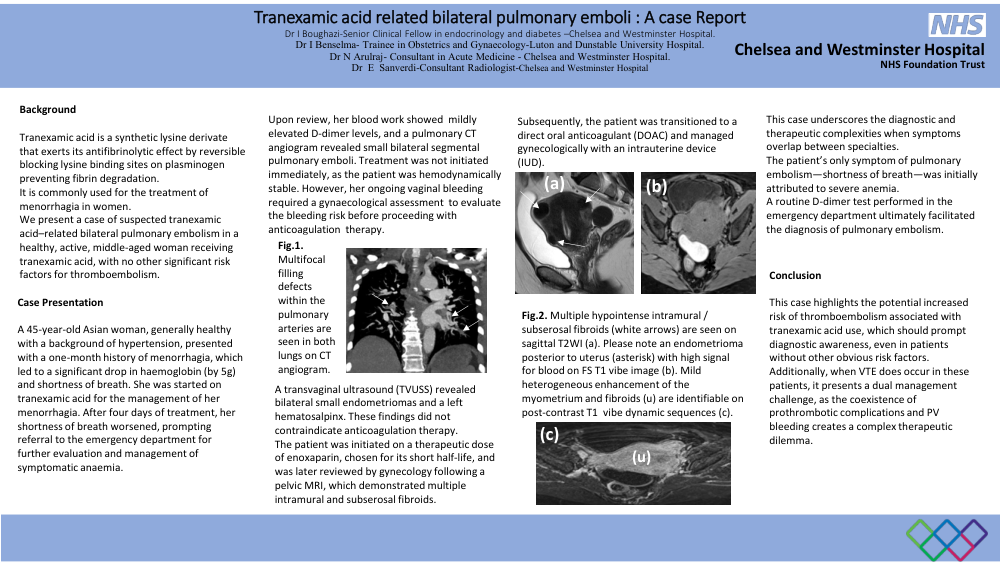
Upon review, her blood work showed mildly elevated D-dimer levels, and a pulmonary CT angiogram revealed small bilateral segmental pulmonary emboli. Treatment was not initiated immediately, as the patient was hemodynamically stable. However, her ongoing vaginal bleeding required a gynaecological assessment to evaluate the bleeding risk before proceeding with anticoagulation therapy.
A transvaginal ultrasound (TVUSS) revealed bilateral small endometriomas and a left hematosalpinx. These findings did not contraindicate anticoagulation therapy.
The patient was initiated on a therapeutic dose of enoxaparin, chosen for its short half-life, and was later reviewed by gynecology following a pelvic MRI, which demonstrated multiple intramural and subserosal fibroids.
Subsequently, the patient was transitioned to a direct oral anticoagulant (DOAC) and managed gynecologically with an intrauterine device (IUD).
This case underscores the diagnostic and therapeutic complexities when symptoms overlap between specialties.
The patient’s only symptom of pulmonary embolism—shortness of breath—was initially attributed to severe anemia.
A routine D-dimer test performed in the emergency department ultimately facilitated the diagnosis of pulmonary embolism.
Conclusion:
This case highlights the potential increased risk of thromboembolism associated with tranexamic acid use, which should prompt diagnostic awareness, even in patients without other obvious risk factors.
Additionally, when VTE does occur in these patients, it presents a dual management challenge, as the coexistence of prothrombotic complications and PV bleeding creates a complex therapeutic dilemma.
.