2,281 posters, 63 videos, 56 audios, 43 topics, 18 sessions, 6,174 authors, 2,323 institutions
ePostersLive by SciGen Technologies S.A. All rights reserved.
RCOG World Congress 2025
June 23 - 25, 2025 | ExCeL London, UK
EP.0608
Bowel Perforation Due to Migrated Copper IUD: A Case Report
Poster Presenter
Authors
Affiliations
Part of Topic
General gynaecology
Title: Bowel Perforation Due to Migrated Copper IUD: A Case Report
Authors: Dr Deepthika Jeyaraman1, Dr Ashley Poole2 and Ms Ayesha Mahmud2
Background: Intrauterine devices (IUDs) are highly effective, reversible, long-acting contraceptives used worldwide. Uterine perforation is a rare complication of IUD insertion, occurring in about 1–2 per 1000 cases.1 Migration of an IUD to adjacent structures can lead to complications such as obstruction, perforation and fistulae.2 The percentage of IUDs causing bowel perforation is exceedingly rare. The exact incidence is not available.
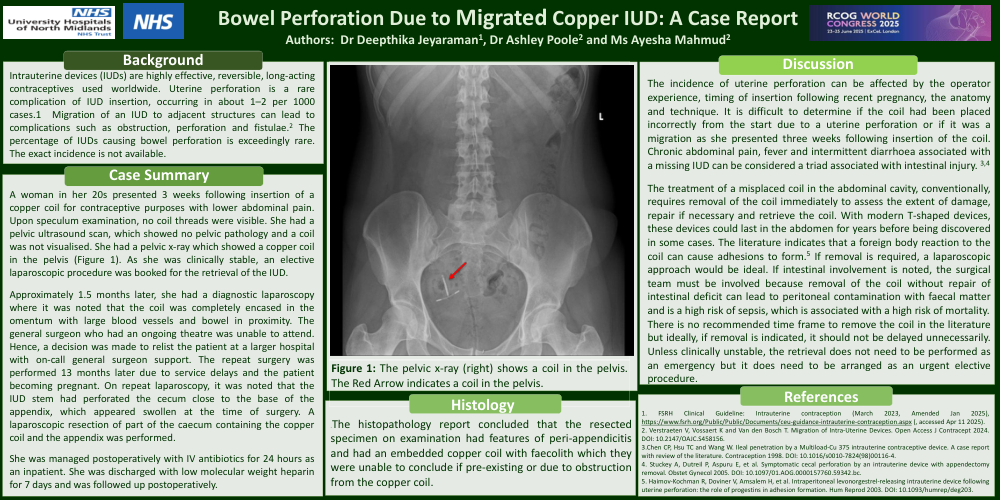
Case Summary: A woman in her 20s presented 3 weeks following insertion of a copper coil for contraceptive purposes with lower abdominal pain. Upon speculum examination, no coil threads were visible. She had a pelvic ultrasound scan, which showed no pelvic pathology and a coil was not visualised. She had a pelvic x-ray which showed a copper coil in the pelvis (Figure 1). As she was clinically stable, an elective laparoscopic procedure was booked for the retrieval of the IUD.
Approximately 1.5 months later, she had a diagnostic laparoscopy where it was noted that the coil was completely encased in the omentum with large blood vessels and bowel in proximity. The general surgeon who had an ongoing theatre was unable to attend. Hence, a decision was made to relist the patient at a larger hospital with on-call general surgeon support. The repeat surgery was performed 13 months later due to service delays and the patient becoming pregnant. On repeat laparoscopy, it was noted that the IUD stem had perforated the cecum close to the base of the appendix, which appeared swollen at the time of surgery. A laparoscopic resection of part of the caecum containing the copper coil and the appendix was performed.
She was managed postoperatively with IV antibiotics for 24 hours as an inpatient. She was discharged with low molecular weight heparin for 7 days and was followed up postoperatively.
Histology: The histopathology report concluded that the resected specimen on examination had features of peri-appendicitis and had an embedded copper coil with faecolith which they were unable to conclude if pre-existing or due to obstruction from the copper coil.
Discussion: The incidence of uterine perforation can be affected by the operator experience, timing of insertion following recent pregnancy, the anatomy and technique. It is difficult to determine if the coil had been placed incorrectly from the start due to a uterine perforation or if it was a migration as she presented three weeks following insertion of the coil. Chronic abdominal pain, fever and intermittent diarrhoea associated with a missing IUD can be considered a triad associated with intestinal injury. 3,4
The treatment of a misplaced coil in the abdominal cavity, conventionally, requires removal of the coil immediately to assess the extent of damage, repair if necessary and retrieve the coil. With modern T-shaped devices, these devices could last in the abdomen for years before being discovered in some cases. The literature indicates that a foreign body reaction to the coil can cause adhesions to form.5 If removal is required, a laparoscopic approach would be ideal. If intestinal involvement is noted, the surgical team must be involved because removal of the coil without repair of intestinal deficit can lead to peritoneal contamination with faecal matter and is a high risk of sepsis, which is associated with a high risk of mortality.
There is no recommended time frame to remove the coil in the literature but ideally, if removal is indicated, it should not be delayed unnecessarily. Unless clinically unstable, the retrieval does not need to be performed as an emergency but it does need to be arranged as an urgent elective procedure.
References: 1. FSRH Clinical Guideline: Intrauterine contraception (March 2023, Amended Jan 2025), https://www.fsrh.org/Public/Public/Documents/ceu-guidance-intrauterine-contraception.aspx (, accessed Apr 11 2025).
2. Verstraeten V, Vossaert K and Van den Bosch T. Migration of Intra-Uterine Devices. Open Access J Contracept 2024. DOI: 10.2147/OAJC.S458156.
3.Chen CP, Hsu TC and Wang W. Ileal penetration by a Multiload-Cu 375 intrauterine contraceptive device. A case report with review of the literature. Contraception 1998. DOI: 10.1016/s0010-7824(98)00116-4.
4. Stuckey A, Dutreil P, Aspuru E, et al. Symptomatic cecal perforation by an intrauterine device with appendectomy removal. Obstet Gynecol 2005. DOI: 10.1097/01.AOG.0000157760.59342.bc.
5. Haimov-Kochman R, Doviner V, Amsalem H, et al. Intraperitoneal levonorgestrel-releasing intrauterine device following uterine perforation: the role of progestins in adhesion formation. Hum Reprod 2003. DOI: 10.1093/humrep/deg203.