2,281 posters, 63 videos, 56 audios, 43 topics, 18 sessions, 6,174 authors, 2,323 institutions
ePostersLive by SciGen Technologies S.A. All rights reserved.
RCOG World Congress 2025
June 23 - 25, 2025 | ExCeL London, UK
EP.0591
Surgical management of secondary haematometrocolpos: a case series of two
Poster Presenter
Authors
Isobel Stronge, Andrew Simon, Henna Rather, Victoria Sampson, Wai Yoong
Affiliations
Part of Topic
General gynaecology
Surgical management of secondary haematometrocolpos: a case series of two
Stronge I, Simon A, Rather H, Sampson V and Yoong W
North Middlesex University Hospital, London
Objective
To discuss two cases of secondary amenorrhoea and haematometrocolpos.
Case 1
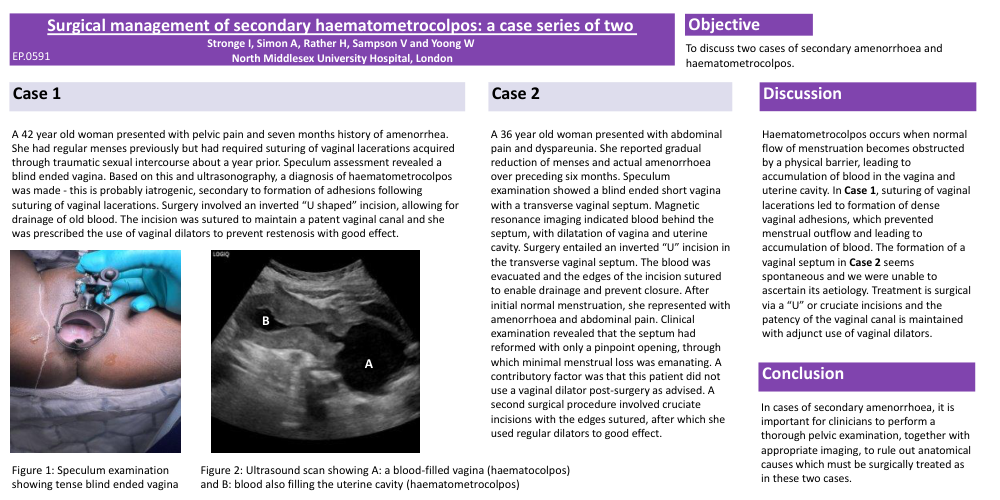
A 42 year old woman presented with pelvic pain and seven months history of amenorrhea. She had regular menses previously but had required suturing of vaginal lacerations acquired through traumatic sexual intercourse about a year prior. Speculum assessment revealed a blind ended vagina. Based on this and ultrasonography, a diagnosis of haematometrocolposwas made - this is probably iatrogenic, secondary to formation of adhesions following suturing of vaginal lacerations. Surgery involved an inverted “U shaped” incision, allowing for drainage of old blood. The incision was sutured to maintain a patent vaginal canal and she was prescribed the use of vaginal dilators to prevent restenosis with good effect.
Case 2
A 36 year old woman presented with abdominal pain and dyspareunia. She reported gradual reduction of menses and actual amenorrhoea over preceding six months. Speculum examination showed a blind ended short vagina with a transverse vaginal septum. Magnetic resonance imaging indicated blood behind the septum, with dilatation of vagina and uterine cavity. Surgery entailed an inverted “U” incision in the transverse vaginal septum. The blood was evacuated and the edges of the incision sutured to enable drainage and prevent closure. After initial normal menstruation, she represented with amenorrhoea and abdominal pain. Clinical examination revealed that the septum had reformed with only a pinpoint opening, through which minimal menstrual loss was emanating. A contributory factor was that this patient did not use a vaginal dilator post-surgery as advised. A second surgical procedure involved cruciate incisions with the edges sutured, after which she used regular dilators to good effect.
Discussion
Haematometrocolpos occurs when normal flow of menstruation becomes obstructed by a physical barrier, leading to accumulation of blood in the vagina and uterine cavity. In Case 1, suturing of vaginal lacerations led to formation of dense vaginal adhesions, which prevented menstrual outflow and leading to accumulation of blood. The formation of a vaginal septum in Case 2 seems spontaneous and we were unable to ascertain its aetiology. Treatment is surgical via a “U” or cruciate incisions and the patency of the vaginal canal is maintained with adjunct use of vaginal dilators.
Conclusion
In cases of secondary amenorrhoea, it is important for clinicians to perform a thorough pelvic examination, together with appropriate imaging, to rule out anatomical causes which must be surgically treated as in these two cases.