2,281 posters, 63 videos, 56 audios, 43 topics, 18 sessions, 6,174 authors, 2,323 institutions
ePostersLive by SciGen Technologies S.A. All rights reserved.
RCOG World Congress 2025
June 23 - 25, 2025 | ExCeL London, UK
EP.0587
Uterine Arteriovenous Malformation: Approach and Treatment in a Nulligravidous Virgin Woman
Poster Presenter
Authors
Affiliations
Part of Topic
General gynaecology
Uterine Arteriovenous Malformation: Approach and Treatment in a Nulligravidous Virgin Woman
Introduction
• Uterine arteriovenous malformation (UAVM) is a rare and potentially life-threatening condition characterized by abnormal connections between uterine arteries and veins.
• To our knowledge, this is the first reported case of UAVM in a nulliparous, virgin patient presenting with profuse vaginal bleeding.
Objectives
• Contribute to the limited literature on UAVM in unique patient populations.
• Discuss treatment approaches with a focus on fertility preservation.
Clinical case
Patient Profile and Presentation:
• A 20-year-old woman presented with heavy vaginal bleeding.
• She had a history of a similar episode requiring blood transfusion and an anaphylactic reaction to tranexamic acid.
Clinical Course:
• Lost 3 liters of blood managed with blood product replacement.
• Patient stabilized with spontaneous cessation of bleeding.
Diagnostic Findings:
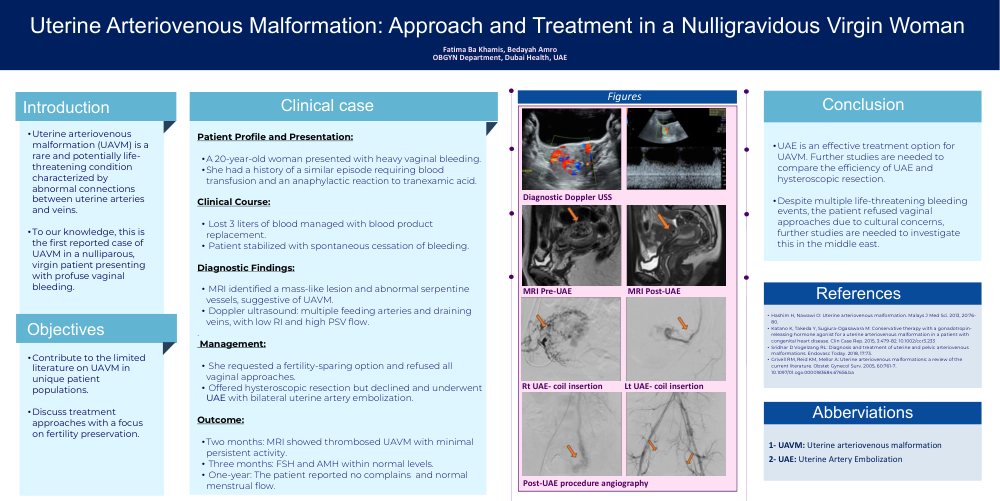
• MRI identified a mass-like lesion and abnormal serpentine vessels, suggestive of UAVM.
• Doppler ultrasound: multiple feeding arteries and draining veins, with low RI and high PSV flow.
.
Management:
• She requested a fertility-sparing option and refused all vaginal approaches.
• Offered hysteroscopic resection but declined and underwent UAE with bilateral uterine artery embolization.
Outcome:
• Two months: MRI showed thrombosed UAVM with minimal persistent activity.
• Three months: FSH and AMH within normal levels.
• One-year: The patient reported no complains and normal menstrual flow.
Conclusion
• UAE is an effective treatment option for UAVM. Further studies are needed to compare the efficiency of UAE and hysteroscopic resection.
• Despite multiple life-threatening bleeding events, the patient refused vaginal approaches due to cultural concerns, further studies are needed to investigate this in the middle east.