2,281 posters, 63 videos, 56 audios, 43 topics, 18 sessions, 6,174 authors, 2,323 institutions
ePostersLive by SciGen Technologies S.A. All rights reserved.
RCOG World Congress 2025
June 23 - 25, 2025 | ExCeL London, UK
EP.0580
Emergency Gynaecological Hysterectomy: A Life-Saving Intervention in Acute Menorrhagia
Poster Presenter
Authors
Roshan Jabeen, Upendra Bhawana, Oscar Barnick, Robert MacDermott, Priya Das Chowdhury, Gabriel Awadzi
Affiliations
Part of Topic
General gynaecology
Emergency Gynaecological Hysterectomy: A Life-Saving Intervention in Acute Menorrhagia
Roshan Jabeen, Bhawana Upendra, Oscar Barnick, Priya Chowdhury, Robert MacDermott, Gabriel Awadzi, Darent Valley Hospital Dartford
Introduction
Fibroids are a frequent cause of HMB (heavy menstrual bleeding), especially when large and occupying the endometrial cavity. While hysterectomies are typically elective, emergency hysterectomies for non-obstetric reasons are very rare but critical in managing life-threatening cases. This case underscores the importance of prompt decision-making and timely intervention. Our case illustrates that emergency hysterectomy for non-obstetric reasons may be the only suitable intervention in such cases.
Case Report
A 35-year-old parous woman presented to the emergency department with a 7-hour history of acute HMB and haemodynamic instability.
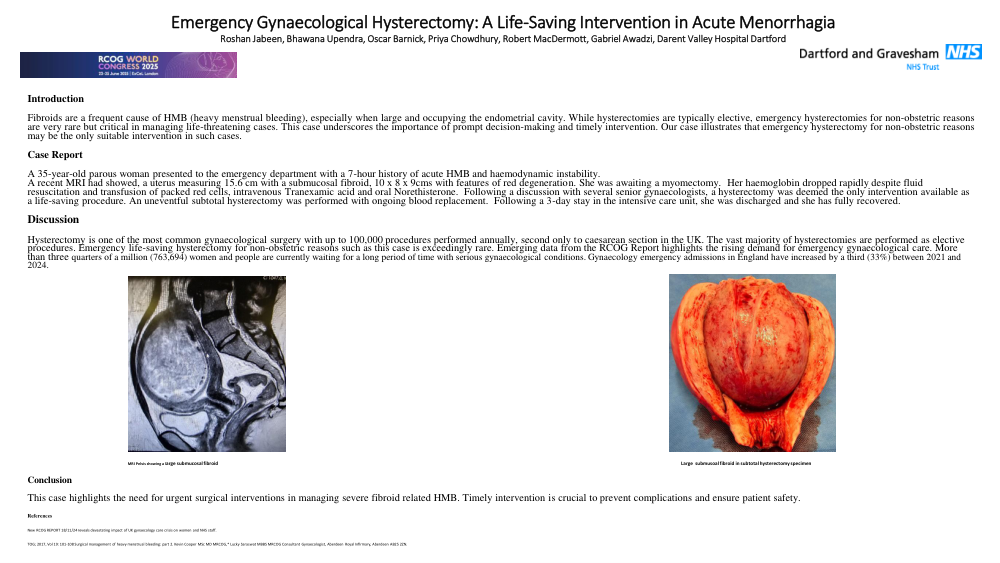
A recent MRI had showed, a uterus measuring 15.6 cm with a submucosal fibroid, 10 x 8 x 9cms with features of red degeneration. She was awaiting a myomectomy. Her haemoglobin dropped rapidly despite fluid resuscitation and transfusion of packed red cells, intravenous Tranexamic acid and oral Norethisterone. Following a discussion with several senior gynaecologists, a hysterectomy was deemed the only intervention available as a life-saving procedure. An uneventful subtotal hysterectomy was performed with ongoing blood replacement. Following a 3-day stay in the intensive care unit, she was discharged and she has fully recovered.
Discussion
Hysterectomy is one of the most common gynaecological surgery with up to 100,000 procedures performed annually, second only to caesarean section in the UK. The vast majority of hysterectomies are performed as elective procedures. Emergency life-saving hysterectomy for non-obstetric reasons such as this case is exceedingly rare. Emerging data from the RCOG Report highlights the rising demand for emergency gynaecological care. More than three quarters of a million (763,694) women and people are currently waiting for a long period of time with serious gynaecological conditions. Gynaecology emergency admissions in England have increased by a third (33%) between 2021 and 2024.