2,281 posters, 63 videos, 56 audios, 43 topics, 18 sessions, 6,174 authors, 2,323 institutions
ePostersLive by SciGen Technologies S.A. All rights reserved.
RCOG World Congress 2025
June 23 - 25, 2025 | ExCeL London, UK
EP.0577
Successful Management of Heterotopic Pregnancy: A Case Report
Poster Presenter
Authors
Affiliations
Part of Topic
General gynaecology
Successful Management of Heterotopic Pregnanc y : A Case Report
1- Nida Aftab (Clinical Fellow) , 2- Sajitha Parveen (Consultant) , 3- Anita Nargund (Consultant) - O&G ABUHB
INTRODUCTION
Heterotopic pregnancy is the coexistence of living or dead intrauterine pregnancy, single or multiple,and extrauterine pregnancy located in the oviduct,ovary, uterine Cornu, cervix or peritoneal cavity.This condition is very rare (1:30000 pregnancies). Nevertheless in the latter years because of the development and accessibility of assisted reproductive techniques, the incidence of heterotopic pregnancies increased to 1:100 of pregnancies.The aim of this report is to present a case of early recognized intrauterine and extrauterine pregnancy.
CASE
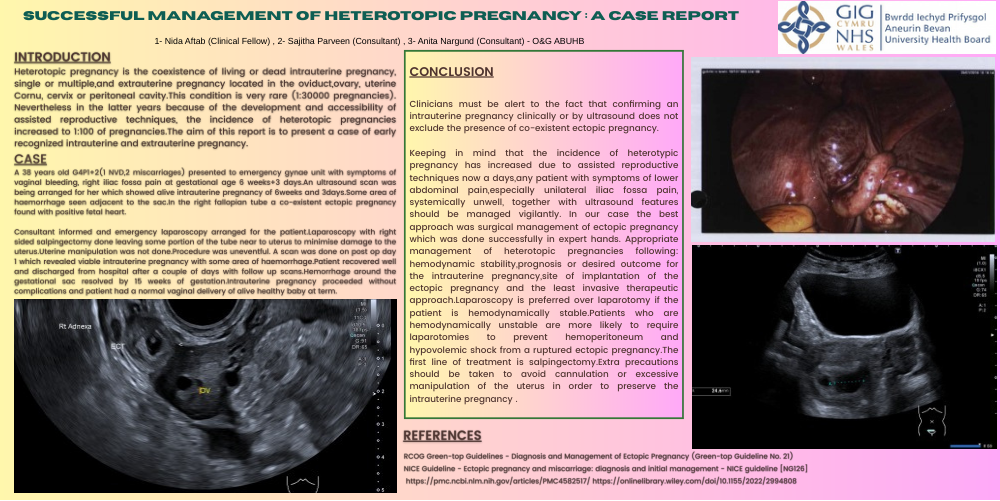
A 38 years old G4P1+2(1 NVD,2 miscarriages) presented to emergency gynae unit with symptoms of vaginal bleeding, right iliac fossa pain at gestational age 6 weeks+3 days.An ultrasound scan was being arranged for her which showed alive intrauterine pregnancy of 6weeks and 3days.Some area of haemorrhage seen adjacent to the sac.In the right fallopian tube a co-existent ectopic pregnancy found with positive fetal heart.
Consultant informed and emergency laparoscopy arranged for the patient.Laparoscopy with right sided salpingectomy done leaving some portion of the tube near to uterus to minimise damage to the uterus.Uterine manipulation was not done.Procedure was uneventful. A scan was done on post op day 1 which revealed viable intrauterine pregnancy with some area of haemorrhage.Patient recovered well and discharged from hospital after a couple of days with follow up scans.Hemorrhage around the gestational sac resolved by 15 weeks of gestation.Intrauterine pregnancy proceeded without complications and patient had a normal vaginal delivery of alive healthy baby at term.
CONCLUSION
Clinicians must be alert to the fact that confirming an intrauterine pregnancy clinically or by ultrasound does not exclude the presence of co-existent ectopic pregnancy.
Keeping in mind that the incidence of heterotypic pregnancy has increased due to assisted reproductive techniques now a days,any patient with symptoms of lower abdominal pain,especially unilateral iliac fossa pain, systemically unwell, together with ultrasound features should be managed vigilantly. In our case the best approach was surgical management of ectopic pregnancy which was done successfully in expert hands. Appropriate management of heterotopic pregnancies following: hemodynamic stability,prognosis or desired outcome for the intrauterine pregnancy,site of implantation of the ectopic pregnancy and the least invasive therapeutic approach.Laparoscopy is preferred over laparotomy if the patient is hemodynamically stable.Patients who are hemodynamically unstable are more likely to require laparotomies to prevent hemoperitoneum and hypovolemic shock from a ruptured ectopic pregnancy.The first line of treatment is salpingectomy.Extra precautions should be taken to avoid cannulation or excessive manipulation of the uterus in order to preserve the intrauterine pregnancy .
REFERENCES
RCOG Green-top Guidelines - Diagnosis and Management of Ectopic Pregnancy (Green-top Guideline No. 21)
NICE Guideline - Ectopic pregnancy and miscarriage: diagnosis and initial management - NICE guideline [NG126]
https://pmc.ncbi.nlm.nih.gov/articles/PMC4582517/ https://onlinelibrary.wiley.com/doi/10.1155/2022/2994808