2,281 posters, 63 videos, 56 audios, 43 topics, 18 sessions, 6,174 authors, 2,323 institutions
ePostersLive by SciGen Technologies S.A. All rights reserved.
RCOG World Congress 2025
June 23 - 25, 2025 | ExCeL London, UK
EP.0576
New-Onset Multiple Sclerosis in Pregnancy: A Case Report
Poster Presenter
Part of Topic
General gynaecology
New-Onset Multiple Sclerosis in Pregnancy: A Case Report
Objective:
Diagnosing and managing neurological conditions during pregnancy can be difficult. Multiple sclerosis (MS), a rare autoimmune disease, presents additional challenges when first
diagnosed during pregnancy. MS affects both the mother’s health and the baby’s outcomes, making timely recognition and treatment essential.
Case Presentation:
A 29-year-old woman in her second pregnancy developed neurological symptoms at 29 weeks’ gestation. She experienced tingling, weakness
in both legs, numbness, and problems with bladder and bowel control. Initially suspected to have cauda equina syndrome, further
investigation was performed as her symptoms worsened.
Her lower limb strength deteriorated from moderate to severe. Sensations reduced below L1 spinal level, and her anal tone became poor.
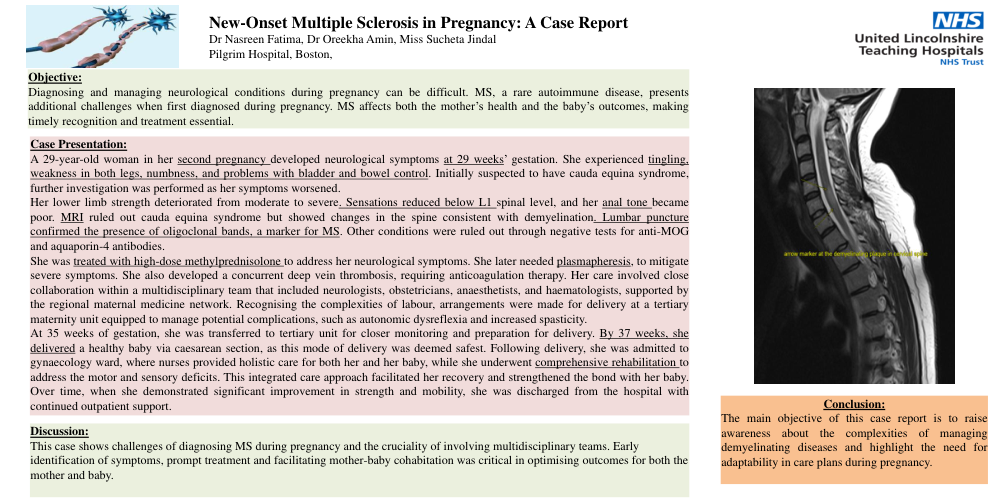
MRI ruled out cauda equina syndrome but showed changes in the spine consistent with demyelination. Lumbar puncture confirmed the
presence of oligoclonal bands, a marker for MS. Other conditions were ruled out through negative tests for anti-MOG and aquaporin-4
antibodies.
She was treated with high-dose methylprednisolone to address her neurological symptoms. She later needed plasmapheresis, to mitigate
severe symptoms. She also developed a concurrent deep vein thrombosis, requiring anticoagulation therapy.
Her care involved close collaboration within a multidisciplinary team that included neurologists, obstetricians, anaesthetists, and
haematologists, supported by the regional maternal medicine network. Recognising the complexities of labour, arrangements were made for
delivery at a tertiary maternity unit equipped to manage potential complications, such as autonomic dysreflexia and increased spasticity.
At 35 weeks of gestation, she was transferred to tertiary unit for closer monitoring and preparation for delivery. By 37 weeks, she delivered a
healthy baby via caesarean section, as this mode of delivery was deemed safest.
Following delivery, she was admitted to gynaecology ward, where nurses provided holistic care for both her and her baby, while she
underwent comprehensive rehabilitation to address the motor and sensory deficits. This integrated care approach facilitated her recovery
and strengthened the bond with her baby. Over time, when she demonstrated significant improvement in strength and mobility, she was
discharged from the hospital with continued outpatient support.
Discussion:
This case shows challenges of diagnosing MS during pregnancy and the cruciality of
involving multidisciplinary teams. Early identification of symptoms, prompt treatment and
facilitating mother-baby cohabitation was critical in optimising outcomes for both the
mother and baby.
Conclusion:
The main objective of this case report is to raise awareness about the complexities of
managing demyelinating diseases and highlight the need for adaptability in care plans
during pregnancy.
Discussion:
This case shows challenges of diagnosing MS during pregnancy and the cruciality of
involving multidisciplinary teams. Early identification of symptoms, prompt treatment and
facilitating mother-baby cohabitation was critical in optimising outcomes for both the