2,281 posters, 63 videos, 56 audios, 43 topics, 18 sessions, 6,174 authors, 2,323 institutions
ePostersLive by SciGen Technologies S.A. All rights reserved.
RCOG World Congress 2025
June 23 - 25, 2025 | ExCeL London, UK
EP.0563
Retrospective Review of High-Dose HRT Prescribing and Progesterone Adequacy
Poster Presenter
Authors
Javaria Malik, Dragana Abbott, Gioia Canciani, Ivilina Pandeva
Affiliations
Part of Topic
General gynaecology
Abstract Title: Retrospective Review of High-Dose HRT Prescribing and Progesterone Adequacy
Authors: Javaria Malik, Dragana Abbott, Gioia Canciani, Ivilina Pandeva
Background:
project
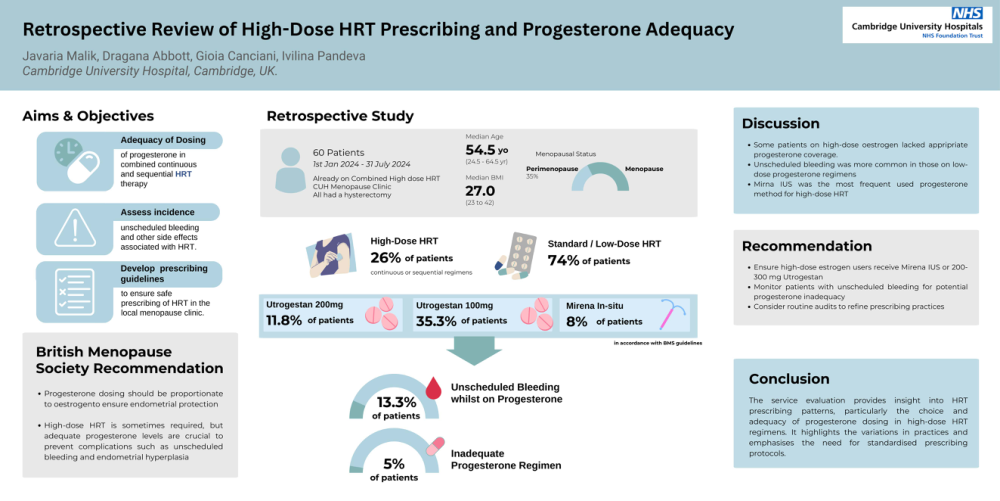
Aims and Objectives: To investigate the adequacy of progesterone dosing in combined continuous and sequential HRT therapy . To assess incidence of unscheduled bleeding and other side effects associated with HRT. To develop safe prescribingguidelines for HRT in the local menopause clinic.
Design: A retrospective service evaluation was conductedbetween January 2024 and August 2024, including all patients on combined HRT attending the menopause clinic.
Method: Data collection included: patient’s demographics, age ,BMI, menopausal status, symptoms and duration of HRT. The type and dose of progesterone were specifically reviewed to assess whether the prescribed dose was proportionate to the oestrogen dose, in accordance with BMS guidelines. In addition, data on unscheduled bleeding or other side effects were also collected in relation to progesterone dose adequacy.High dose HRT was defined as estrogen dose exceedingstandard levels requiring proportionately adjusted progesterone
.
Result: 60 patients were included with median age of 54.5 years (range of 34.5 to 64.5 years) and median BMI of 27.0( Range: 23 to 42). 17(28%) patients received high-dose HRT, while the remaining patients were on standard or low-dose regimens.Within the high-dose HRT group, 8 patients (47.1%) were using the Mirena intrauterine system for endometrial protection. Among those taking oral progesterone, 6 patients (35.3%) were on low-dose Utrogestan (100 mg), while 2 patients (11.8%) were prescribed high-dose Utrogestan (200 mg). Additionally, 1 patient (5.9%) was receiving. Women receiving high-dose estradiol were either on continuous or sequential regimens. The majority were prescribed transdermal estrogen in the form of patches or gels, with a few on oral therapy. Eight patients (13.3%) on high-dose HRT experienced unscheduled bleeding.Three patients (5.0%) were identified as being on an inadequate progesterone regimen.
Conclusion: The service evaluation provides insight into HRT prescribing patterns, particularly the choice and adequacy of progesterone dosing in high-dose HRT regimens. It highlights thevariations in practices and emphasises the need for standardised prescribing protocols.