2,281 posters, 63 videos, 56 audios, 43 topics, 18 sessions, 6,174 authors, 2,323 institutions
ePostersLive by SciGen Technologies S.A. All rights reserved.
RCOG World Congress 2025
June 23 - 25, 2025 | ExCeL London, UK
EP.0561
Optimizing Group and Save Testing in Minimal Access Gynecological Surgery
Poster Presenter
Authors
Affiliations
Part of Topic
General gynaecology
OPTIMIZING GROUP AND SAVE TESTING IN MINIMAL ACCESS GYNECOLOGICAL SURGERY
Dr Neha Uddin , Dr Omar Lotfi, Mrs Madhu Kolli
AIM:
• Assess the cost-effectiveness and clinical impact of requiring two blood samples for Group and Save before gynaecological procedures.
• Evaluate whether a risk-based selective approach can enhance preoperative efficiency.
METHODS:
Design: Retrospective analysis (Oct 2023–Oct 2024).
• Setting: Aneurin Bevan University Health Board.
• Procedures: Selected laparoscopic gynaecological surgeries (excluding complex cases).
• Focus Areas:
Group and Save history, transfusion needs, and single-sample eligibility
RESULTS AND DISCUSSION
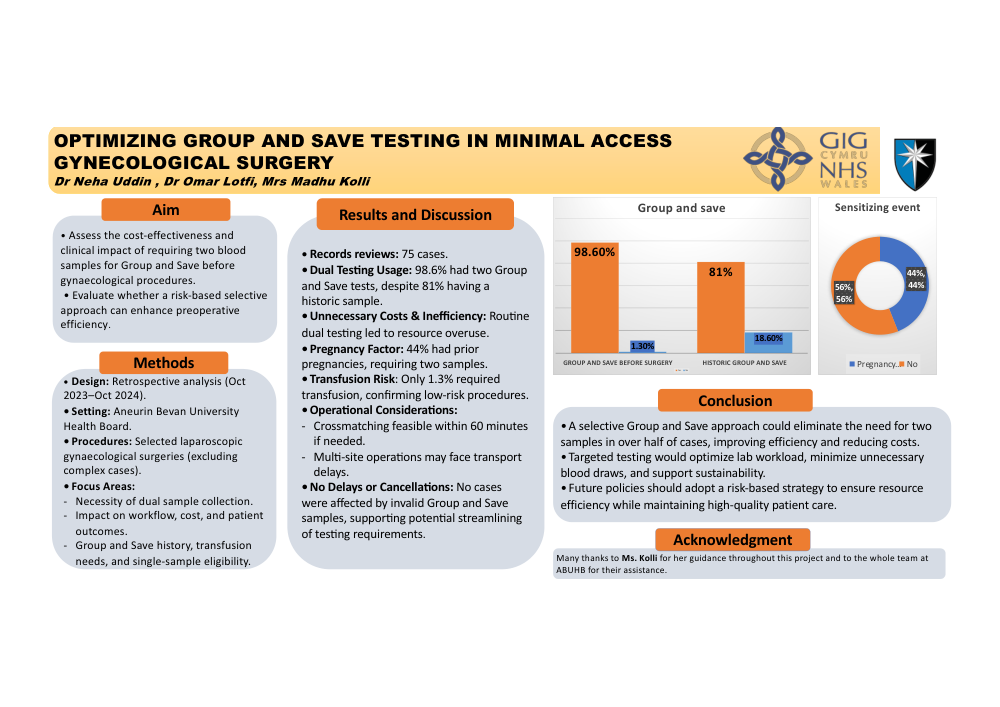
• Records reviews: 75 cases.
• Dual Testing Usage: 98.6% had two Group and Save tests, despite 81% having a historic sample.
• Unnecessary Costs & Inefficiency: Routine dual testing led to resource overuse.
• Pregnancy Factor: 44% had prior pregnancies, requiring two samples.
• Transfusion Risk: Only 1.3% required transfusion, confirming low-risk procedures.
• Operational Considerations:
• No Delays or Cancellations: No cases were affected by invalid Group and Save samples, supporting potential streamlining of testing requirements.
CONCLUSION:
• A selective Group and Save approach could eliminate the need for two samples in over half of cases, improving efficiency and reducing costs.
• Targeted testing would optimize lab workload, minimize unnecessary blood draws, and support sustainability.
• Future policies should adopt a risk-based strategy to ensure resource efficiency while maintaining high-quality patient care.