2,281 posters, 63 videos, 56 audios, 43 topics, 18 sessions, 6,174 authors, 2,323 institutions
ePostersLive by SciGen Technologies S.A. All rights reserved.
RCOG World Congress 2025
June 23 - 25, 2025 | ExCeL London, UK
EP.0557
Outpatient Endometrial Ablation: A retrospective comparison of Paraostial vs. Fundal Anaesthetic Infiltration
Poster Presenter
Authors
Sina Mathema, Huda Alabdali, Bomee Kim, Aaron McAvoy, Shahzad Salim
Affiliations
Part of Topic
General gynaecology
Pain Scores in Outpatient Endometrial Ablation: Paraostialvs. Fundal Local Anaesthesia Infiltration
Introduction
Endometrial ablation (EA) is a therapeutic option for managing heavy menstrual bleeding (HMB) in women who have not responded to pharmacological treatments, have declined such options, or experience severe symptoms (NICE, 2021). This study aims to compare pain scores in fundal block versus paraostialblock during outpatient endometrial ablation (OEA), and to assess patient suitability, tolerability, and the overall efficacy of OEA under local anaesthesia.
Method
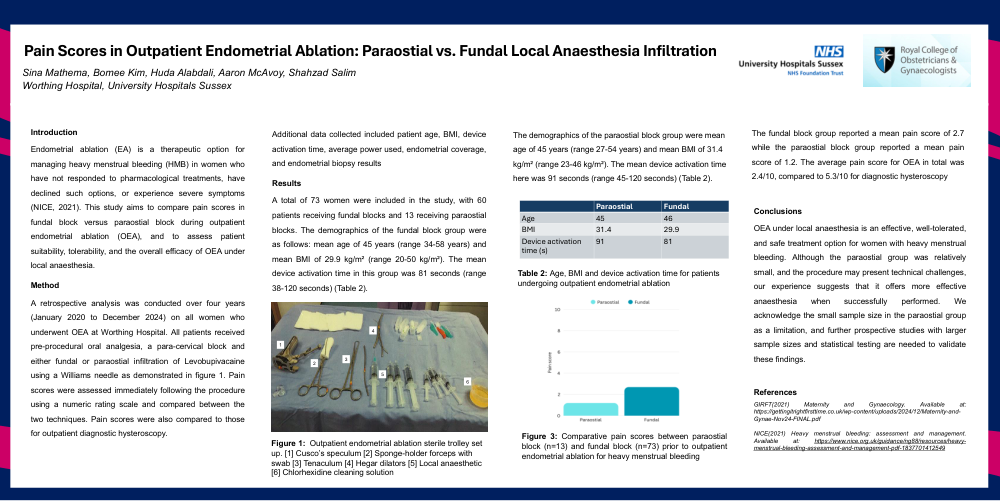
A retrospective analysis was conducted over four years (January 2020 to December 2024) on all women who underwent OEA at Worthing Hospital. All patients received pre-procedural oral analgesia, a para-cervical block and either fundal or paraostial infiltration of Levobupivacaine using a Williams needle as demonstrated in figure 1. Pain scores were assessed immediately following the procedure using a numeric rating scale and compared between the two techniques. Pain scores were also compared to those for outpatient diagnostic hysteroscopy. Additional data collected included patient age, BMI, device activation time, average power used, endometrial coverage, and endometrial biopsy results
Results
A total of 73 women were included in the study, with 60 patients receiving fundal blocks and 13 receiving paraostialblocks. The demographics of the fundal block group were as follows: mean age of 45 years (range 34-58 years) and mean BMI of 29.9 kg/m² (range 20-50 kg/m²). The mean device activation time in this group was 81 seconds (range 38-120 seconds) (Table 2).
The demographics of the paraostial block group were mean age of 45 years (range 27-54 years) and mean BMI of 31.4 kg/m² (range 23-46 kg/m²). The mean device activation time here was 91 seconds (range 45-120 seconds) (Table 2).
The fundal block group reported a mean pain score of 2.7 while the paraostialblock group reported a mean pain score of 1.2. The average pain score for OEA in total was 2.4/10, compared to 5.3/10 for diagnostic hysteroscopy
Conclusions
OEA under local anaesthesia is an effective, well-tolerated, and safe treatment option for women with heavy menstrual bleeding. Although the paraostial group was relatively small, and the procedure may present technical challenges, our experience suggests that it offers more effective anaesthesia when successfully performed. We acknowledge the small sample size in the paraostial group as a limitation, and further prospective studies with larger sample sizes and statistical testing are needed to validate these findings.
References
GIRFT(2021) Maternity and Gynaecology. Available at: https://gettingitrightfirsttime.co.uk/wp-content/uploads/2024/12/Maternity-and-Gynae-Nov24-FINAL.pdf
NICE(2021) Heavy menstrual bleeding: assessment and management. Available at: https://www.nice.org.uk/guidance/ng88/resources/heavy-menstrual-bleeding-assessment-and-management-pdf-1837701412549