2,281 posters, 63 videos, 56 audios, 43 topics, 18 sessions, 6,174 authors, 2,323 institutions
ePostersLive by SciGen Technologies S.A. All rights reserved.
RCOG World Congress 2025
June 23 - 25, 2025 | ExCeL London, UK
EP.0552
Review of Unplanned Return to Theatre Cases in Gynaecologic Surgery
Poster Presenter
Part of Topic
General gynaecology
Review of Unplanned Return to Theatre Cases in Gynaecologic Surgery: A Retrospective Single Centre Data
T Kasapoglu, S Hameed, M Maclachlan, G Ghazi, V Balakrishnan, N Iram
Princess Alexandra Hospital NHS Trust, Obstetrics and Gynaecology, Harlow, United Kingdom
Objective: To identify the characteristics and associated risk factors in patients who had unplanned return to the operating theatre.
Design: This was a retrospective review of case notes, with data collection from electronic records, of 10 women who returned to the theatre in 30 days following the primary operation in the obstetrics & gynaecology department from January 2023 to January 2024. Data was collected and analysed individually to assess the factors in a secondary setting hospital.
Method: Data collection was performed using digital software (Alex Health database) with the support of the local IT team. Those women who returned to the theatre for an emergency operation following a gynaecological surgery were eligible for our study.
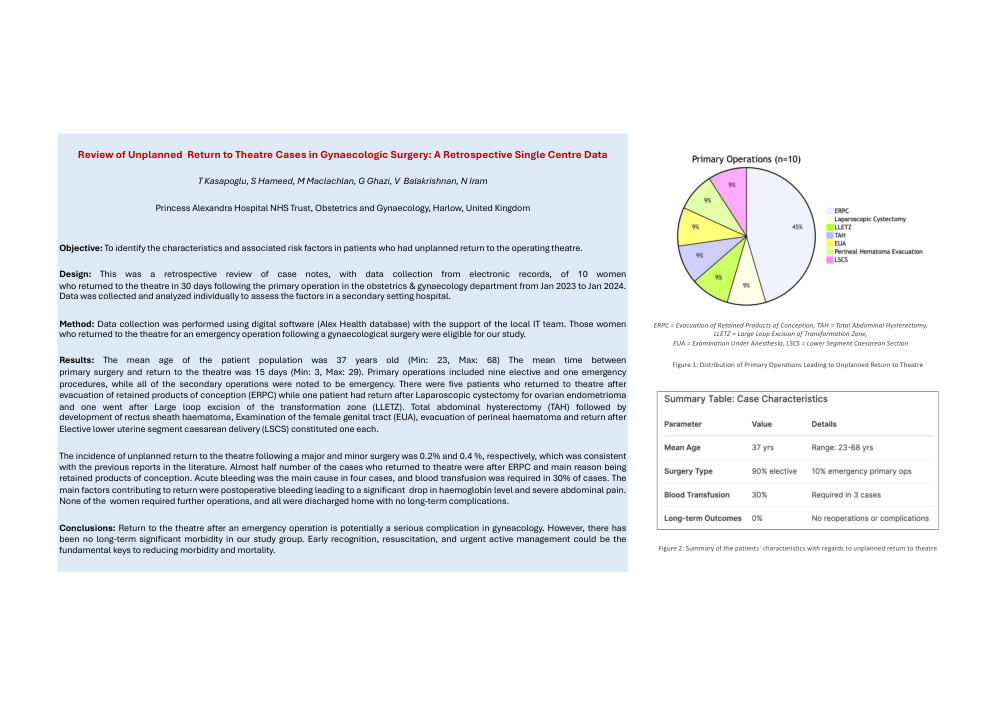
Results: The mean age of the patient population was 37 years old (Min: 23, Max: 68) The mean time between primary surgery and return to the theatre was 15 days (Min: 3, Max: 29). Primary operations included nine elective and one emergency procedures, while all of the secondary operations were noted to be emergency. Five patients returned to theatre after evacuation of retained products of conception (ERPC), while one patient had a return after Laparoscopic cystectomy for ovarian endometrioma, and one went after Large loop excision of the transformation zone (LLETZ). Total abdominal hysterectomy (TAH) followed by development of rectus sheath haematoma, Examination of the female genital tract (EUA), evacuation of perineal haematoma and return after Elective lower uterine segment caesarean delivery (LSCS) constituted one each.
The incidence of unplanned return to the theatre following a major and minor surgery was 0.2% and 0.4 %, respectively, which was consistent with the previous reports in the literature. Almost half of the cases that returned to theatre were after ERPC, and the main reason was retained products of conception. Acute bleeding was the main cause in four cases, and blood transfusion was required in 30% of cases. The main factors contributing to the return were postoperative bleeding leading to a significant drop in haemoglobin level and severe abdominal pain. None of the women required further operations, and all were discharged home with no long-term complications.
Conclusions: Return to the theatre after an emergency operation is potentially a serious complication in gynaecology. However, there has been no long-term significant morbidity in our study group. Early recognition, resuscitation, and urgent active management could be the fundamental keys to reducing morbidity and mortality.