2,281 posters, 63 videos, 56 audios, 43 topics, 18 sessions, 6,174 authors, 2,323 institutions
ePostersLive by SciGen Technologies S.A. All rights reserved.
RCOG World Congress 2025
June 23 - 25, 2025 | ExCeL London, UK
EP.0547
reported due the unlikehood of cervical fibroids the cause of bladder rupture
Poster Presenter
Authors
Affiliations
Part of Topic
General gynaecology
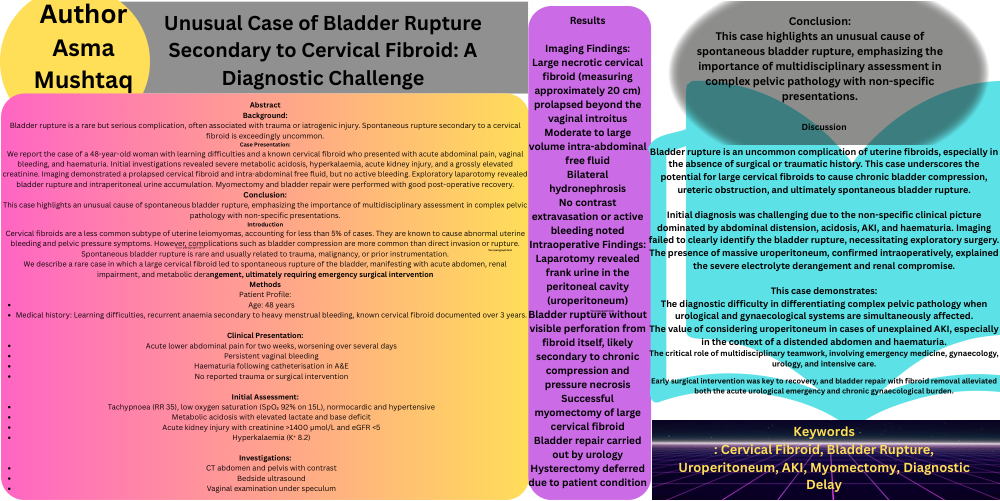
Unusual Case of Bladder Rupture Secondary to Cervical
Fibroid: A Diagnostic Challenge
Author: Dr. Asma Mushtaq
Results:
Introduction: Cervical fibroids are a less common
subtype of uterine leiomyomas, accounting for less
than 5% of cases. They are known to cause
abnormal uterine bleeding and pelvic pressure
symptoms. However, complications such as bladder
compression are more common than direct invasion
or rupture. Spontaneous bladder rupture is rare and
usually related to trauma, malignancy, or prior
instrumentation. We describe a rare case in which a
large cervical fibroid led to spontaneous rupture of
the bladder, manifesting with acute abdomen, renal
impairment, and metabolic derangement, ultimately
requiring emergency surgical intervention.
Patient Profile:
Age: 48-year-old female
Medical history: Learning difficulties, recurrent
anaemia secondary to heavy menstrual bleeding,
known cervical fibroid documented over 3 years.
Clinical Presentation: Acute lower abdominal pain for
two weeks, worsening over several days Persistent
vaginal bleeding Haematuria following
catheterisation in A&E No reported trauma or surgical
intervention
Initial Assessment:
• Tachypnoea (RR 35), low oxygen saturation (SpO₂
92% on 15L), normocardic and hypertensive
• Metabolic acidosis with elevated lactate and base
deficit
• Acute kidney injury with creatinine >1400 μmol/L
and eGFR <5
• Hyperkalaemia (K⁺ 8.2)
Investigations:
• CT abdomen and pelvis with contrast
• Bedside ultrasound
• Vaginal examination under speculum
Imaging Findings:
Large necrotic cervical fibroid (measuring approximately
20 cm) prolapsed beyond the vaginal introitus Moderate
to large volume intra-abdominal free fluid Bilateral
hydronephrosis No contrast extravasation or active
bleeding noted Intraoperative
Findings: Laparotomy revealed frank urine in the
peritoneal cavity (uroperitoneum) Bladder rupture
without visible perforation from fibroid itself, likely
secondary to chronic compression and pressure
necrosis Successful myomectomy of large cervical
fibroid Bladder repair carried out by urology
Hysterectomy deferred due to patient condition Discussion: Bladder rupture is an
uncommon complication of uterine
fibroids, especially in the absence of
surgical or traumatic history. This case
underscores the potential for large cervical
fibroids to cause chronic bladder
compression, ureteric obstruction, and
ultimately spontaneous bladder rupture.
Initial diagnosis was challenging due to the
non-specific clinical picture dominated by
AKI, and haematuria. Imaging failed to
clearly identify the bladder rupture,
necessitating exploratory surgery. The
presence of massive uroperitoneum,
confirmed intraoperatively, explained the
severe electrolyte derangement.
Conclusion: This case highlights an unusual
cause of spontaneous bladder rupture,
emphasizing the importance of
multidisciplinary assessment in complex
pelvic pathology with non-specific
presentations