2,281 posters, 63 videos, 56 audios, 43 topics, 18 sessions, 6,174 authors, 2,323 institutions
ePostersLive by SciGen Technologies S.A. All rights reserved.
RCOG World Congress 2025
June 23 - 25, 2025 | ExCeL London, UK
EP.0545
Tubo-ovarian Abscess Management: A Two-year Clinical Audit
Poster Presenter
Part of Topic
General gynaecology
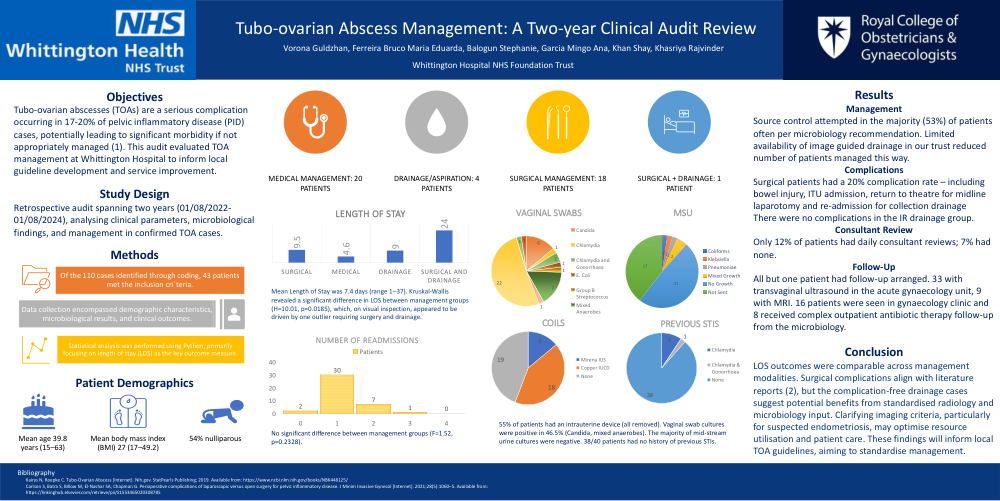
Tubo-ovarian Abscess Management: A Two-year Clinical Audit Review
Vorona Guldzhan, Ferreira Bruco Maria Eduarda Ferreira, Balogun Stephanie, Garcia Mingo Ana, Khan Shay, Khasriya Rajvinder
Objective
Tubo-ovarian abscesses (TOAs) are a serious complication occurring in 17-20% of pelvic inflammatory disease (PID) cases, potentially leading to significant morbidity if not appropriately managed (1). This audit evaluated TOA management at Whittington Hospital to inform local guideline development and service improvement.
Design
A retrospective audit spanning two years (01/08/2022-01/08/2024), analysing clinical parameters, microbiological findings, and management in confirmed TOA cases.
Method
Of the 110 cases identified through coding, 43 patients met the inclusion criteria. Data collection encompassed demographic characteristics, microbiological results, and clinical outcomes. Statistical analysis was performed using Python, primarily focusing on length of stay (LOS) as the key outcome measure.
Results
Demographics: Mean age 39.8 years (15–63); mean body mass index (BMI) 27 (17–49.2); 54% nulliparous.
Management: 20 received medical therapy, 4 underwent image-guided drainage, 18 had surgery (89% laparoscopic), and 1 had drainage plus surgery. Surgical patients had a 20% complication rate, with no complications in drainage-only cases.
Length of Stay: Mean LOS was 7.4 days (range 1–37). Kruskal-Wallis revealed a significant difference in LOS between management groups (H=10.01, p=0.0185), which, on visual inspection, appeared to be driven by one outlier requiring surgery and drainage. Dunn’s post-hoc test showed no significant inter-group differences.
Readmissions: No significant difference between management groups (F=1.52, p=0.2328).
Contraception & Microbiology: 55% of patients had an intrauterine device (all removed). Vaginal swab cultures were positive in 46.5% (Candida, mixed anaerobes), yet 37% were managed without microbiologist input.
Consultant Review: Only 12% of patients had daily consultant reviews; 7% had none.
Follow-Up: All but one patient had follow-up arranged: 33 with transvaginal ultrasound in the acute gynaecology unit, nine with magnetic resonance imaging (MRI), and 16 in clinic. 8 received complex outpatient antibiotic therapy follow-up.
Conclusions
LOS outcomes were comparable across management modalities. Surgical complications align with literature reports (2), but the complication-free drainage cases suggest potential benefits from standardised radiology and microbiology input. Limited consultant involvement indicates opportunities for protocol refinement. Clarifying imaging criteria, particularly for suspected endometriosis, may optimise resource utilisation and patient care. These findings will inform local TOA guidelines, aiming to standardise management and enhance multidisciplinary collaboration.