2,281 posters, 63 videos, 56 audios, 43 topics, 18 sessions, 6,174 authors, 2,323 institutions
ePostersLive by SciGen Technologies S.A. All rights reserved.
RCOG World Congress 2025
June 23 - 25, 2025 | ExCeL London, UK
EP.0542
Review of complications following elective gynaecological surgery in a District General Hospital
Poster Presenter
Authors
Affiliations
Part of Topic
General gynaecology
A REVIEW OF COMPLICATIONS FOLLOWING ELECTIVE GYNAECOLOGICAL SURGERY IN A DISTRICT GENERAL HOSPITAL
Introduction:
In response to challenges posed by the COVID-19 pandemic, the Trust relocated elective gynaecological surgeries to a non-acute site to establish a ‘green pathway’ and minimize infection risks. This presented challenges in managing post-operative complications due to the absence of a specialist gynaecology team on-site. To address this, the Trust adopted a low threshold for transferring patients to the acute site if deviations occurred during recovery. This study evaluates whether post-operative complications were promptly identified and managed, ensuring patient care was not compromised by the dual-site service.
Objectives:
To evaluate the safety and efficacy of a 'green pathway' by conducting a retrospective review of cases that required transfer to the acute site post operatively for management of suspected acute complications.
Methods:
A retrospective cohort review was conducted for 29 months (April 2022–September 2024) at a DGH. Incident reports were analysed to assess associated complications. Data were collected from electronic patient records (Evolve). Data extracted included patient demographics, comorbidities, procedural details, post operative complications, transfer to the acute hospital, return to theatre, surgical outcome, and length of inpatient stay.
Results:
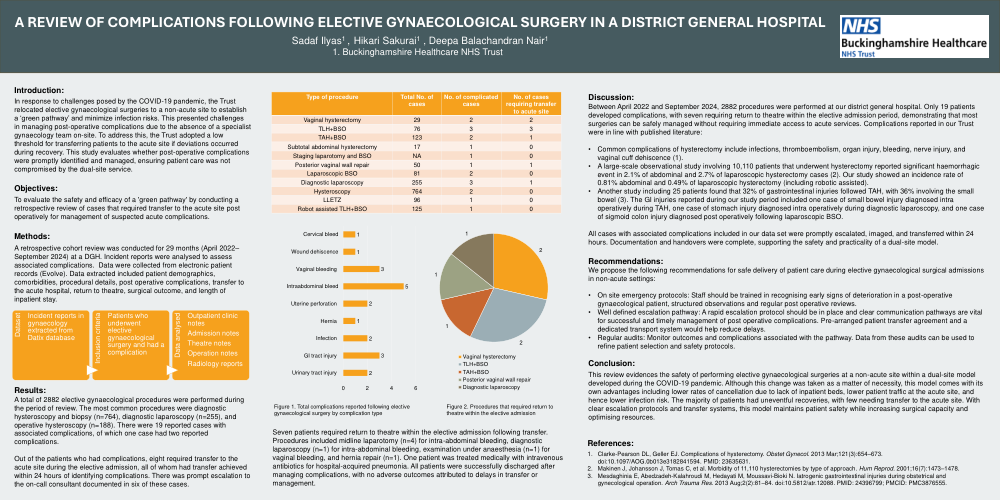
A total of 2882 elective gynaecological procedures were performed during the period of review. The most common procedures were diagnostic hysteroscopy and biopsy (n=764), diagnostic laparoscopy (n=255), and operative hysteroscopy (n=188). There were 19 reported cases with associated complications, of which one case had two reported complications.
Seven patients required return to theatre within the elective admission following transfer. Procedures included midline laparotomy (n=4) for intra-abdominal bleeding, diagnostic laparoscopy (n=1) for intra-abdominal bleeding, examination under anaesthesia (n=1) for vaginal bleeding, and hernia repair (n=1). One patient was treated medically with intravenous antibiotics for hospital-acquired pneumonia. All patients were successfully discharged after managing complications, with no adverse outcomes attributed to delays in transfer or management.
Out of the patients who had complications, eight required transfer to the acute site during the elective admission, all of whom had transfer achieved within 24 hours of identifying complications. There was prompt escalation to the on-call consultant documented in six of these cases.
Discussion:
Between April 2022 and September 2024, 2882 procedures were performed at our district general hospital. Only 19 patients developed complications, with seven requiring return to theatre within the elective admission period, demonstrating that most surgeries can be safely managed without requiring immediate access to acute services. Complications reported in our Trust were in line with published literature:
All cases with associated complications included in our data set were promptly escalated, imaged, and transferred within 24 hours. Documentation and handovers were complete, supporting the safety and practicality of a dual-site model.
Recommendations:
We propose the following recommendations for safe delivery of patient care during elective gynaecological surgical admissions in non-acute settings:
Conclusion:
This review evidences the safety of performing elective gynaecological surgeries at a non-acute site within a dual-site model developed during the COVID-19 pandemic. Although this change was taken as a matter of necessity, this model comes with its own advantages including lower rates of cancellation due to lack of inpatient beds, lower patient traffic at the acute site, and hence lower infection risk. The majority of patients had uneventful recoveries, with few needing transfer to the acute site. With clear escalation protocols and transfer systems, this model maintains patient safety while increasing surgical capacity and optimising resources.