2,281 posters, 63 videos, 56 audios, 43 topics, 18 sessions, 6,174 authors, 2,323 institutions
ePostersLive by SciGen Technologies S.A. All rights reserved.
RCOG World Congress 2025
June 23 - 25, 2025 | ExCeL London, UK
EP.0541
Fibroids – Our experiences
Poster Presenter
Authors
Affiliations
Grant Government college, Grant Government Medical College, Mumbai
Part of Topic
General gynaecology
Video
Title : Fibroids - Our experience
Authors : Dr Ketki Parasnis, Dr Ashok R Anand
Introduction:
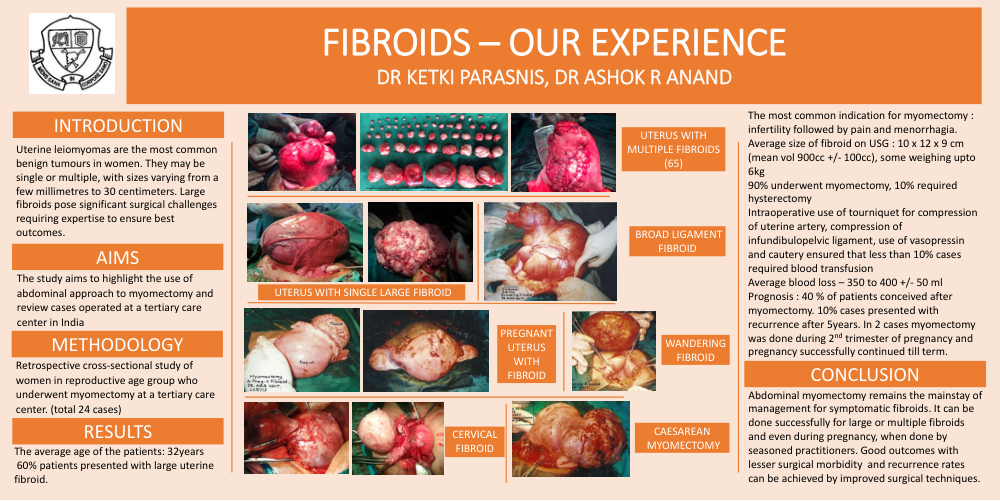
Uterine leiomyomas are the most common benign tumours in women. They may be single or multiple, with sizes varying from a few millimetres to 30 centimeters. Large fibroids pose significant surgical challenges requiring expertise to ensure best outcomes.
Aims :
The study aims to highlight the use of abdominal approach to myomectomy and review cases operated at a tertiary care center in India
Methodology:
Retrospective cross-sectional study of women in reproductive age group who underwent myomectomy at a tertiary care center. (total 24 cases)
Results:
The average age of the patients: 32years
60% patients presented with large uterine fibroid.
The most common indication for myomectomy : infertility followed by pain and menorrhagia.
Average size of fibroid on USG : 10 x 12 x 9 cm (mean vol 900cc +/- 100cc), some weighing upto 6kg
90% underwent myomectomy, 10% required hysterectomy
Intraoperative use of tourniquet for compression of uterine artery, compression of infundibulopelvic ligament, use of vasopressin and cautery ensured that less than 10% cases required blood transfusion
Average blood loss - 350 to 400 +/- 50 ml
Prognosis : 40 % of patients conceived after myomectomy. 10% cases presented with recurrence after 5years. In 2 cases myomectomy was done during 2nd trimester of pregnancy and pregnancy succesfully continued till term.
Conclusion :
Abdominal myomectomy remains the mainstay of management for symptomatic fibroids. It can be done successfully for large or multiple fibroids and even during pregnancy, when done by seasoned practitioners. Good outcomes with lesser surgical morbidity and recurrence rates can be achieved by improved surgical techniques.