2,281 posters, 63 videos, 56 audios, 43 topics, 18 sessions, 6,174 authors, 2,323 institutions
ePostersLive by SciGen Technologies S.A. All rights reserved.
RCOG World Congress 2025
June 23 - 25, 2025 | ExCeL London, UK
EP.0534
Comparison of complication rates following open versus laparoscopic hysterectomies - NUH NHS Trust
Poster Presenter
Authors
Affiliations
Part of Topic
General gynaecology
AUDIT: COMPARISON OF COMPLICATION RATES FOLLOWING OPEN VESUS LAPAROSCOPIC HYSTERECTOMIES – NOTTINGHAM UNIVERSITY HOSPITALS NHS TRUST
Mai Mahmoud, Hannah Bruguier, Awahid Uddin, Khaled Sabrah, Mr. James Phillips
Introduction:
•Hysterectomy is a frequently performed procedure in gynaecology, with nearly 40,000 surgeries conducted annually in the UK for benign reasons [1].
•Over the last 30 years, laparoscopic hysterectomy (LH) has emerged as the preferred method for performing hysterectomies, surpassing abdominal (AH) and vaginal (VH) routes. Currently, LH accounts for more than two-thirds to three-quarters of all hysterectomy procedures.[2,3].
•The 2023 Cochrane review highlighted several benefits of LH compared to AH. It offers faster recovery, shorter hospital stays and lower risk of wound infections, febrile episodes, and the need for transfusions [4].
• While LH offers notable benefits, it also brings some considerations, such as a higher risk of ureteric injury and longer surgical times. The estimated risk of ureter injury during AH is about 0.2%, whereas for LH, it ranges from 0.2% to 2%.
Objective:
•This audit aimed to compare the rates and types of complications linked to AH and LH within our trust. By analysing patient records, we focused on both intraoperative complications (like haemorrhage and internal organ injury) and early to late postoperative complications.
•Our analysis was informed by the latest findings from the 2023 Cochrane review, which served as a benchmark for our observations.
Method:
• For this audit, data was collected from Excel sheets using the OPCS coding system, incorporating electronic patient records from our trust's systems (DHR, NOTIS, and consultant letters).
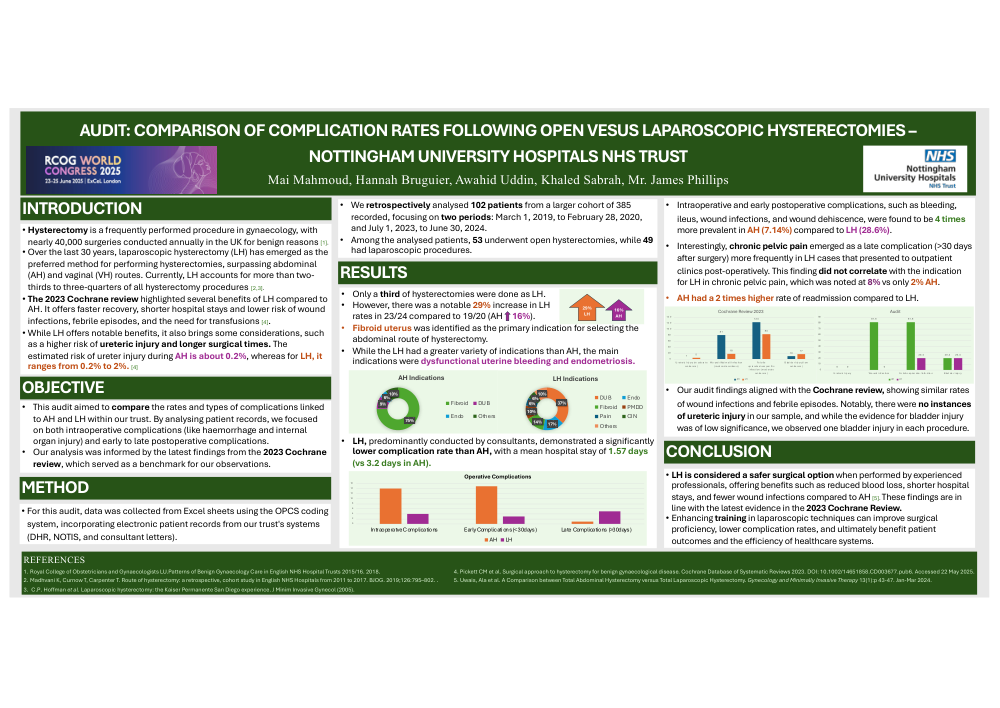
•We retrospectively analysed 102 patients from a larger cohort of 385 recorded, focusing on two periods: March 1, 2019, to February 28, 2020, and July 1, 2023, to June 30, 2024.
•Among the analysed patients, 53 underwent open hysterectomies, while 49 had laparoscopic procedures.
•Only a third of hysterectomies were done as LH.
•However, there was a notable 29% increase in LH rates in 23/24 compared to 19/20 (AH increased 16%).
•Fibroid uterus was identified as the primary indication for selecting the abdominal route of hysterectomy.
•While the LH had a greater variety of indications than AH, the main indications were dysfunctional uterine bleeding and endometriosis.
•LH, predominantly conducted by consultants, demonstrated a significantly lower complication rate than AH, with a mean hospital stay of 1.57 days (vs 3.2 days in AH).
•Intraoperative and early postoperative complications, such as bleeding, ileus, wound infections, and wound dehiscence, were found to be 4 times more prevalent in AH (7.14%) compared to LH (28.6%).
•Interestingly, chronic pelvic pain emerged as a late complication (>30 days after surgery) more frequently in LH cases that presented to outpatient clinics post-operatively. This finding did not correlate with the indication for LH in chronic pelvic pain, which was noted at 8% vs only 2% AH.
•AH had a 2 times higher rate of readmission compared to LH.
•Our audit findings aligned with the Cochrane review, showing similar rates of wound infections and febrile episodes. Notably, there were no instances of ureteric injury in our sample, and while the evidence for bladder injury was of low significance, we observed one bladder injury in each procedure.
Conclusion:
•LH is considered a safer surgical option when performed by experienced professionals, offering benefits such as reduced blood loss, shorter hospital stays, and fewer wound infections compared to AH [5]. These findings are in line with the latest evidence in the 2023 Cochrane Review.
•Enhancing training in laparoscopic techniques can improve surgical proficiency, lower complication rates, and ultimately benefit patient outcomes and the efficiency of healthcare systems.