2,281 posters, 63 videos, 56 audios, 43 topics, 18 sessions, 6,174 authors, 2,323 institutions
ePostersLive by SciGen Technologies S.A. All rights reserved.
RCOG World Congress 2025
June 23 - 25, 2025 | ExCeL London, UK
EP.0529
A prospective audit into management of tubo-ovarian abscesses at St Helier Hospital.
Poster Presenter
Authors
Affiliations
Part of Topic
General gynaecology
Background@
•Tubo-ovarian abscess (TOA) represent a severe form of pelvic inflammatory disease occurring in 10-35% of cases with a high morbidity (10%).
•Common symptoms are fever and pelvic pain.
•Initial management is with intravenous antibiotics, if unsuccessful, BASHH advise surgical intervention if there is no improvement after 24 hours.
•A standard operating procedure was developed at St Helier’s Hospital as per BASHH guidance.
•We aim to review the number of cases of TOA presenting at St. Helier Hospital and the adherence to the current SOP.
Methods:
•Patients were identified from gynaecology handover lists.
•Exclusion criteria was self-discharge.
•Data collection was performed using electronic records system
Results:
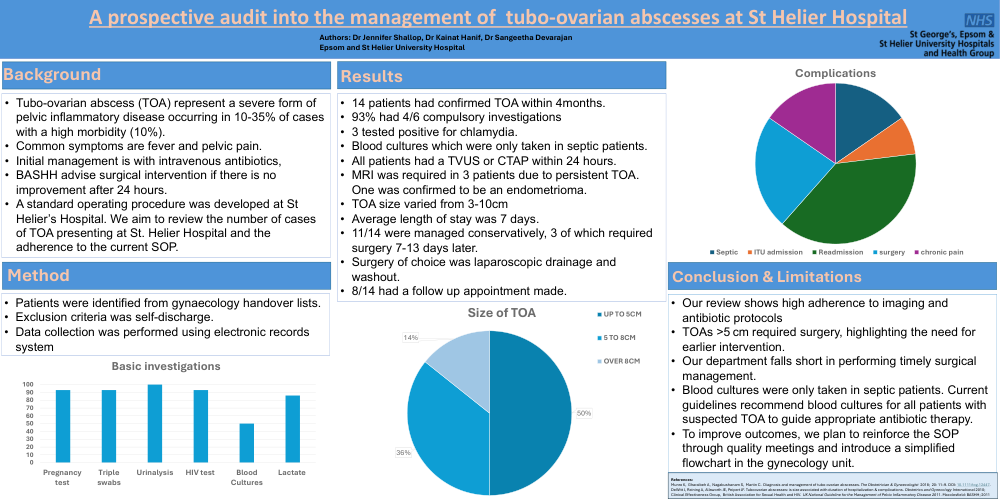
•14 patients had confirmed TOA within 4months.
•93% had 4/6 compulsory investigations
•3 tested positive for chlamydia.
•Blood cultures which were only taken in septic patients.
•All patients had a TVUS or CTAP within 24 hours.
•MRI was required in 3 patients due to persistent TOA. One was confirmed to be an endometrioma.
•TOA size varied from 3-10cm
•Average length of stay was 7 days.
•11/14 were managed conservatively
•3 of these required surgery 7-13 days later.
•Surgery of choice was laparoscopic drainage and washout.
•8/14 had a follow up appointment made.
Conclusion:
•Our review shows high adherence to imaging and antibiotic protocols
•TOAs >5 cm required surgery, highlighting the need for earlier intervention.
•Our department falls short in performing timely surgical management.
•Blood cultures were only taken in septic patients. Current guidelines recommend blood cultures for all patients with suspected TOA to guide appropriate antibiotic therapy.
•To improve outcomes, we plan to reinforce the SOP through quality meetings and introduce a simplified flowchart in the gynecology unit.